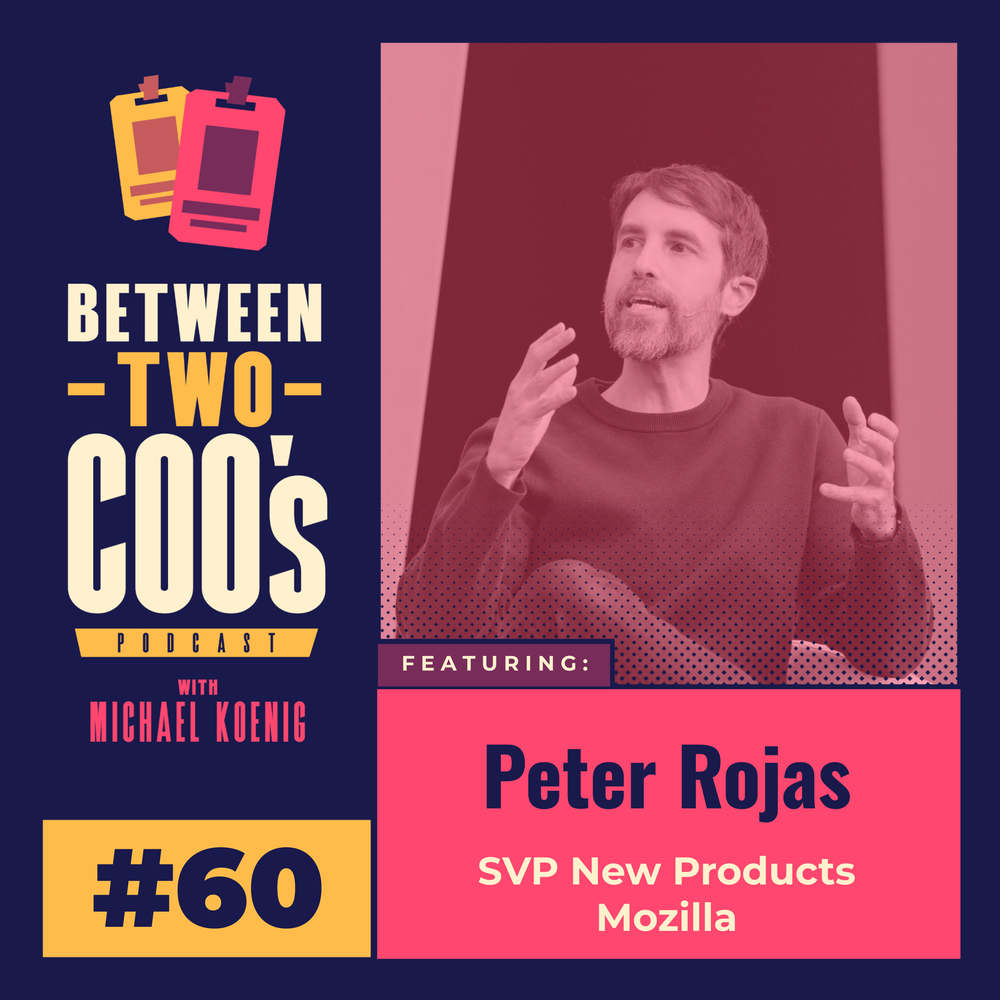
Peter Rojas, New Products at Mozilla, on Why Ideas Don't Decide Success
Watch on YouTube
Peter Rojas planted the seed for this show, and in this episode he sits in the guest chair. He co-founded Gizmodo and Engadget, invested as a VC at BetaWorks, ran new products at Meta, and now leads new product development at Mozilla. He and Michael dig into why building inside a big company is a different discipline than running a startup, why a handful of bets a year is harder than a portfolio of seventy, and why coordination, not ideas, is usually what stalls execution at scale.
Topics Covered
- The email that started the show (1:46)
- Startup vs building inside a company (3:33)
- The corporate product numbers game (6:57)
- Vibe coding and Mozilla Pioneers (11:03)
- When a trusted brand is the advantage (15:13)
- Why incumbents lose the next wave (18:04)
- Meta's metaverse bet vs AI (21:58)
- If I were running Meta (25:44)
- Was the VR bet a failure (29:02)
- Why coordination breaks at scale (30:27)
- Fear, focus, and the CEO filter (35:07)
- How Mozilla runs on KPIs (38:56)
- The founder who hid his idea (40:30)
- Where to find Peter (46:33)
About Peter Rojas
Peter Rojas co-founded Gizmodo and Engadget, two of the publications that defined a generation of technology media. He started blogging in 2001, just as a content management system that once cost a million dollars was becoming free with WordPress, and he built formats that felt native to the web rather than ported from print.
Since then he has worked as both an operator and an investor. He was a founder and VC at BetaWorks, where he backed dozens of early-stage companies, and he spent time inside companies operating at real scale, including AOL and Meta, where he worked on Messenger and new products.
Today Peter leads new product development at Mozilla, where he runs the Mozilla Pioneers program, a paid effort to widen the top of the funnel for new ideas. His focus is building new products inside a big company without losing the speed and discovery instincts of a startup.
Mentioned in This Episode
- Peter Rojas on LinkedIn
- Mozilla Pioneers: paid program inviting outside builders to prototype ideas with Mozilla
- WordPress: the open source CMS Peter credits for opening publishing to anyone
- Lovable: AI prototyping tool referenced as vibe coding example
- Replit: AI-assisted coding environment cited alongside Lovable
- Claude Code: in production use at Mozilla per Peter
- Rec Room: consumer VR company Peter invested in at BetaWorks
Listen & Subscribe
Apple Podcasts · Spotify · YouTube · Amazon Music · RSS
About Between Two COO's
Hosted by Michael Koenig · betweentwocoos.com · b2coos.com
For more on OKRs and operational excellence, visit Helm.
Full Transcript
Show full transcript
Peter Rojas: Speed of market discovery is basically the difference between success and failure for startups. And if you can understand the contours of what the market wants faster than others, you can probably have a good chance of finding success. Sometimes we forget that the beauty of the internet is that you don't have to ask anybody's permission to go and build something and put it up on the internet and try to find customers for it. But you could imagine if your only option was to make an app, and then Google or Apple for whatever reason felt like it wasn't something they wanted in their app store. You can have a business.
Michael Koenig: Hello and welcome to Between Two COOs. I'm your host, Michael Koenig. And before we start, I want to read part of an email that my guest sent me several years ago. Quote, I also don't think it's crazy to try and create content around being a COO. Maybe start a newsletter or podcast where you interview COOs about what the job is like. Everyone wants to talk to CEOs and founders, but COOs are the unsung heroes, and I bet people would love to get to talk about their role. End quote. That's right. My guest today is Peter Rojas, the person who planted the seed for Between Two COOs. And if that name sounds familiar, Peter founded Gizmodo and Engadget, two properties that didn't just cover technology, they shaped how people understand it. He's been an operator and investor and a builder inside companies that operate at real scale like AOL and Meta. And today he's at Mozilla working on what comes next. Throughout my career as a COO, I've run into some problems, one of them being that once a company gets big enough, the challenges stop being ideas. It becomes about coordination, execution, knowing when to commit and when to shut something down, especially when the costs of being wrong are real. Peter has lived this for a long time, so this conversation isn't just about trends. It's about how large organizations actually make decisions, what breaks as they scale, and how operators decide what earns more resources versus getting killed. Peter Rojas, let's get into it.
Peter Rojas: Hi, thanks. And where's my royalty on every podcast, right? That's how it works.
Michael Koenig: Well, like I mentioned, you've worked across startups, AOL, Meta, now Mozilla, very different systems. What actually changes in how decisions get made as organizations move from scrappy to massive?
Peter Rojas: Yeah, the way that I like to think about it is that when you're doing a startup, you have this challenge that you have to show enough traction or signal to prove to investors, whether existing or new, that you can keep going, and have a shared understanding about what your milestones look like. One of the things, I may have talked about this with you and Hunter when we talked about our work years ago, is that for every stage of investor, what they're thinking about is what gets the next stage of investor to write a check. That's their benchmark. So you have to understand the psychology of not just the investors you want money from, but the next stage of investor. Whereas when you're building internally, you don't have this way to go and test the market and get external validation. You have to get your internal stakeholders, whether that's a person like me who runs a new products organization, or the CEO, the CFO, a committee, the board, to understand that you've seen enough traction with this idea. In some ways you have a similar challenge, you have to demonstrate that you're on the path, but you only have basically one person or one constituency you can go to for that additional capital. And oftentimes, before they even approve an idea in the first place, they want a much more laid out path of milestones. That doesn't acknowledge that progress can be very nonlinear with a startup or a new product. It feels like you're bumping along, pivoting, exploring, trying to do market discovery, trying to find product-market fit. And even when you hit product-market fit, it's not always up and to the right. So one of the challenges I have is making sure the people I'm accountable to, the CEO, the board, other members of the C-suite here at Mozilla, understand what that process looks like, and that we have to invest ahead of traction, because we don't have the luxury of going out to the market and getting validation from talking to 100 different funds. We have to be comfortable with a different level of risk than the typical product development process you might see with established products.
Michael Koenig: So is it easier because you work on new products? You were doing this at Meta, now you're doing it at Firefox, but you did it before in independent companies. Easier as a free agent, or more fun, different challenges? How would you consider it?
Peter Rojas: Definitely different. You have advantages and disadvantages. If we're doing an enterprise version of Firefox, for example, you get a big step up. Besides building on top of Firefox, we get to leverage the brand, the network, the existing relationships. So with things we're building, we try to think about, and this was the same at Meta and AOL, what are the unfair advantages we can leverage. But that can only take you so far. When I was at Messenger, it was a very different process of thinking about how you define success when you're introducing a new feature or making an incremental change versus doing something standalone, zero to one. To me one of the biggest challenges is that as a VC you have a portfolio. Each BetaWorks fund, we usually had about 60 to 75 companies in each fund. You expect most are probably not going to work, and the model typically has a couple of outliers, a handful of base hits that do well but don't return the fund, a lot of things that get acquired at cost, and an even greater number that don't work at all. At a big company, even as big as Meta, the most products I had at one point was maybe 14 or 15. I have eight products in progress right now at Mozilla. I really wish I could do 25 or 30 a year. There's something about it being a numbers game that makes it more challenging, and it creates a higher opportunity cost for what you do. So you often have to do more work to initially validate a concept and understand the market opportunity than a startup founder might. What you don't often see is that it's not just who is able to raise money. There are many more times that products and concepts and ideas get started and never even get to a place where the founders have enough conviction to try to raise money. The top of the funnel is gigantic. At the corporate level we have to evaluate ideas too, but our ability to meaningfully explore and validate them is more constrained, because I can't go do 50, I can't go do 25, I can do a handful per year. So I have to have more conviction, knowing the risks of them not working are about the same as in the regular innovation landscape.
Michael Koenig: Just a brief note for listeners, I did leave out that Peter was a founder of BetaWorks and was a VC. I worked with Peter, gosh, almost feels like a decade ago.
Peter Rojas: Almost 10 years ago, I think.
Michael Koenig: Yeah. So Peter's also bringing the lens of a very successful VC to this. Now, you talked about doing eight products right now and you'd love to do 25 to 30.
Peter Rojas: Yeah.
Michael Koenig: Let's talk about AI, because it feels like we can now. And this is timely. I don't know that I'll be able to get this podcast out before your application window closes, but you do have Mozilla Pioneers right now. Talk to me a little bit about this. And I'm curious, with the tools that are out there, what is preventing you from doing 25 to 30 products?
Peter Rojas: Great question. So I'll talk about Pioneers first. Pioneers is one way I'm trying to solve this top of the funnel problem. It's a program where we invite builders to come spend a couple of months with us. It's a paid program. You can do it part-time. You don't have to quit your existing job, but you have to get your existing job's permission. If they own all of your work product and IP, then you can't do this, because we don't want to create conflicts down the line. It came from a realization that with vibe coding and the ability to use AI tools like Lovable and Replit for prototyping, a process that might have taken six to nine months, and a founder plus a couple of engineers and a designer, I can essentially have someone prototype their ideas in hours and at least get some understanding of what they want to build. Even though you can prototype and express ideas more quickly, there's still time you have to be in the market. As a biggish company, not tiny, there are processes we have to follow. Things have to get cleared with legal. Mozilla is backed by a nonprofit and is mission-driven, so we have values we don't compromise. We go above and beyond to protect user privacy, to be transparent, to use and build open source whenever we can. That slows things down a little. And though we use Claude Code and other tools in production, it doesn't mean we cut corners on shipping safe, secure products. The second part is, even if you can make the prototype, you still have to do the work to understand and segment your potential customers. You want to talk to customers. AI can help identify who to talk to and what questions to ask, but there's nothing that substitutes for a founder getting on the phone and talking to people. Maybe it all becomes AI to AI someday, I don't want to discount that, but there's work you have to do to understand what you really want to build. The thing I always tell my teams here is that speed of market discovery is basically the difference between success and failure for startups. If you can figure out the contours of what the market wants faster than others, and then give them what they want, you have a good chance of finding success. But it takes time to get feedback from the market, even if you can iterate more quickly in response. My goal is that Pioneers will let us expand the number of ideas we consider per year. But there's a difference between considering an idea and having enough conviction to put it out in the market.
Michael Koenig: It's interesting, the speed of market discovery, and this becomes much more difficult when you have a name like Mozilla that we all have a lot of affinity for. We're getting back to risk. It's much easier for someone with no name to go put a bunch of different things out versus Mozilla, which has to be safe and secure. It's one of the things that worries me whenever I see the latest and greatest AI tool come out. I have a list of 12 questions I copy and paste to their support people about security and how my privacy is used. I wouldn't have that problem going to Mozilla. So it's actually almost a benefit, a leg up.
Peter Rojas: Yeah. We want to be a company you can trust to build and make things, and that centers the user and the customer, because we're not just consumer, we have enterprise products. You can trust us, we're going to prioritize you. We're not a public company, we don't have shareholders, we're not backed by or run by billionaires. I don't want to disparage anyone, I use plenty of things made by the big companies and I worked for one of them. But our incentives are just different, and our long-term alignment is different. Fundamentally we have this legacy of really wanting to make sure the internet remains a public good that everybody has a chance to participate in. We were talking before the podcast about something you're working on, and I think sometimes we forget that the beauty of the internet is that you don't have to ask anybody's permission to go build something and put it up and find customers for it. But you could imagine if your only option was to make an app, and then Google or Apple felt like it wasn't something they wanted in their app store. We fundamentally believe the internet needs to stay open and be something everybody can participate in and shape.
Michael Koenig: I love it. You're taking me back to my Automattic days when we had very similar beliefs.
Peter Rojas: Oh, absolutely. A lot of similarities. Matt's vision for WordPress came from a very similar era of the internet.
Michael Koenig: Yeah, absolutely. Let's talk about these eras of the internet. Gizmodo and Engadget, you've seen multiple tech waves up close. Blogging, Web 2.0, mobile, social, VR, AI. What felt similar going into those moments, and what genuinely feels different this time?
Peter Rojas: One of the things I've seen, if you go back even to the era of mainframes, is that every time we have an interface transition, mainframes to mini computers, mini computers to PCs, PCs to mobile, and mobile to AI, we initially start with a phase where people try to port over the user experience paradigms of the previous wave. If you go back to pre-iPhone, a lot of mobile phones felt like they were trying to shrink the PC desktop into a little screen, and it didn't really work. You had to reimagine and come up with something that felt completely native to mobile. One of the things I find really interesting about AI right now is that we're still figuring out what it actually means to have interfaces and workflows and experiences that are truly native to AI, that aren't skeuomorphic in the sense of trying to take what we already know and fit it into the existing framework. It's a real challenge. But one of the things I've seen is that it makes it very difficult for the incumbents from the previous generation to dominate the next one. Now, AI may be an exception. It may turn out that Google ends up winning for all sorts of reasons you and I could enumerate.
Michael Koenig: Right.
Peter Rojas: But one of the things I love about technology, and disruption is a cliché word to use, but it does shake the snow globe. You're kind of like, things are up for grabs again. That's why I got so excited about blogging. I started blogging in 2001. When I worked at Red Herring, a magazine that covered technology, we paid a million dollars for a content management system. Within a few short years, Matt made that free with WordPress. When I saw that anybody could publish, that all of a sudden the things that mattered were not going to be whether you had access to a printing press, or could afford a million-dollar CMS, or could afford the servers, it meant everything was up for grabs again. I dove headlong into that and created some big brands that took advantage of a format that felt native to it. Gizmodo and Engadget weren't trying to be magazines or newspapers. We created something totally unique and new.
Michael Koenig: And a different business model as well.
Peter Rojas: Different business model, different voice, different style, different publishing cadence, all of it. Everything felt native to the web and to blogging.
Michael Koenig: It's fascinating. I want to tie this into some of your time at Meta, and you may or may not be able to talk about this, but you spent real time there during the big metaverse push where I think Mark put in $14 billion, and that was seen as this astronomical investment. And now he's effectively betting the farm. I don't know if you saw this in the most recent earnings. He's putting up every dollar of their free cash flow, $132 billion, on AI. From your vantage point, how do you think about the difference between those two bets?
Peter Rojas: So the genesis of the investment he made, it's funny, he changed the name to Meta like two months after I joined.
Michael Koenig: Yeah.
Peter Rojas: Not that it had anything to do with me. But the genesis of the focus on the metaverse and VR headsets was about what we talked about earlier, not wanting to be dependent on the big platforms, on Google and Apple. Mark didn't want Facebook, which became Meta, to be at the mercy of the companies that made the devices people used Instagram, WhatsApp, and Facebook on. So there was a strong desire to capture the next wave and own it. Strategically you can see the logic, you don't want to keep missing these shifts. Microsoft tried really hard to be successful in mobile and ended up having to cede the market. There were a lot of people in 2002 who thought, sorry Palm, sorry Nokia, this window is going to grind you all to dust. So there's a logic to that bet, but it was predicated on users adopting VR headsets at a rate that never materialized. I invest in VR companies, I invested in Rec Room, one of the most successful consumer VR companies, and they were as successful as anyone could have been but didn't turn out to be a gigantic company. It was a bet, it didn't materialize. Now there's a real desire, and I'd have to be careful about what I know from when I was there.
Michael Koenig: Yeah, right.
Peter Rojas: The desire now, whether you get to AGI or superintelligence or whatever you call it, is that Mark doesn't want Meta to be boxed out or constrained in a world where OpenAI and Google end up winning. There are a lot of ways to decide what winning means. So at a high level, you probably don't want to lose to them, but in defining how Meta wins, I would probably take a slightly different approach than what he's doing right now.
Michael Koenig: Okay, you're running Meta. You opened the door there. You're running Meta.
Peter Rojas: So one of the challenges is that everybody has this perspective that the race to be won is that everyone's going to have an agent that does things for them, and whoever creates that agent, that's the future. I think that may not be quite as cut and dried. It's not clear to me that the average person necessarily wants Meta to be their agent, versus a Google, which has more productivity type experiences, email and calendar and search, which is utility driven. You don't search for entertainment, you might search to get to entertainment, but you don't search as a form of entertainment. Whereas Meta's bread and butter is more on the entertainment side, Instagram, Reels. There's some social utility with WhatsApp, but it's hard to monetize. It's interesting to see how Apple has in a way sat out a little, feeling like, we have the devices, the billions of handsets, we can afford to wait and see. Meta runs the risk of overbuilding on the data center side. They're taking on a lot of debt, and there's a risk of underinvesting in the place where they make the most money, the ads business. You can imagine a world where they say, we're going to constrain how much we invest in trying to get to superintelligence, and invest more in optimizing our ads and getting so great there that no one can compete with us. Then as we get a better sense of what consumers want, whether it's agents or whatever, we lean into that. And I think Anthropic has been really smart here, where they've ceded the consumer market, focused on coding and enterprise, and found a great lane for themselves. They may turn out to be a better long-term business than OpenAI even.
Michael Koenig: Yeah, absolutely. Especially now, those Super Bowl ads they dropped earlier are epic in terms of ads coming to OpenAI. It's really interesting. A lot of people think about Meta and VR headsets as maybe a fail as far as Meta goes. But keep in mind, I think the Quest sold like 20 million headsets.
Peter Rojas: Yeah, it's not nothing.
Michael Koenig: It's not nothing. It's astronomical. If you compare it to gaming consoles, it's right up there.
Peter Rojas: It's insane. I think the problem is they didn't want to make a gaming console. If you're going to build a gaming console business, you need to structure the investment differently. I think they thought we're going to sell hundreds of millions of these headsets a year eventually. They didn't get to that. To be fair to Mark, if you go back to 2016, a lot of people were like, this is the next big thing. I have multiple VR headsets, I spent a decent amount of time in VR, and I was like, this seems pretty cool to me.
Michael Koenig: Coming back to your experience as an operator, I'll be a product guy. Coordination is an operational problem that we COOs and the listeners often get pulled into, when the strategy is clear but execution stalls. In larger orgs, at least in my experience, it's usually the limiting factor. At Meta, Mozilla, in your experience, what specifically has made coordination work, and what was the thing that broke when it didn't? I say this because these are enduring companies, the processes are there.
Peter Rojas: One of the things, and if you've talked with people who've worked at Meta, is that you don't always have enough clarity around who's the decision maker, or you have a decision maker who wants it to be bottoms up rather than being clear at the outset about, here's our objective, here's what I want, here's how I'm going to make a decision. This was not a unique experience for me. You'd be in an alignment call and there'd be 40 or 50 people on it, people chiming things in, and you'd have enough senior people on the call that the more junior people would basically be assigned things in real time. It'd be like, well, I had this idea, have you looked at this? And now a PM has to go spend two weeks running something down that probably won't matter, just to satisfy somebody senior who had a notion of something we maybe need to explore. We've all had those experiences. Meta is successful and gets things done, so decisions get made at some point. But you can see how things get bogged down. So one of the things I'm obsessed with is having real clarity about what we want to do and what's expected. I'm always pushing. We're putting together a board deck right now, a great example. I said, I just want to make sure, I'm going to take this slide, but the other slides are going to be handled by these other people. It's a pedestrian thing, but as a leader, if you're modeling it, just get granular when you need to. We forget that a lot of junior people, and sometimes even ourselves as senior leaders, assume people can fill in the blanks, or that we'll fill them in correctly. I love getting very clear about who makes the decision, what's at stake, what we're considering, and the timeframe. One thing I like about Mozilla is there's not a lot of preciousness where leaders feel they have to put their fingerprints on something before it's worth moving forward. It didn't have to come from me for us to move forward. I saw a lot at Meta where you'd put together a strategic document, 35 pages, laying out the roadmap and trade-offs and justifications, and then every senior person above me had to change it, put something into it, tweak it. You realize it's not really in service of making the decision or the outcome better. It was just to feel like they were doing their jobs. I don't get a lot of that here. People say, I could make you go back and forth on this, maybe it makes it a tiny bit better, but we don't have time, we've got work to do. I really like that.
Michael Koenig: It's also people putting in those touches so they feel like they're earning their paycheck and justifying why they're there.
Peter Rojas: If you're that insecure about your position or your job, either you're not great at your job, or you're at a place that tries to make you feel uncomfortable and insecure. Meta is notorious for that. They kind of want people to be anxious and scared a little bit. I think it works until it doesn't, and I don't think it's a healthy way to operate. We want to work with urgency, but I don't want people freaked out. Everything is doable, that's what I tell my team. If we do our jobs properly, everything we have to do should be something we know we can accomplish. We might get a little lucky, we can have stretch goals, but there's no value in setting a goal and then not doing the work underneath to outline how we do it, how we anchor the business objective to the specific things we're going to do. One thing I check with myself is that I need to be able to zoom out and articulate the vision and the business goals, but also drill down and understand the actual execution and strategy. It doesn't mean I'm doing it myself, but I need to make sure the people charged with the execution know what they need to do and have focus.
Michael Koenig: So often, especially listeners on this show, we'll be working for CEOs, and much of the time we're the filter that keeps people focused, so that when our CEO comes and says, hey, I found this really amazing AI tool, check it out, it's like, no, no, no. If I send this to anyone, especially coming from me, let alone you, they're going to drop everything and go look at it. It's a giant distraction. So it sounds like Mozilla is doing a great job of keeping an eye on the ball, which is the finished product.
Peter Rojas: Yeah, I think so. We have a new CEO who started in December, who was previously the head of Firefox. I think Anthony's doing a great job of bringing discipline and focus, and making clear that we want to be ambitious, but we have to make tough decisions about what we want to do and what we don't. We have a new COO too. We didn't have that role when I joined. Subha had been running a handful of different groups and consolidated some things under her as the new COO. What I respect about how she approaches the job is that if we don't have the right executional processes and cadences in place, all the ambitions around the product work won't happen. It might not be glamorous, but we've got to make sure we have the right tooling, infrastructure, and HR processes. That foundational work makes a really big difference.
Michael Koenig: How does Mozilla run? Do you have an operating system, OKRs or something like that?
Peter Rojas: The way we set it up, we have high-level goals that we articulate and translate into KPIs. Like a lot of places, the success or failure of those KPIs translates into the overall annual corporate bonus system. That's pretty typical. As we think about KPIs, individuals have their own goals that have to ladder up to those KPIs. I'm C-suite, so my goals are just the KPIs related to my organization. Either I accomplish those or I don't, there's not a lot of mushiness. For others it's, how do I deliver impact toward those KPIs given my scope and function. For some roles it's easier to translate than others. As a PM, if the goal is to move Firefox DAU, I can pretty clearly understand what I need to do. In finance it might be more indirect. But that's how we organize our work.
Michael Koenig: Thanks for the in-the-weeds question, I would have kicked myself if I didn't ask it. Well, Peter, I know we're pretty much at time. It's time for my last and favorite question. We've all had those moments in the C-suite or the investor chair where we've seen something completely off the wall and thought, I never thought I'd see that. Do you have one you can share?
Peter Rojas: I do. It's something that happened when I was an investor at BetaWorks. We were pre-seed investors, one of the first investors in an early company, a couple of people and a really early prototype. We're comfortable with that, knowing there are going to be pivots and a meandering path. So we invested in a company doing some analytics thing. It wasn't a rocket ship, they were trying to figure it out. The investor updates they were sending were getting increasingly vague. After a few months I thought, let me catch up with the founder. So I ping him, hey, let's get coffee, I just want to understand what's going on. We meet and he's explaining, but being very unclear. Finally I said, because I have no problem saying this, I don't really understand what it is that you're doing, maybe you need to break it down for me. He's like, no, no, I'm not going to tell you. I don't want you to know what I'm doing. We're pivoting, but I don't want BetaWorks to know. And I said, wait, hold on. One, we're on the same team. I have a confidentiality agreement, I have no interest in sharing what you're doing with anyone outside my fund. But also, I have information rights in our investment agreement. Two, I can't help you if I don't know what you're doing. And three, this is so unusual that when you go out to raise more money and other investors do their reference check with me, I can't recommend you, because this is crazy. I told him, it's Friday afternoon, you're a first-time founder, I have my partner meeting Monday at 11. If you walk this back by 11, I won't bring it up. He never did. I didn't hear from him until a year and a half later when he was trying to raise more money. I wrote back, first of all you're not getting more money from me, but two, my relationships with other investors are based on me being credible and honest, and I can't recommend you in good faith. They went out of business, and not because I didn't write another check. I've just never seen anyone do that before or since.
Michael Koenig: That is madness. I've never heard that before.
Peter Rojas: I know. I had to tell my partners, and everyone in the meeting was like, wait, what? I was like, no, I'm not making this up, he won't tell us what he's working on.
Michael Koenig: Did you ever find out?
Peter Rojas: No. Some other business analytics thing. People can be very weird about this stuff. There's an even bigger lesson I've enshrined. One, nobody really cares what you're working on. If it works, everyone's going to copy it, and if it doesn't work, it doesn't matter. The other thing, and I told this to somebody who was raising money and being a bit like, we don't want the idea out there, I said, you have it all wrong. Here's how you should talk to investors. You should be like, I don't care who knows our idea, because my team is so good and is going to execute this so much better than everybody else that I don't care who knows. And that makes an investor want to get the checkbook out. I love that confidence. Honestly, I don't care if my ideas are out there now. It doesn't matter.
Michael Koenig: That's awesome. That's definitely crazy.
Peter Rojas: Let that sink in.
Michael Koenig: I wonder what they're up to now.
Peter Rojas: Maybe I should check LinkedIn. It's probably going to say stealth.
Michael Koenig: That's amazing. Peter, this has been awesome. Thanks so much. Where can people keep up with you?
Peter Rojas: It's funny, I do have a personal website, roj.as.
Michael Koenig: You haven't updated it since 2021.
Peter Rojas: I know, I haven't updated it in a long time. I'm on Bluesky at roj.as, that's what I use the domain for. I'm on LinkedIn, just Peter Rojas. I'm easy to find. LinkedIn and Bluesky are the only two things I'm on now.
Michael Koenig: Perfect. Sorry to call out your lack of blogging.
Peter Rojas: It's all right. I should be better about it.
The COO's Execution Playbook
Frameworks, templates, and hard-won lessons from operators who've been in the chair. Every Tuesday.
No spam. Unsubscribe anytime.