Corporate innovation with one investor instead of a hundred: Peter Rojas of Mozilla
The structural problem with corporate innovation, in Peter Rojas's account, is not budget or talent. It is that a startup can test its idea against a hundred investors and a corporate team has exactly one constituency to convince.
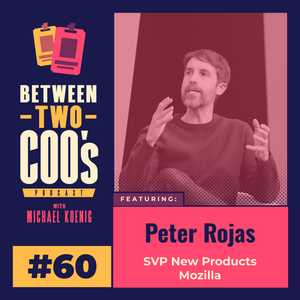
Rojas founded Gizmodo and Engadget, has been an operator and investor inside companies at real scale including AOL and Meta, was a partner at Betaworks, and now runs new products at Mozilla.
He is also the person who planted the seed for this show. Michael opens by reading from an email Rojas sent him years ago suggesting he start a newsletter or podcast interviewing COOs, on the grounds that everyone wants to talk to CEOs and founders while COOs are the unsung heroes.
One constituency instead of a market
Rojas's framing of what actually changes between a startup and a large organization is the sharpest thing in the conversation.
In a startup you have to demonstrate enough traction or signal to convince investors, existing or new, that you can keep going. And his insight about how that works is worth having: at every stage, what an investor is thinking about is what gets the next stage of investor to write a check. Which means you have to understand not only the psychology of the investors you want money from, but of the ones after them.
Building internally, you have no way to test the market and get external validation. You have to convince internal stakeholders instead. Sometimes a person like him who runs new products, sometimes the CEO or CFO, sometimes a committee or the board.
And they typically want, before approving anything at all, a much more laid-out path of milestones.
Which is where the mismatch lives. That expectation does not acknowledge that progress on a new product is genuinely nonlinear. You bump along, you pivot, you explore, you do market discovery, you look for product-market fit. And even when you find it, it is not simply up and to the right, because there is still product optimization, flow design, and working out the most leveraged dollar for acquisition.
So a substantial part of his job is helping the CEO, the board and the rest of the executive team understand that process, and that they have to invest ahead of traction, because they do not have the luxury of going out and getting validation from a hundred different funds. It requires being comfortable with a different level of risk than an established product development process.
Why the numbers game does not transfer
The second structural difference is volume, and Rojas has both sides of it.
At Betaworks, each fund held roughly 60 to 75 companies. You expect most not to work: a couple of outliers, a handful that do well without returning the fund, some acquired around cost, and a larger number that fail entirely.
At Meta, the most products he had at one time was perhaps 14 or 15. At Mozilla he has eight in progress and says he wishes he could run 25 or 30 a year.
Which raises the opportunity cost of each one. So corporate teams have to do more work up front to validate a concept and understand the market opportunity than a startup founder typically does.
His observation about what is invisible in the startup comparison is the fair one. We only see who raised money and who did not. We do not see the far larger number of products and concepts people started working on and abandoned before they had enough conviction to even try raising. The top of the funnel is enormous, consisting of every idea anyone decided not to pursue.
Corporate teams have to evaluate ideas too, and their ability to meaningfully explore and validate them is far more constrained, while the odds of any given one working are about the same.
What Pioneers is solving
Rojas's answer to the top-of-funnel problem is a program called Pioneers, inviting builders to spend a couple of months with Mozilla. It is paid, can be done part-time, and does not require leaving your existing job, though it does require your employer's agreement, and is not possible if they own all of your work product and intellectual property.
The reason it can exist now is prototyping speed. A process that might once have taken six or nine months, and required a founder plus a couple of engineers and a designer, can now produce a prototype in hours using current tooling, which is at least enough to understand what you are trying to build.
What speed of prototyping does not solve
The more interesting half is what Rojas says has not been compressed, because it is a corrective to a lot of current enthusiasm.
First, process. Mozilla is not enormous but is not tiny, things have to clear legal, and because it is backed by a nonprofit and mission-driven, there are values it does not compromise on: going beyond the norm on user privacy, on transparency, and on using and building open source wherever possible. That slows things down. And while they use AI coding tools in production, that does not mean cutting corners on shipping safe and secure products.
Second, and more universal: even with a prototype in hand, you still have to do the segmentation work and talk to customers. AI can help identify who to talk to and what to ask, and there is no substitute for a founder getting on the phone and talking to people.
Which produces the line he tells his teams: speed of market discovery is basically the difference between success and failure for startups. If you can understand the contours of what the market wants faster than others, and then give it to them, you have a good chance.
But getting feedback from the market takes time, even when you can iterate faster in response to it.
His conclusion about the program: Pioneers should expand the number of ideas they consider per year. And there is a difference between considering an idea and having enough conviction to put it into market.
Why trust is a product advantage
Michael's observation is that a strong brand cuts both ways. It is easier for an unknown company to put many experiments out than for one carrying real affinity and an expectation of safety and security.
His counterpoint is the useful one: he keeps a list of a dozen questions he copies to the support team of every new AI tool, about security and how his data is used. He would not need to ask Mozilla.
Rojas's answer explains why that is deliberate. They want to be a company whose products you can trust, centering the user or customer, including enterprise customers. They are not public, have no shareholders, and are not backed or run by billionaires. Without disparaging the large companies, whose products he uses and one of which he worked for, his point is that the incentives and the long-term alignment are simply different.
And underneath it, a legacy commitment to the internet remaining a public good that everyone can participate in.
His illustration of what that means practically is one worth keeping. The beauty of the internet is that you do not need anyone's permission to build something, put it up, and go find customers. Imagine instead that your only option was to make an app, and one of two companies decided it was not something they wanted in their store. You would not have a business.
Every platform shift starts skeuomorphic
Asked what feels similar and what feels different about this technology wave, having lived through blogging, Web 2.0, mobile, social and VR, Rojas gives the best historical frame in the episode.
Every interface transition, from mainframes to minicomputers to PCs to mobile to AI, begins with people porting over the interaction paradigms of the previous wave.
His example is mobile before the iPhone, when most phones felt like an attempt to shrink a desktop onto a small screen, which did not work. Someone had to reimagine something that felt native to the device.
What he finds interesting about the current moment is that we are still working out what interfaces, workflows and experiences genuinely native to AI look like, rather than fitting AI into the framework we already know.
And his structural observation: these transitions make it very difficult for incumbents from the previous generation to dominate the next one. Though he allows AI may be an exception.
His account of why he moved into blogging in 2001 is the personal version. At a technology magazine, they had paid a million dollars for a content management system. Within a few years that capability was free with WordPress. When anyone could publish, the things that had mattered, access to a printing press, an expensive publishing system, servers, stopped mattering. Everything was up for grabs again.
And what he built took advantage of it. Gizmodo and Engadget were not trying to be magazines or newspapers. Different business model, different voice, different style, different publishing cadence, all of it native to the web.
Two very large bets
Michael asks how Rojas thinks about the difference between Meta's metaverse investment and its current AI spending.
Rojas notes wryly that the company changed its name about two months after he joined.
His account of the metaverse logic connects back to the earlier theme. The genesis was not wanting to depend on the platforms other companies control, or to be at the mercy of the makers of the devices people use to reach Instagram, WhatsApp and Facebook. A strong desire to capture and own the next wave, given how expensive it is to keep missing shifts. He points to Microsoft trying hard to succeed in mobile and ultimately ceding the market.
There was, he says, a logic to the bet, and it was predicated on adoption of headsets at a rate that never materialized. He is careful about his own position, noting he invests in VR companies including one of the most successful consumer VR businesses, which was about as successful as anyone could have been and did not become enormous.
Michael's counterpoint is that tens of millions of headsets is not nothing, and compares favorably with games consoles. Rojas agrees, and identifies the mismatch: if you are building a games console business, you structure the investment differently. The assumption was hundreds of millions of units a year.
On the current bet, he is careful about what he knows from his time there. His read is a desire not to be boxed out if the largest AI companies end up winning.
And his own alternative strategy is the interesting part. It is not clear to him that the average person wants a social company to be their agent, rather than one whose products are already productivity and utility driven, with email, calendar and search. Search is utility, not entertainment, whereas the social company's strength is entertainment.
He notes one large device maker has effectively sat out, on the basis that it has the devices and the users and can afford to wait.
So his counterproposal would be to constrain the spending aimed at the frontier, invest more heavily in optimizing the advertising business until nobody can compete there, and lean into whatever consumers actually turn out to want once that becomes clearer. He points to Anthropic as having been smart in choosing a lane rather than contesting everything.
The forty-person alignment call
The operational section, and the one most listeners will recognize.
Rojas names two related failures at large scale. Not having enough clarity about who the decision maker is. Or having a decision maker who wants the process to be bottom-up rather than stating at the outset what the objective is, what they want, and how they will decide.
The result is the alignment call with forty or fifty people, where senior participants chime in and junior people are effectively assigned work in real time. Someone senior has a notion, and a product manager spends two weeks chasing something that probably will not matter, simply because it was voiced.
He is careful to note that Meta is successful and decisions do get made. The point is how easily things can bog down.
So his obsession is clarity about what is wanted and what is expected. His example is deliberately mundane: assembling a board deck and confirming which slide he owns and who handles the others.
His argument for why a leader should model that: junior people, and senior people too, assume others can fill in the blanks, or that they will fill them in correctly. He would rather be very clear about who decides, what is at stake, what is under consideration, and the timeframe.
Preciousness
The thing he likes about Mozilla is the absence of what he calls preciousness: leaders needing their fingerprints on something before it counts.
His description of the pattern he saw elsewhere will be familiar to anyone who has written a strategy document. You produce a thirty-five page proposal laying out the roadmap, the trade-offs and the justifications. Then every senior person above you has to change something and add something.
And his verdict: it was not in service of making the decision or the outcome better. It was so they could feel they were doing their job.
Michael's read is that people add those touches to justify their presence. Rojas's response is blunt and fair. If you are that insecure about your position, either you are not good at your job, or you are working somewhere that deliberately makes you feel insecure.
His view of that management style: it works until it does not, and it is not a healthy way to operate. He wants urgency without people being frightened.
Everything should be doable
His formulation of what goal setting should produce is the line to keep.
Everything is doable. If the work is done properly, everything the team has to do should be something they know they can accomplish. Not that luck plays no part, and not that stretch goals are illegitimate. But there is no value in setting a goal without doing the work underneath to outline how it happens and to anchor the business objective to specific actions.
His own discipline follows: he needs to be able to zoom out and articulate the vision and the business goals, and to drill down far enough to understand the execution and strategy. Not doing it himself, but understanding it well enough to be sure the people responsible know what they need to do and have focus.
How Mozilla runs
High-level goals translated into a set of KPIs, with performance against them feeding the annual company bonus.
Individual goals ladder up to those KPIs. As a member of the executive team, Rojas's goals simply are the KPIs for his organization, with no mushiness: he achieves them or he does not.
He notes the translation is easier for some roles than others. A product manager working against a usage target can see clearly what to do. For someone in finance it is more indirect.
He also credits the newer leadership, a CEO who previously ran Firefox and a newly created COO role, for bringing discipline and focus, and for being clear about what the company will and will not do.
His respect for how the COO approaches it is worth ending on. Without the right execution processes and cadences in place, none of the product ambitions happen. It may not be glamorous, and the tooling, the infrastructure and the HR processes are what make the rest possible.
The 5 things I took away from this conversation
1. Corporate innovation has one investor, not a hundred. That single structural fact explains most of the difference. A startup tests its thesis against a market of funders. A corporate team has to convince one constituency who wants a milestone plan before approving anything, for work whose progress is inherently nonlinear.
2. Prototyping got fast, market discovery did not. The most useful corrective in the episode. You can build the thing in hours now. You still have to segment the market and talk to customers, and that has not compressed at all.
3. Every platform shift starts by porting the last one. Pre-iPhone phones were shrunken desktops. We are currently at the equivalent stage with AI, still fitting it into interaction models we already know, which means the genuinely native version has not been built yet.
4. The forty-person alignment call assigns work by accident. Somebody senior voices a thought, a product manager loses two weeks. The fix is not fewer people, it is stating up front who decides, what the objective is, and how the decision will be made.
5. Everything should be doable. Peter's standard for goal setting. If the work underneath has been done, connecting the business objective to specific actions, then the team should know they can accomplish what is on the list. A goal without that work is a wish.
FAQ
What makes corporate innovation different from a startup? The validation path. A startup can test its idea against many external investors and get market feedback. A corporate team must convince a single internal constituency, which typically wants a detailed milestone plan before approving anything, despite the progress of a new product being genuinely nonlinear.
Why do corporate innovation teams take fewer shots? Because they cannot. Rojas ran roughly 60 to 75 companies per fund as a venture investor, and manages eight products at Mozilla. Fewer attempts raises the opportunity cost of each, which forces more validation work up front while the odds of any one working stay roughly the same.
Has AI made building new products faster? Prototyping, yes, from months to hours. Rojas is clear that market discovery has not compressed, because understanding customer segments still requires talking to customers, and because a mission-driven company still has legal, privacy and security processes it will not shortcut.
Why do incumbents struggle at platform shifts? Because early attempts port the previous paradigm's interaction models onto the new medium, as pre-iPhone phones tried to shrink the desktop. The winning products are the ones that feel native to the new medium, which established players are structurally slower to build.
How do large organizations make decisions badly? Rojas names two failures: unclear ownership of the decision, and leaders who want a bottom-up process rather than stating the objective and the decision criteria. The visible symptom is a large alignment call where senior participants informally assign work that consumes weeks.
Also mentioned
- Mozilla and its Pioneers program for external builders
- Gizmodo and Engadget, founded by Rojas and native to the blogging era
- Betaworks, and the portfolio economics of pre-seed investing
- Meta's metaverse investment, and the headset adoption that did not arrive
- WordPress making a million-dollar content management system free, and what that unlocked
Listen to the full episode
Peter Rojas on Between Two COO's
Between Two COO's is hosted by Michael Koenig. Subscribe on Apple Podcasts, Spotify, or wherever you listen.
More on Innovation
The COO's Execution Playbook
Frameworks, templates, and hard-won lessons from operators who've been in the chair. Every Tuesday.
No spam. Unsubscribe anytime.