Physical AI scales at the speed of trust
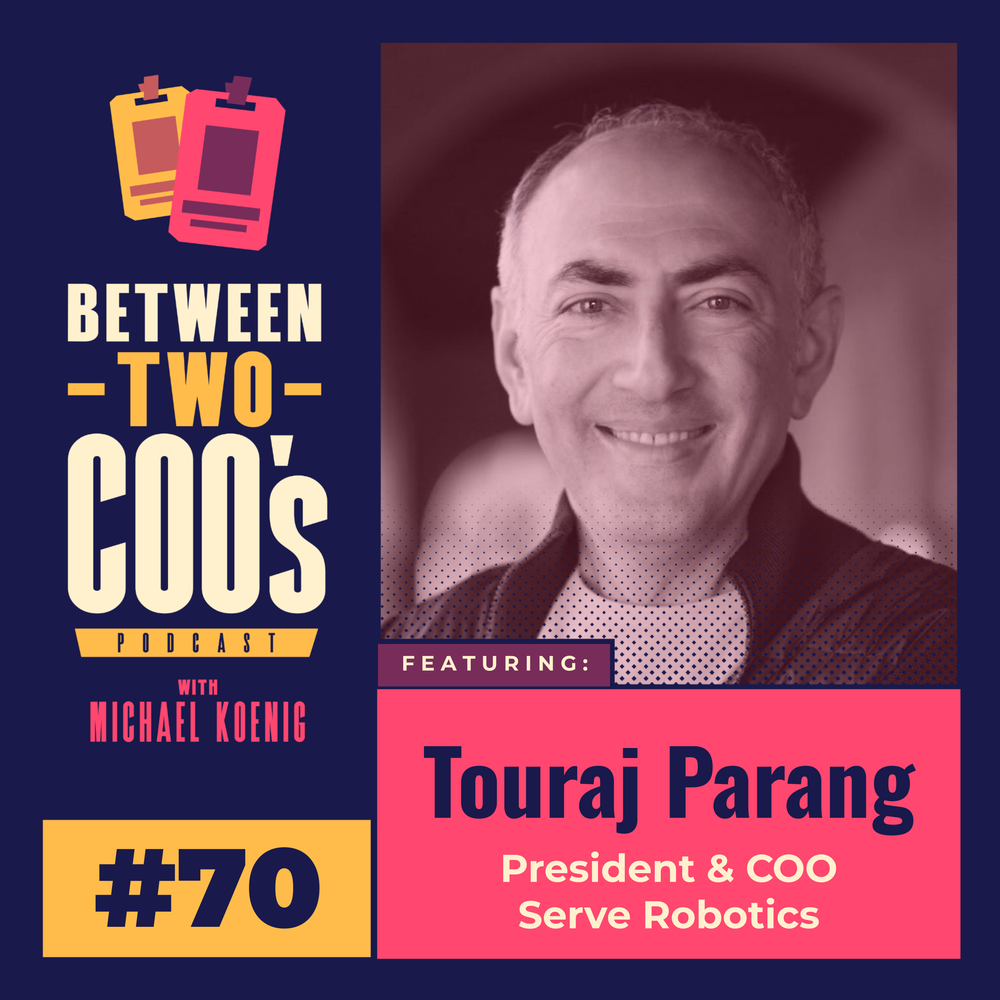
Ask most people what holds physical AI back and they will say the technology. Touraj Parang gave me a different answer.
Parang is president and chief operating officer of Serve Robotics, which has about 2,000 sidewalk delivery robots deployed across the country. He describes the company's bigger vision as a physical AI layer: robots working in public spaces that are unstructured, complex, and chaotic. On Between Two COOs I asked him what becomes the next constraint on the business as the AI keeps improving and the robots need less help. He said trust.
The constraint is trust
“I say that robots kind of move at the speed of trust and scale at the speed of trust,” Parang said. “No matter how great your technology is, if people don't trust it, you're not gonna be able to go too far with it.”
He was specific about how trust is earned: through repeated, reliable, safe interactions with the people around the robot. He expects the robotics companies with the best safety profile, the ones that are most trusted, to be the ones that get to scale. The rest, he said, stay a nice lab experiment.
Giving up speed on purpose
This is where it gets practical. Parang said safety has been the number one priority at Serve from the beginning, and he gave two examples of what that costs.
First, the robots stay under certain speeds. Going faster would be good for the business. Serve does not do it until it has enough conviction in its systems and processes that the extra speed adds no risk to the people nearby.
Second, street crossings. Parang called an intersection one of the highest-risk moments for a robot. So a human remote supervisor pilots the robot across, even though he describes the company's autonomy as fantastic.
Both choices make the business slower and more expensive in the short run. Both are the point.
Going to the regulator before the regulator comes to you
In many places there is no rule on the books that stops a robot from using a sidewalk. Serve does not treat that as permission. Parang said the company goes to the municipality and the regulators first and tells them it intends to come to their neighborhood.
It brings the benefits, its safety profile, how many deliveries it has done, and how many incidents it has had. It also brings a law enforcement response plan, so police know how to interact with the robots.
I asked whether the lack of written regulation is something he worries about, or whether the attitude is that they will get there when they get there. “We don't say we get there when we get there,” he said. “We say, ‘Do the right thing first.’”
Principles over perception
Serve has a name for this value: principles over perception. Follow the right principles, Parang said, and perception will eventually catch up.
That matters because the coverage is lopsided. When a robot crashes into the glass of a bus stop it could not see, it gets sensationalized. Parang's response is to focus on the core metrics that matter to the company and the communities it serves.
He pointed to Los Angeles, where Serve has operated the longest. When robots first show up in a neighborhood there is a lot of discussion. After a while, he said, people barely notice them. He described seeing a robot that had flipped on its side or got caught in a tree well, and people who parked their car and came over to rescue it.
What operators can take from this
You probably do not run a robot fleet. The pattern still applies to anything new you put in front of people who did not ask for it, including AI inside your own company.
The speed of the technology is not your rollout speed. Your rollout speed is how fast the people affected come to trust it. That is earned in repetitions, and each one has to go well.
Two moves from Serve translate directly. Keep a human in the loop at the highest-risk step, even after the system can handle it. And bring your record to the people who could say no before they have a reason to ask.
Parang's line about self-driving cars covers the end state. It is magical, he said, “and then it becomes infrastructure that everybody accepts.”
FAQ
What is physical AI? Touraj Parang of Serve Robotics describes robots as embodied AI, a true manifestation of software in the physical world. He says Serve's vision is a physical AI layer of robots that work in public spaces around people.
What limits how fast physical AI can scale? Trust. Touraj Parang, president and COO of Serve Robotics, says robots move and scale at the speed of trust, and that good technology will not go far if people do not trust it.
How do sidewalk delivery robots cross the street? At Serve Robotics, a human remote supervisor pilots the robot across intersections. Parang says a street crossing is one of the highest-risk moments for a robot, so the company keeps a person in direct control there.
How does Serve Robotics work with city regulators? It goes to them first. Parang says Serve tells municipalities it intends to operate, shares its safety profile, delivery count, and incident history, and brings a law enforcement response plan, even where no regulation requires it.
What does principles over perception mean? It is a Serve Robotics value. Parang describes it as doing the right thing first and not worrying about what people think of you, because perception eventually catches up with the right principles.
How many robots does Serve Robotics have? Parang says Serve Robotics has more or less 2,000 robots deployed nationwide doing sidewalk deliveries.
More on AI

The COO's Execution Playbook
Frameworks, templates, and hard-won lessons from operators who've been in the chair. Every Tuesday.
No spam. Unsubscribe anytime.