Tom Masterson, Deep Genomics COO on AI Drug Discovery That Learned the Rules
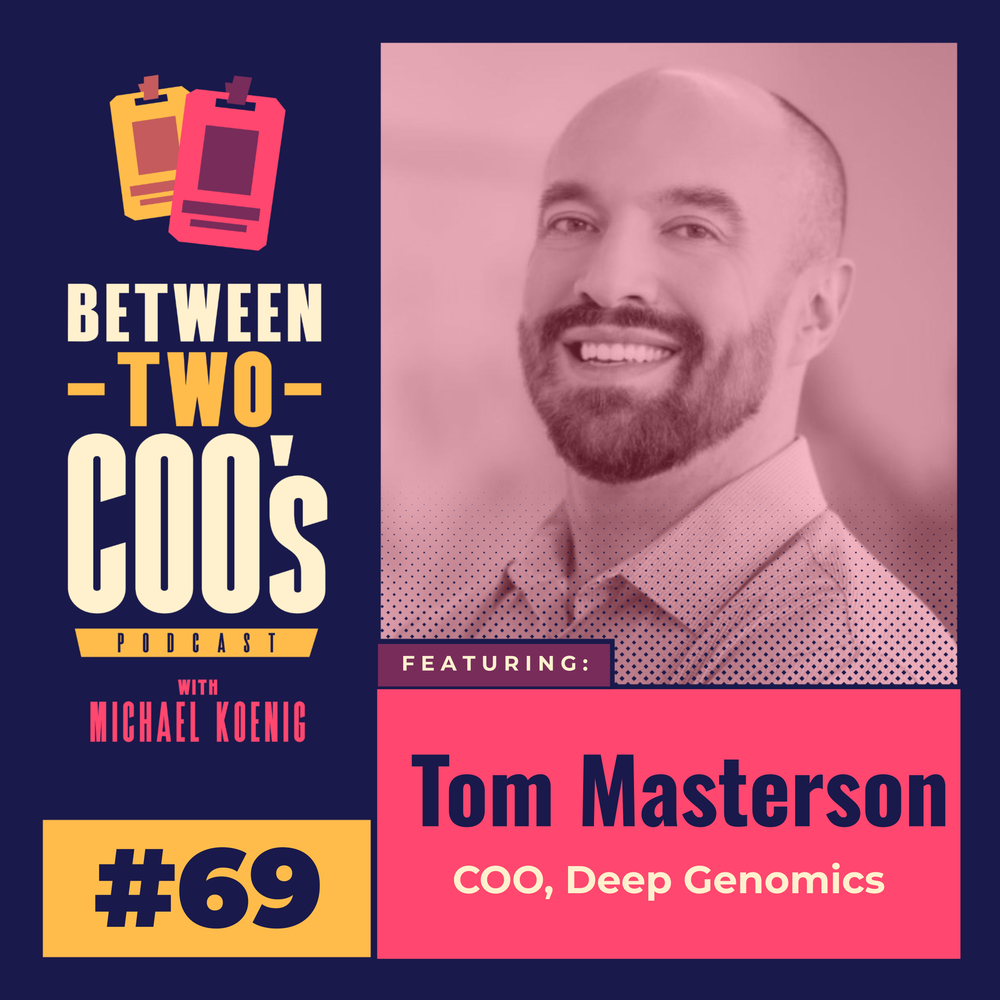
Deep Genomics gave its model a cholesterol target it had never seen and about 3,500 candidate molecules, and asked which ones would work. The model came back with nine. One of them is a drug that is already approved and in patients. Tom Masterson, the company's chief operating officer, is careful to call it a retrospective study. He also says the model treated it as a pretty normal task, which he finds the more striking part.
The founding idea goes back to 2002, when Brendan Frey, working in Geoffrey Hinton's lab at the University of Toronto, decided that genetic code is a lot like computer code. It was right but early. For years the company built task-specific models, about 40 of them. When foundation models arrived, one of its scientists built one that outperformed most of the rest, and Deep Genomics rebuilt around it. Masterson explains why that choice was easy, what a lab in the loop is, and why the company designs toxic molecules on purpose so its models learn what toxic looks like.
The second half is the operating job. Masterson started as a genetics graduate selling dental lasers, got an MBA because his boss told him to, and became COO after the new CEO noticed he was already doing the job without the authority. He talks about getting scientists to adopt process, running waterfall and agile side by side, the quarterly rhythm between portfolio review, scientific advisors, and the board, and why an N-of-one cure is one of the hardest questions a fiduciary can face.
Topics Covered
- Cold open: no room for hallucination (0:00)
- An AI model picks an approved drug out of 3,500 (0:27)
- Life sciences vs healthcare, explained (1:13)
- Brendan Frey, Hinton's lab, and right but early (2:25)
- Transformers and the switch to foundation models (4:24)
- How a biological foundation model works (5:06)
- Retiring 40 task-specific models (6:18)
- GenomeKit and the engineering that survived (8:02)
- What lab in the loop means (9:12)
- Precision over creativity (10:09)
- Why pharma's historical data is biased (11:58)
- Pretend your code is going into a patient (12:50)
- Lab time vs code time (13:19)
- Raising money for a 10-year bet (15:28)
- Finding drugs the human brain couldn't (17:30)
- The siRNA result and why it matters (18:18)
- What siRNA is, in plain English (19:27)
- The model learned the rules (20:59)
- Brute force vs what nobody else can do (21:20)
- Tom's path: genetics, dental lasers, sales at 21 (22:50)
- The push to get an MBA (24:31)
- Microbiome, a caregiver startup, and the pandemic (25:11)
- Joining Deep Genomics (25:51)
- Why genetic medicine mostly goes to the liver (26:55)
- Fixing ops at a university spinout (28:01)
- From chief of staff to COO (29:32)
- Getting scientists to adopt process (30:17)
- Eliminate yourself from the loop (31:19)
- A good time to be a generalist (32:38)
- Waterfall and agile side by side (33:39)
- The quarterly rhythm: portfolio, advisors, board (35:39)
- What the COO owns today (37:45)
- It is still a business (39:30)
- Personalized cancer vaccines and N of one (41:22)
- A hero to the world or to your shareholders (43:18)
- I never thought I'd see that: a two-week forensic audit (44:19)
- The barbecue champion (47:01)
- Wrap (47:40)
About Tom Masterson
Tom Masterson is chief operating officer of Deep Genomics, the Toronto company building biological foundation models for RNA drug discovery. He joined in business development and strategy, then served as chief of staff to founder Brendan Frey and to CEO Brian O'Callaghan before becoming COO. He partners with the CEO on board and investor relations, owns the company's project management and executive functions, and is the person who turns Deep Genomics' science into its business story.
Before Deep Genomics he was the first employee at Microbiome Insights in Vancouver, worked in contract research and healthcare design strategy, and founded Caregiver Support, a startup that helped family caregivers through medical crises. He started his career selling dental lasers at a medical device company. He holds a BSc in cell biology and genetics from the University of British Columbia and an MBA from Harvard Business School.
Frequently Asked Questions
How does Deep Genomics use AI in drug discovery?
Tom Masterson, COO of Deep Genomics, says it starts with fit-for-purpose training data generated in the company's own lab. That data trains a biological foundation model, which he describes as an AI textbook for biology. The outputs of that model then train application models for specific jobs in genetic medicine, such as predicting the on-target and off-target effects of siRNA drugs.
What did Deep Genomics' siRNA model find?
Michael Koenig describes the result in the episode opener: the model was given a cholesterol target it had never seen, PCSK9, and about 3,500 candidate molecules. It picked nine, and one of them is a drug already approved and in patients. Masterson calls it a retrospective study. The point he stresses is that the model had never seen that gene, which tells the team it learned the rules instead of memorizing answers.
What is siRNA?
siRNA stands for small interfering RNA. Masterson explains that it is a fragment a couple dozen base pairs long, compared with a couple thousand for the Moderna COVID vaccine. It sticks to an RNA the cell already makes and recruits a protein that destroys it, so a faulty RNA gets knocked down before it can turn into a harmful protein.
Why are siRNA off-target effects so hard to predict?
Hitting the intended RNA is the easy part, Masterson says. The hard part is that the same tiny fragment can bind to other RNAs all over the cell. Two pharma companies challenged Deep Genomics to predict those mismatches, which was computationally intractable before AI. The goal is to screen 20 candidates in animals instead of 2,000, and to cut late-stage failures that screens miss.
What is a lab in the loop?
It is an iterative cycle of design, test, analyze, and adjust, in which lab experiments produce the data that trains the models and the models shape the next experiments. Masterson says anybody can build one. What matters is designing data that is good for machine learning: causal, with clear provenance, rigorously curated, and fed straight back into the models.
Why does Deep Genomics design toxic molecules on purpose?
So the model learns what toxic looks like. Masterson says historical pharma data is heavily biased, because companies spent years trying to design only safe and effective molecules, so it trains poorly. Deep Genomics designs test molecules that are intentionally toxic, and he says its data sets were more than 10 times larger than its partners' data sets.
Why does AI drug discovery need precision instead of creativity?
Most AI applications reward generative, creative output. In drug development, Masterson says, if you are not delivering the correct result, you kill the patient. He tells engineers to pretend every line of code is going into a patient, because some day it might, and to treat side experiments the same way.
Why did Deep Genomics replace its 40 task-specific models?
When foundation models arrived, one of the company's scientists built one that outperformed most of its existing models. Deep Genomics was well capitalized as biotech markets turned, and had pulled back from taking molecules into the clinic, where costs rise about 10 times. Masterson says rebuilding was the obvious decision, and the engineering underneath, including the open source GenomeKit, stayed in place.
How do you run a company where the lab and the software move at different speeds?
Masterson says the fatal culture is throwing work over the wall and checking back in two weeks. Deep Genomics expects its people to be multilingual: engineers who understand biology and biologists who understand AI, with machine learning staff in every experimental design. He adds that seasoned drug developers think in 10 years while machine learning teams think in an afternoon, and they often argue hard for the same thing.
How does Deep Genomics set its operating rhythm?
It sets goals and trusts people to reach them, because drug development runs on waterfall stage gates while the platform software runs on agile. Each quarter starts with an internal portfolio review, then a scientific advisory board meeting about two weeks later, then the board meeting about two weeks after that. The advisory board includes Yann LeCun, Vic Myer, Mark Edbrooke, Richard Scheller, and Ben Neale.
How did Tom Masterson become COO of Deep Genomics?
He joined in business development and strategy, saw the company needed operations help more than deals, and started writing process maps. He became chief of staff to founder Brendan Frey, then to CEO Brian O'Callaghan, who told him he seemed like a COO without any authority over anybody. O'Callaghan gave him the authority and the title.
How do you get scientists to follow operating process?
Masterson says scientists already write every experiment as a procedure, so the argument is easy to win. The real objection is time. His approach is to act as a force multiplier, fix anything that is not working right away, and remove himself from the loop early by handing each process to a professional, such as a dedicated project management hire.
Why don't AI drug discovery companies pursue N-of-one cures?
Masterson says Deep Genomics has designed N-of-one drugs and can identify a mutation and design a therapeutic against it. The problem is the business. Curing one patient can be like pouring all of your resources into a cost center. You may be a hero to the world and not to your shareholders, and a fiduciary has to wrestle with that every time.
Mentioned in This Episode
Listen & Subscribe
Apple Podcasts · Spotify · YouTube · Amazon Music · RSS
About Between Two COO's
Hosted by Michael Koenig · betweentwocoos.com · b2coos.com
For more on OKRs and operational excellence, visit Helm.
Full Transcript
Show full transcript
Michael Koenig: If a machine can read it, it can find what's broken and design a fix.
Tom Masterson: You should pretend your line of code is going into a patient because at some day it might. If you are not delivering the correct result, you kill the patient. But we also think we're just gonna find drugs that the human brain couldn't find. What that tells us is that the model has actually learned the rules, not that it's memorized the answers to some test. What we think is gonna be really exciting is when we start doing things that, like, genuinely nobody else can do, even with brute force.
Michael Koenig: Everybody says AI is going to transform medicine. I haven't seen many examples of it yet, but here's one. A company in Toronto gave a model a cholesterol target it had never seen and 3,500 possible molecules and asked which ones would work. It came back with nine, and one of them was a drug that's already approved and in patients. So the idea underneath all of this is almost too simple. It's that genetic code is code, and if a machine can read it, it can find what's broken and design a fix. My guest today is the chief operating officer of that company, Deep Genomics. Tom Masterson, welcome to Between Two COOs.
Tom Masterson: Thanks, Michael. Excited to be here.
Michael Koenig: Let's start at the beginning. What does Deep Genomics actually do?
Tom Masterson: Right. So I'll get to Deep Genomics in a second. It might help to just, like, break down exactly what we mean when we say life sciences and everything, 'cause even that can be quite confusing, even to people who claim to be in the life sciences. So when I think about this, I draw a fairly bright line, despite a few major categories overlapping it, between life sciences and healthcare. So healthcare is where I would put clinics, hospitals, payer providers, all that kind of stuff that is the proximal layer around the patient and around the physicians that are actually executing on healthcare. Life sciences backs everything up quite a bit into the research and development kind of phase of the world. And in that space within life sciences, you would find people that produce tools. You think about people that are producing, like, genome sequencers, microscopes, all those types of things. You'd find people that are offering services, you know, contract research kind of groups. You'd find some people that are trying to branch into selling the drugs themselves, although I think that's where we get into the overlap, which is where pharma and, like, medical device companies come in that are actively selling the product of the last one, which is, like, the deep R&D companies that are working on cutting-edge medical device imaging and, in our case, biotechnology and drugs. We would describe ourselves as a tech bio because we put tech first. So in your preamble, you were talking about the identification of a drug that works against PCSK9 by our system. That is quite a long ways in the making. It dates all the way back to our founder working out of Geoff Hinton's lab at the University of Toronto, the to-be Nobel laureate. But Brendan would say during the AI winter back then, they were working in what could easily be described as a windowless closet. So Brendan was working on all sorts of algorithms and everything. Most notably, people know him for the wake-sleep algorithm. If you're doing any deep space telecom or if you're on Wi-Fi right now, send Brendan a gift or something, because that kind of algorithm is what enabled that kind of technology. Brendan and his family were exposed to a medical problem. I won't go further than that 'cause he rarely does. But in his mind, when he looked at this, he thought genetic code is pretty similar to computer code. So why don't I just aim all of my efforts in machine learning, deep learning, which deep learning you could give Brendan some credit in the founding of that with all of his cohorts, Yann LeCun, Geoff Hinton, Yoshua Bengio. They were all around there at the time. And that was the thesis Brendan embarked upon in 2002. So that is a long time in the making. It turns out to be quite a bit more complex than that. And really, this was like one of those situations you hear about in tech all the time: right, but early. So at the time, everybody was building task-specific models. We're gonna make one model for this, one model for that, you know, a bot that writes poetry, a bot that writes legal script. And until the advent of foundation models and modern infrastructure technology that's improved, that was the best anybody could do, just because it required so much compute power off of those chips and architectures that weren't sufficient. Well, along come transformers, and suddenly the world starts to blow up, as we have been experiencing in the last few years. And Deep Genomics, because we've been working on this problem for about 10 years now, we've been paying close attention to the developments in the field. And when the foundation model architecture came along, one of our scientists built a foundation model, and it suddenly started to outperform most of our other models. And we thought, "Well, this is probably the way this is all gonna go." So Deep Genomics started working on foundation models. The basic sequence for how what we do works is we take a huge amount of training data, fit-for-purpose training data. I can get into how that all is, like, really a sophisticated thing in and of itself in a bit. That training data then trains what we would call a biological foundation model. That effectively creates an autonomous textbook almost, like basically an AI textbook for biology. It sort of expands our understanding of what is going on in the genetic space. We then take the outputs of that model and train application models to do really specific things in genetic medicine. So the model you referenced, which is called DeepRNA-I, is trained to predict both the on- and off-target effects of a class of drugs called small interfering RNAs, or RNA interference, made famous by companies like Alnylam. And the challenge there is predicting off-target in that drug is really, really hard to do, and I can get into that later too. But that entire spectrum of development, from data, training data, all the way to prediction that enables drug discovery, that is the Deep Genomics bookends. That's where we live in terms of artificial intelligence.
Michael Koenig: This really transformational technology happens, you know, far into the life of Deep Genomics. I think you had something like 40 models at one point. Tell me about it.
Tom Masterson: Yeah. I mean, so sometimes we were quite fortunate to have raised a good chunk of capital. And at that time, I think everybody was overestimating the utility of those task-specific models. That turned out to be a fortunate thing, because as the markets really turned against biotech companies in general, we were left with lots of cash and suddenly reduced aspirations to take molecules to the clinic, which is where costs go completely out of control in biotech. Like, you're talking 10X increase in your cost base once you start going to the clinic. So we were in some ways... What's the luck is when preparation meets opportunity? We were in some ways fortunate to be well-capitalized at a time when the industry was undergoing significant change. So in some ways, like, reinventing the wheel wasn't a particularly hard decision. It was the obvious decision. We were sitting there with these 40 models, I wouldn't say struggling to know how to deploy them, but, you know, the returns weren't staggering in the way that the example you articulated at the front end, which is sort of normal for us to see now. We're starting to feel like that's kind of what we're expecting. It's starting to feel that way. I shouldn't say that we're expecting results like that every day. But I don't think it was a particularly difficult choice to, like, wrap it all up. The very good thing, Michael, that I need to stress is, like, Deep Genomics has a robust engineering foundation. So we have done a lot of work over the course of the life of the company that remains vital today. We have, for example, there's a technology we developed called GenomeKit. By the way, I've made a career out of being comfortable being the stupidest person in the room. That is true at this company, like, by a lot. And GenomeKit is effectively like a web browser for the genome. So it's one of those things that people that aren't really deeply in tune with this sort of, they go, "Oh." It's like, of course it's more complicated than that. Say you take the original sequence of the human genome, like the one that was completed a couple decades ago, whenever that was. Well, the moment you introduce any kind of mutations or anything like that, well, is it still valid? Well, with a technology like GenomeKit, it allows you to navigate all that much more easily, make annotations to places where you need to do it, so that we can preserve traceability, continuity, all those types of things. And we put that one out open source. But it still remains integral to what we do. We have a lot of bits of technology that are like that. The engineering that underpins the models as part of our platform is just as critical. So yes, we reinvented how we do the modeling, but a lot of the other stuff remained valuable and in place.
Michael Koenig: Part of that is lab in the loop. Tell me about that.
Tom Masterson: Sure. So I think it's kind of, it's not too dissimilar to, like, lean methodologies or anything in tech where a lot of your listeners would be familiar, that you need to have, like, a rapid iteration to drive better performance, success, intelligence, all these types of things. The critical part about a lab in the loop is that it is where we do all the experimentation that creates the data for our platform. Data for our platform is critical, and we have been quite surprised to find out, as we explore the marketplace, just how much better we are at that than other people that we would expect to be good at it. What it involves is... Let me back up for one second. If you think about, like, scaling laws in AI, this... I'm gonna come back to the lab in the loop, I swear. But generally, like, what's rewarded for most applications that we see day to day is generative. You know, is the AI coming up with new stuff for you? Is it being creative? Is it doing all this expansive things that you wanna do? When you think about the fields of drug development, genetic medicine, what matters is precision. If you are not delivering the correct result, you kill the patient. It's not like, oh, it came up with a cool new way of doing it, and we should reward that feature of the model. No, no, no, no, no. Everything here is precision oriented. Okay. So bring that back to the lab-in-the-loop concept. What matters is having data that you can really be confident in its provenance, that it's causal in nature, so that when we flip off this switch in a genetic pathway, that these 10 million results end up happening across the rest of the cell. Those types of things are really the gasoline that fuels the engine of Deep Genomics. So anybody can build a lab in the loop, which is just an iterative training cycle. You know, you design, test, analyze, adjust, all those kinds of things. But what we need to be laser focused on when we do these things is designing data that is good for machine learning, that is rigorously curated and maintained, all those things, and immediately feeds back in so that we continually improve the models. So the model that predicted the drug that you referenced in the opener, that one went through, I don't even know how many cycles. It was quite a few and quite a bit of data. The partners we were working with, you know, our data sets were dwarfing theirs by over 10X. They were designed in a much better way. It's important to understand, like, the data needs to have a certain amount of noise. In fact, probably more noise than good signals. So we wanna design test molecules that are intentionally toxic so that the model learns what toxic looks like. It seems sort of obvious when I say it out loud, but when you go and look at historical data from a pharma company, for example, the results are biased because they've been trying to design molecules that are effective and safe the entire way. And so all their historical data is biased, like very, very biased, and it doesn't really work too well for training.
Michael Koenig: Oh, how interesting.
Tom Masterson: So basically, it's our secret sauce to getting the models better, faster, faster, faster.
Michael Koenig: And it couldn't be more critical because model hallucination equals death.
Tom Masterson: Yeah. I mean, so to be clear, to really come back to just making it real. We have just as many people who wear latex gloves and handle pipettes as we do people that are coding on computers. We encourage people, at least I say this from time to time, like, your lines of code, you should pretend your line of code is going into a patient because at some day it might. And you should pretend that that little experiment you're running on the side, which you might not care all that much about, the result from that could end up being the difference between a patient living or dying. Those are the types of considerations you have to live with when you're doing these types of experiments.
Michael Koenig: I imagine that lab experiments take much longer to run than experiments in code. So you have these two timeframes running at this business that are both interrelated. Is it you're running something in the lab and the engineers are like, "Oh, we'll see you guys in two weeks," or something? I imagine that there's a tension there.
Tom Masterson: Yeah. When it's not working well, yes, 100%, that is what happens. I think the fatal culture in one of these companies is to have that kind of throw it over the wall and check back in in two weeks kind of thing. Like, we refer to, like, one of our qualities or values is to be, like, multilingual. So we expect our software engineers to understand biology, and we expect our biologists to understand AI, and vice versa, all those types of things. So when we are designing experiments in the lab, we expect somebody from machine learning and AI to be involved in those experimental designs. So we strive, and it's work, to not have that disconnect become a thing in the company. But I'll go even a step further, because this is one of my greatest challenges. It's not just the work that's disconnected temporally like that, it's even just the way of thinking. You start talking to people that are seasoned drug developers, and they think in 10 years. When you ask them, like, "What's the short-term ramification of this?" they're thinking, like, one or two years. And if you ask somebody in ML what the short-term ramification is, they're like, "Well, you mean, like, once I run the simulation this afternoon? Is that what you're talking about?" And you often find that these people are arguing vociferously for the same thing with each other. And it's really quite a stunning thing to see from the outside, 'cause you can sort of see that they both are saying the same thing. They're just talking in different timeframes, and it's quite a challenge sometimes.
Michael Koenig: That's interesting. And the funding aspect to this, I think, is also interesting. You know, you have tech companies that'll go out and raise $100 million. That means something very different to a tech bio company, as you call yourselves, because you not only need the people, but you also need the time to actually go out and develop this. How does that play into how you think about capital deployment?
Tom Masterson: Well, we've been pretty capital efficient. Like I said, the last time we executed on a fundraise was about five years ago, six years ago maybe even now. It's closer to that. There is a lot in biotech that is about investing for what you're working on right now. And it can be viewed from the outside as pretty cold, and from the inside it's pretty cold too. You see this a lot in the States, in particular in Boston. A company moves from a preclinical to a clinical stage, and suddenly those preclinical scientists are let go. And in Boston, you just walk down the street and you get a new job. In Toronto, we have to be quite a bit more thoughtful about that. It's not like the biotech jobs are growing on trees. So it's a big challenge for management to do that in a really responsible way. The good thing is the investors that want to be in on something like this, they understand all these things, typically. What we come across is more like there are challenges on both sides of it. Sometimes you wanna raise from tech people who expect things today, and you have to convince them it's gonna take 10 years. And sometimes you wanna raise from biotech people, and they wanna understand why you're so focused on all these models when all I really care about is that you're producing a new drug for some fatty liver disease. And there's a big tension in between those two things, and it's difficult, but you just have to be very strong in your convictions on what exactly you're trying to accomplish. And for us, that's pretty clear. I mean, we think if we get this right, not only will we be able to eliminate certain stages of drug discovery, like just don't bother with the cellular testing, maybe don't bother with the animal testing, that would be pretty cool. But we also think we're just gonna find drugs that the human brain couldn't find. There's just these combinatorial... So a lot of times, like, when we're trying to explain what we do to people, they are looking for a crystal clear answer. Like, why did the model make that particular drug the highest priority drug? And they're looking for a, "Oh, 'cause it did this." And, well, no, the model predicted that because of the 3 million signals it considered, this was the highest probability one on the blended mean of those inputs. So it's different. I've started rambling off course a little bit here, but that's part of the challenge that we have in explaining things to investors sometimes.
Michael Koenig: Right. That makes sense. And to my knowledge, there's still no FDA-approved drug that was discovered by AI.
Tom Masterson: No.
Michael Koenig: You have had this huge breakthrough. Like, we may not have an appreciation for just how big of a deal this was.
Tom Masterson: Yeah, I mean, it could be a big deal. We'll couch this in saying it's a retrospective study. I think what the people in the scientific community would say is, like, that's cool, but you'll never convince them that something retrospective is as good as "it discovered this and it went out in the world and succeeded." But it is a pretty stunning result that we can do that type of discovery. That's not the first time this company's done that, but it is probably the easiest. The model found that to be, like, a pretty normal task. That's, I think, probably the more stunning part about it. It is an incredible result. I think you said it quite well in the opener, but what we did was we trained this model on all sorts of on- and off-target siRNA signal. For the listener, siRNA means small interfering RNA. So if you think about, like, the Moderna vaccine for COVID, that was a couple thousand base pairs long in terms of a sequence. A small interfering RNA is, you know, a couple dozen base pairs long. It's this tiny little fragment, and what it does, it goes in, sticks to an RNA that's already in the cell, something that you produce naturally. And what we want is to target it to an RNA that is faulty, like, that we would prefer not turn into a protein. We wanna knock this thing down and make sure that it doesn't produce this toxic effect that we're seeing. That's actually the easy part. You just find a complementary region, you stick it in there, it recruits this protein the cell makes, and it just destroys the RNA. The hard part is that this tiny little fragment can be hitting all sorts of different RNAs all over the cell in all sorts of places you don't want it to. So what we designed was a computational method to interrogate where those mismatches are, and where we can actually get away with designing something that will not have a significant number of those mismatches. And by doing that, we're able to reduce late-stage failures that don't always show up in screens. So that's part of the reason we think this is a stunning result. There have been methods to do this before, but they've effectively added no value. What we're able to do is just say, "Well, instead of screening 2,000 of these things, just screen 20 of 'em, put 'em into rats or mice or whatever, and start your pipeline there." It is critical to understand that the model had never seen that gene that you identified in the opener, yet it was still able to make the predictions. What that tells us is that the model has actually learned the rules, not that it's memorized the answers to some test. So we think it's a pretty important moment for the company, for sure.
Michael Koenig: Is it the equivalent to catching a rocket falling back down from Earth, or not quite yet?
Tom Masterson: That's interesting. I wouldn't say quite yet. I think the part that hangs a lot of people up on this is that we were challenged to do this by two separate pharma companies, because it's computationally, before AI, just intractable. There was no amount of compute that you could apply to figure this problem out. But at the end of the day, the problem that it solves, you can just brute force your way through this problem. Like, to identify the off-target effects, you can just run 10 times as many molecules, and you'll find good ones eventually. Eventually you will run into problems that we can spot that crop up later, but if you're running a broad enough pipeline all the way through, you can get through it. What we think is gonna be really exciting is when we start doing things that, like, genuinely nobody else can do, even with brute force. So it's an interesting question. I don't think it's quite that level, but I wouldn't bet against us doing something that would be similar to that. That's where we're going, for sure.
Michael Koenig: That's amazing. That's so cool. Well, all right. We dove way into the deep end there. Let's talk about you.
Tom Masterson: I wish you'd had Brendan to dive into the deep end, by the way. I hope he's not embarrassed by my lack of facility with the topic, but anyway.
Michael Koenig: As far as I know, you did fantastically well. Tom, how'd you end up here?
Tom Masterson: From scratch, eh? Let's go, like, way back. Like many people, I grew up just ignorantly thinking I'd follow my father into medicine. Didn't really have a plan, just thought, "Ah, it seems like a good career. I'll do that." And then around third year university in my genetics degree, I discovered the ability to think critically for the first time in my life, I think, and decided that 3:00 AM trips to the hospital were probably not in the cards for me. Pursued a brief dalliance going after dental school, and that led me to a medical device company that was working on lasers for a dental application. That's sort of why I took the job. I thought it would look good on my dental school application. After a while, I thought, "This is actually really fun. I like this whole sales data thing." It was a combination medical device and drug, and my boss at the company was an MBA. Like, she didn't have life sciences experience, so my entire value to her was I could explain basic science to her in real time. I was sort of going back and forth with her on this kind of stuff. And suddenly somebody went on maternity leave covering marketing for this dental laser. I jumped all over it. My boss walked into my office the next day. It was a time when interns had offices, by the way. It's stupid to think about nowadays. And she's out here saying, "Would you ever, like, consider doing sales?" And I said, "Yeah, I guess so. I don't really know." I was, like, an ignorant little 21-year-old new grad. And she fired two salespeople the next day and gave me their jobs. I worked at that for about a year. She told me that my genetics degree was cool, but go get an MBA so I can read a balance sheet and an income statement. She said... Should I censor myself on this podcast? How's swearing? 'Cause the exact quote was, "Do it at night and work for me, or go somewhere where people give a shit." And her husband Bob was a Harvard grad from the MBA times, and he told me to go check it out. I thought he was nuts. Visited campus once and dedicated the next couple years to getting into that school. Did that. Worked for a life sciences tool maker when I was in my internship. Graduated, tried a couple things that were not in the life sciences, but I just ended up having to come back. Did a time as a first employee at a microbiome analysis company. Microbiome is the general term for, like, the microbial community that exists in any environment. So that could be, like, soil microbes that help grow soil, or it could be what's in your gut helping you digest food. Those are sort of the two biggest ones that people talk about. Couple other stops. I tried my own startup, a tech startup designed to help family caregivers navigate crises, like a kid with cancer. That was the big focus of what we did, which was actually, like, a predecessor to conversational AI. Unfortunately, we launched something that required in-person collaboration, and then a pandemic hit, and then a few years later foundation models emerged and would've wiped out our entire tech stack anyway. So I emerged from that financially low and physically way too big, and found myself looking at Deep Genomics, and it was a company I'd been a fan of for about five years at that point. When I heard the thesis of, like we articulated earlier, that genetic code is computer code, it made perfect sense to me. And when I was able to get on board, I just jumped at the first thing that they had, which was to do business development and strategy, looking at delivery technologies. We can come back, I can explain what a delivery technology is. And then eventually just looked at a business that needed help on the ops, which is actually always my strong suit, more than it needed help on the business development and that stuff at the time, and worked my way into the COO chair.
Michael Koenig: What does that look like at Deep Genomics when you need more help on the ops than you do on the business development side?
Tom Masterson: Okay. So to back up, part of it was just that the deals were not needed that we thought needed to be done. So delivery in this space means a technology that lets you access a new tissue or an organ or something like that. For the most part, genetic medicines are bigger molecules, so they have a harder time getting into some tissues. So the only places where you can really reliably deliver genetic medicines, for most companies: the liver, 'cause everything goes to the liver. Some really, like, therapeutically not that useful parts of the kidney. You can inject directly into the spinal cord or into the brain to deliver a genetic medicine to the central nervous system. And then there's some applications in the eye where you, again, do direct injection into the eye, and a few other places that are physiologically similar. Like, the testicle would be similar to the brain because it's got a blood barrier kind of thing. No blood gets in there. So when we decided that we needed to rework our AI, the delivery technology piece can just then be punted. We don't need to worry about getting into smooth muscle or something for a few years. So, like, let's not think about that for now and focus on the internal work of getting the models and the computational stuff right. What it looked like in terms of needing ops help was a company that was founded out of a university. Most of the employees, it was their first job. And that combination, I've seen it many times, it results in brilliant work, sometimes pointed at the wrong thing, sometimes not documented that well. And so it's generally, like, an alignment and a discipline issue. And I think the thing that I've come to realize throughout my career is that people are usually, like, pretty open to getting those things right if you can just make it accessible for them. You don't even have to make it easy. They just have to understand the value. They need to be pointed in the right direction. I spent a lot of time in my first job, that one with the dental laser. I moved on to a regulatory and ops position after that. And in medical device, everything is a process map. Like, you're just process mapping everything that you do. Everything you do has a process map associated with it. So I started writing process maps. That was how I started doing the ops stuff around here. I'm like, "This is how we get a project approved. It goes through these steps. This is how we file these things. It goes through these steps." And bit by bit, I wore people down. And eventually, Brendan, wanting to go back to the innovative stuff, working on the ML, assumed the role of chief innovation officer and replaced himself as CEO and brought in Brian. And at the time, I was Brendan's chief of staff, so I became Brian's chief of staff, and Brian remarked to me, like, "Never had a chief of staff before. It just seems like you're a COO without any authority over anybody." And I said, "Well, I guess that's kind of about right." And he's like, "Well, I think we should just give you some authority," and he made me the chief operating officer. And that was how I ended up in that seat, and that was what it looked like building that out.
Michael Koenig: That's fantastic. Now, the alignment part. Maybe I'm putting words in your mouth, but you essentially bludgeoned everyone to death in terms of the process maps. Like, was it really just like, "Okay, I relent" type of thing, and now I'll start doing things the way you would like? It doesn't matter what industry you're in, this is a problem that all companies have.
Tom Masterson: I mean, so here's the thing. Scientists especially, especially, I think, on the experimental side, they write up all of their experiments as a procedure. Like, they have a full experimental guideline. This is how they do it, because if you can't repeat your result in the lab, it's not a worthy result. So amongst the scientists, it's not a hard argument to win. The problem is that, like, they probably rightfully feel like their time could be better spent doing something else. Maybe we're saying the same thing here, but my entire ethos, there's a couple things. For those people, all I'm trying to do is be a force multiplier. I know it's very Silicon Valley kind of language and whatever. I'm north of the border. So I try to make this as easy as possible for them to do. Whenever I'm building one of these systems, I'm like, "Listen, if it's not working for you, tell me, and I'm gonna jump in there and fix it right now." Like, very Kaizen kind of attitude to, like, making this work for you. That's how I would always approach it with my team. And then the other piece is, like, I would endeavor to eliminate myself from that loop rather early if I can. Like, make my presence there not that useful quickly. And that's either me handing it off to somebody who knows more about it than I do. Like, we hired somebody for project management, knows more about it than I ever will. I was never a PMP. It's not my skillset. So great. Done. Like, that part is fixed enough that it can be handed to a professional to run with. I think it's kind of a similar thing that happens with lots of functions in a startup. And then it lets me, like, continue to move from room to room where I'm progressively the stupidest person again and again and again and again, and I learn how to do all these things, and it's just a new challenge day after day. So it's pretty fun.
Michael Koenig: You're essentially just learning the new challenges, learning the new problems. Getting something in place that's good enough so that things don't fall apart until you can get someone in place who can actually do it really well. That's essentially the gig, isn't it?
Tom Masterson: That's the playbook. That's the playbook for me, anyway. That's probably something a lot of COOs do. But it's funny, like, up until a couple years ago, there was always a certain amount of, I don't know if shame is the right word, of being a jack of all trades. Especially in a very technical company, where somebody's the chemistry person and somebody is the liver cell expert, and there's all these people that are very deep on one area of expertise, and you sit there thinking, like, "I'm sort of just broad on a lot of stuff." Sometimes it's a seniority thing, but now there's, like, also a technology piece where, you know, if I need a question answered, it's not that hard to engage with Claude or ChatGPT or whatever and figure out some things on my own. Get it sense-checked, obviously. Like, oh my God, you could make some big mistakes in this field leaning too heavily on those things. But yeah, it's an interesting time to be a generalist, I would say, like, right now. Very interesting time to be a generalist.
Michael Koenig: You're a jack of all trades, master of none, and then you become the master of being a jack of all trades. How does a business like Deep Genomics actually run? What is the operating system of this business?
Tom Masterson: Yeah, that's an interesting question. You would think I would have a canned answer to this question. But it's an interesting piece, because I have to adjust regularly to the vision of our scientific leaders. And sometimes what it takes to succeed on any particular ambition they might have is pretty wildly different. So, like, a really good example of how these things can be completely at odds with each other. Drug development by nature would leverage something more like a waterfall kind of project management design. You have to get to certain stage gates. You move from discovery into, like, a hit, into a lead, into an investigational new drug, into clinical trials, and you're hitting all these stage gates that mean that you've succeeded. Whereas, like, building the software that supports the platform, you're better off using some kind of agile methodology that requires fast iteration. So, like, the operating model of the company, it has to be centered more on giving people goals and, like, aspirations and trusting them to figure it out a lot of the time. It's not something where you can be overly prescriptive from the top, because if you do, you're gonna start forcing people into these working conditions that are just not suited to the work. We even tried to, like... We taught all of our folks in the lab about agile methodologies, and, like, I can pick and choose some of that stuff to use here, but it just fundamentally won't work over here. You have to be comfortable with that. So we set people goals, we figure out what they need to work on, we go and do that. So that's one piece. And then we sort of tackle this all with, like, a little bit of governance. It's in quarterly increments, just 'cause that matches with our board of directors meetings. But we would do, like, an internal portfolio review. We would review all the scientific results, go through that kind of thing. About two weeks after that, we would meet with our scientific advisory board. Lots of luminaries on that. The one that would be familiar to people on this podcast, probably Yann LeCun. In the biology space, we have people like Vic Myer, Mark Edbrooke, Richard Scheller, who's probably put more drugs in humans than anyone alive, and a statistical geneticist called Ben Neale from the Broad Institute. They're really fabulous people, and they pressure test the living hell out of all of our work. And then two weeks after that or so is our board meeting. And so we sort of treat those reporting instances as linked to each other, and we refine in that sort of six-week period at the end of each quarter, and we just repeat and repeat and repeat. And there's various activities in there, budgeting, whatever has to be done on an annual basis, performance reviews, all those types of things. But really, like, we're putting quite a bit of trust in our employees to understand the goals and the intent behind how those were written, and translate those into work at the bench or on their laptops, because there's no way to force a system onto that, as far as I can tell.
Michael Koenig: You place a ton of trust in them to figure out how to actually get there. I think everyone wants to work in that environment, so well done, guys.
Tom Masterson: Except maybe the senior leaders. It can be quite frustrating sometimes when stuff goes off the rails, but that's okay. Like, you sort of have to figure that out. And once in a while, somebody goes and does something different, and you're like, "That ended up being a pretty good idea. That wasn't what I asked you to do, but okay, let's see where that one goes," 'cause I didn't really realize that was gonna be useful. But yeah. Like, there's lots of stuff that we're working on now that it feels hard to connect those dots sometimes, but that's what we're here for at the executive level.
Michael Koenig: Well, let's talk about the COO role here. What specifically is within your areas of responsibility?
Tom Masterson: Right. So before, I was doing, like, all sorts of internal stuff and really being the liaison between R&D and the board. That was kind of, like, the sweet spot. I still have that, but I'm more just, like, the reporter now. I'm not actually in the weeds with the R&D folks trying to drive the agenda. They've got a better handle on that than I did. Again, get it to a good enough spot to, like, hand it off. I try not to be in the room for that portfolio review meeting, for example. I'm just a business voice where they need space to be scientists. So where I've come out is largely on some of the more external-facing stuff. So I partner with our CEO to manage board relations, investor relations. We are trying to now be very un-Canadian and put our chests out, because we think we're actually very good at this, and not very many people know who we are. So we're making a big effort now to become a bit more public facing and start talking about things like this result that we've had, and there are more of those coming. We have other results that we're not talking about yet. And then a lot of it boils down to: if there's one person that is gonna be tasked with turning the scientific message into the business message, that conduit tends to flow through me. And just that bit of responsibility can keep someone pretty busy. So it's managing our PR firm, all that kind of stuff. But it's a very general corporate operations type blend of activities that I'm charged with these days.
Michael Koenig: When we set aside all of the crazy genomics and all of the actual biotech here, it is a business at the end of the day that has to run. And the similar functions are, you know, they're there, just maybe different clothes.
Tom Masterson: Yeah. I mean, there's a lot of parallels that exist. If you were just to describe a system where there's a lot of early stage research and development, the business is run at a loss for quite some time, and then it becomes kinda like this enterprise sales thing where it goes off to some other company that services a group of end users on the other end of that, that end up getting to the consumer. You could be describing any industry. I mean, that's what we do. We come up with a drug, somebody from a pharma company probably buys it, sells it to physicians or direct to patients, however that ends up going, and it gets out there. The differences are that we operate in a really regulated environment, in a way that a lot of things aren't regulated. But it's a good thing, don't get me wrong. And then the multilingual aspect is something that applies there too, in that, like, it would be very hard to crack into this business without a life sciences background. I've seen it done. I mean, our CEO didn't study any kind of life sciences. He just did a tour of duty at Merck and a few other pharma companies and learned the business side of it, and he basically is a serial "I'm gonna take this company over from a founder that needs my help making it more business-like." And you can do it, but it is one of those things where, you know, most people that come in that way, they get very familiar with one sliver of science that that company's working on, and then they just can't pivot into another one. It's very difficult to do.
Michael Koenig: Well, you mentioned Merck. Merck and Moderna showed a cancer therapy built for one patient at a time, that it can actually work like that. And, correct me if I'm explaining this poorly, but essentially they sequenced a tumor, and an AI picks which of the mutations to point the immune system at. And so Brendan wrote this article that the addressable unit can move from whole populations down to individual patients, even when every dose takes months to manufacture. I'm curious about how you all start to think about this.
Tom Masterson: Yeah. So there's a couple sides to this. So every cancer is kind of unique, so in a way it falls into what we would describe as an N-of-one population. There's, you know, the typical sad stories. There's a kid with a genetic mutation, they're the only one in the world with it, and can you fix this in a short period of time? It's a great story, like the baby KJ thing, if you saw that. It was maybe six months or a year ago. Basically, a group of companies got together and effectively cured a kid. Unreal. But it is like pouring all of your resources into a cost center. Because when you think about it, the point you raised earlier, it still has to be a business. Cancer's a big deal, and if they can do this repeatedly and get regulatory approval to do a customized drug for each patient, great. That's gonna be awesome. But there's a different road to tread if you're gonna do it with genetic medicine, with all these different things, because, say you were considering any disease, you're gonna have to figure out what assay you're gonna use to decide whether it's gonna work, can you get the drug into the tissue that you need to get it into, et cetera, et cetera, et cetera. It's not just can you figure out that one little sequence of that one mutation, and can you attack it. So it becomes this really complex story. Now, if you can do it, you're gonna be a hero worldwide. The question is, are you gonna be a hero to your shareholders? And that's a really, like, ugly question to wrestle with in your heart. But as a fiduciary, you have to wrestle with that question all the time if you're exploring the idea of an N-of-one treatment. We've done N-of-one drug designs. Like, we can do them, because we can identify the mutation and design a therapeutic against it. We could do that. But it's not something that is going to drive further funding for us to continue helping patients in the future. It's going to be the kind of thing where we spend all of our money to cure one kid and all feel good about ourselves and write off the whole company, and write off all the technology that goes with it. So it's a really difficult topic to get into, and I really hope that I haven't trivialized any part of it, 'cause it's a doozy.
Michael Koenig: Tom, time for my favorite question. You know, we've all had those moments in the seat where we've come across something just completely wild, and this whole conversation, by the way, has been pretty wild. But I'm wondering if you have one that comes to mind that you can share with us, where you just thought, "I never thought I'd see that."
Tom Masterson: Yeah. I mean, it was more like a "man, I really stepped in it here" kind of moment. But when I was exploring things outside of the life sciences, I got recruited by a group of local angel investors in Vancouver to help them sort of add the business layer to a company they'd all been invested in. And I thought, "Well, this is kinda interesting." I won't give any further details about the company. But they said, "Okay, you're gonna work with this guy, brilliant technical founder. He just needs help on the business side." I was like, "Great." And I go in there and I'm trying to figure it all out. I'm in the midst of writing a business plan, and I start finding all these things. Like, I'm talking to the head of marketing, and she slips that she was away for the weekend with the founder, and I'm kinda like, "You hired your girlfriend to be the head of marketing for this company?" And the investors didn't know that. I found an uncashed investor check just sitting in the desk of a co-working space, unlocked. Like, this thing was just riddled with warts. Like, the kinda thing where if I was doing diligence, I would just say, "I'll invest in the next company, thank you very much." So I brought this all to a head with the investors, and they had to have a real come-to-Jesus with this guy. And I just went, "Guys, this sliver of equity and way-below-market salary, I'm not here for it. I'm gonna go find something else." And effectively, I think of that time as having been, like, a consultant, like a hatchet man who came in and just did the deep dive on this thing, some kind of forensic investigator of this company. 'Cause I thought I was writing a business plan. I spent two weeks, probably, just digging through the records of this company to figure out what skeletons this guy had buried all over the place in this thing. I think they eventually utilized the Wild West of the Vancouver Stock Exchange to turn a small profit for themselves, and got themselves out of that company, is my understanding of how that went down. It was a style of founder that I've come to... I've come to be so grateful when I meet founders that are great. Like, Brendan is brilliant, and he takes feedback like a champ. Like, what a joy, compared to this guy that I worked with for two weeks. Like, I hope I never see him in the street again.
Michael Koenig: You lasted two weeks?
Tom Masterson: How about that? I got myself out of there as fast as I could, man. I was brutal under the hood of that thing. I went in, and I was like, "Here's the list of, like, 80 things I found. You guys need to sort this guy out and find someone else, 'cause I'm not doing this." And I left.
Michael Koenig: That's amazing. Did those two weeks make it on your resume?
Tom Masterson: No. Oh, no, no, no. No, no, no, no, no. No. Not that anybody would notice. Everybody skips down to my, like, barbecue thing on my resume. They don't even stop at that, so I guess...
Michael Koenig: I'm sorry, what's the barbecue thing?
Tom Masterson: I was the 2004 Canadian National Barbecue Champion and 2002 Oregon State Champion, along with my cousin.
Michael Koenig: How did this not come up in our pre-call?
Tom Masterson: You gotta do your research, Michael. Seriously.
Michael Koenig: You gotta do your research. Seriously.
Tom Masterson: You gotta do your research. That is... It says a lot about you.
Michael Koenig: Well, in that case, thank you, Tom. So cool to not only learn about a different industry, but a different industry that is in the throes of just awesome advancement at such a cool time. So thank you very much, and you've got a great gravelly voice as well. I know you had a podcast. You should have a podcast again. And thank you to you all for listening to Between Two COOs. I'm your host, Michael Koenig. Big thank you to Tom Masterson. And tune in next time, when I will do better research and catch if my guest is a barbecue champion or a peanut butter and jelly sandwich champion, which I've told my niece I am for a long time. They're old enough now that they don't believe me anymore. Until then, so long.
More on AI
The COO's Execution Playbook
Frameworks, templates, and hard-won lessons from operators who've been in the chair. Every Tuesday.
No spam. Unsubscribe anytime.