Post acquisition integration and the day one speech that turned Grindr around: Rick Marini on knowing which seat you are best in
Post acquisition integration usually gets discussed as a workstream. Rick Marini's version of it was a single meeting on day one, and by his own account it decided everything that followed.
Marini has spent 26 years running companies. He was a co-founder and CFO at Tickle, CMO and then founder and CEO at BranchOut, and COO of Grindr through its acquisition and public listing. He is now a co-founder of Rails, a crypto perpetuals exchange. The reason I wanted him on is something he said when we first spoke: he thinks he is a good CEO, but he knows he is a great COO.
Saying the quiet thing
That line lands as false modesty until he explains it, and then it does not.
Everyone wants to be the CEO. It is the exciting job, and you are the big dog. His argument is that you have to be honest about where you actually add the most value, and that working alongside genuinely great CEOs is what makes the answer obvious. He names two, both close friends: James Currier at Tickle and Jeff Bonforte at Grindr. Watching them, he could see they were operating on a ten year view where he was seeing two.
So the question stopped being which title he wanted and became where he could be complementary. His brain is built for execution.
His warning to founding teams comes from the same place. Too many pairs are two engineers, or two salespeople, or two business people. You want complementary skills, so that one plus one makes three.
He is also clear on what the realization bought him. Knowing your lane tells you where you will progress fastest and furthest. And knowing what you are not matters equally: he is not a software engineer, so he had no business sitting above the CTO.
By the time they bought Grindr he had seven departments under him, more than anyone else in the organization, and he had worked in all of them.
What they actually bought
The context is what makes the day one story work.
Grindr had been founded about 13 years earlier by Joel Simkhai and sold to a Chinese company that ran it, in Marini's description, as a black box. Five people held equity. Nobody knew the numbers. The Glassdoor rating was around 18 percent and the app rating was somewhere near 1.8.
Which is a strange thing to find attached to roughly $100 million of revenue and $45 million of EBITDA. The business was healthy. The ownership had doubled prices, taken the money, and cared about neither the community nor the product.
Then CFIUS, the Committee on Foreign Investment in the United States, forced a sale. The concern was the data: material usable for blackmail, and GPS traces that could in principle follow troop movements through service members with the app installed.
Marini notes the deal was available to them partly because most blue chip buyers would not touch a gay dating app. There was always someone on an investment committee who said no, which is how a smaller group got to play at that size.
Day one
So three straight men walked in to run the largest gay dating platform in the world, in front of a workforce that included many members of that community and had been treated badly for years. One employee later told him the previous CFO had shouted at people that they were lucky to have jobs.
What they said, roughly, was this. We think we understand the culture here, and it is not going to be the culture going forward. We are going to be transparent. Everyone is going to get equity. We know consumer subscriptions and we do not know this community, its norms or its language. We are going to rely on you at every level, and we have to earn your trust.
Two and a half years later they took the company public on the New York Stock Exchange at a $2 billion valuation. The stock opened around $15 and touched $70 that day, which Marini was busy telling everyone not to extrapolate from. It came back down.
On the floor of the exchange, his head of marketing found him and said that on day one he had not believed a word of it. It sounded too good to be true. And that every single thing promised that morning had been delivered.
That is post acquisition integration. Not a workstream. A promise made in public to people with every reason to disbelieve it, and then kept.
Three months of cash
The Tickle story is the other one worth having.
He and James Currier were classmates at Harvard Business School in the late 1990s, where everyone had taken a paper Myers-Briggs and then spent weeks comparing four letter results. Currier's insight was that the internet could make that fast, fun and viral.
Their first attempt was wrong. They hired PhDs and built serious instruments: anxiety tests, depression tests. Nobody wants to broadcast how depressed they are. Right idea, wrong track.
So they asked their PhDs to build a test for what breed of dog you are. The reaction from a Duke PhD was roughly what you would expect. It went out in January 2000 and traffic exploded.
Thirty venture firms still said no. Andrew Anker and David Hornick at August Capital said yes because they came from media and could see how it got big. About $9 million raised in total, an office in Silicon Valley, thirty people hired, and then the dot-com crash took the advertising market with it.
They got down to three months of cash. Their lawyers advised winding down and paying severance while they still could.
His framing of that moment is fight or flight, and the honest version is not just that they chose to fight. It is that they had a specific thesis: people were taking the tests, the traffic was real, and the problem was the ad-based model. Could they find one test worth paying for?
The IQ test was the answer, precisely because it is the one result you cannot get from a friend. It needs third party validation. Their PhDs built a validated version, it became the thing they charged for, and the revenue recycled straight back into marketing a product that was working. By the end of 2000 Tickle was the fastest growing site on the internet and won a Webby.
What repeats
Across 60 angel investments and 15 unicorns, his list is short.
It starts with people. Smart, good judgment, willing to work hard, high integrity, and deep expertise in their own area. He hires specialists so he does not have to micromanage: align on goals, provide the vision and the tools, then run.
Then the market has to be big enough to hold a real business rather than a lifestyle one.
Then the differentiator, and this is where he is sharpest. Founders tell him their idea is unique. His response is that five other people are probably building it in a garage right now, and the right answer is not fear but knowing why you win anyway. In a market being disrupted, something like 80 percent of the value goes to number one and 15 percent to number two. Uber and Lyft is the exception that proves it, and only because the market was enormous.
On moats in an era when anyone can stand up a product in a weekend, he gives two markers. Network effects, where the service gets more powerful as more people join. And genuine willingness to pay, meaning people who arrive because they love it rather than because you bought them, and who reach for a credit card unprompted.
Grindr was his proof. Marketing could not move the needle because unaided brand awareness was already 85 percent. It was simply where that community wanted to be, for dating or friendship or working out where to go in a new city. Revenue was around $200 million by the time they left.
The 5 things I took away from this conversation
1. Say which seat you are best in, out loud. Rick's line about being a good CEO and a great COO is the most useful sentence in the episode. It is not modesty. It is a claim about where his value is highest, and making it explicit is what let him and Jeff build a genuinely complementary partnership rather than two people quietly competing for the same job.
2. Day one is the whole integration. They walked into a workforce that had every reason to distrust them and made specific, checkable promises: transparency, equity for everyone, we will rely on you. Two and a half years later someone quoted those promises back on the floor of the exchange. Nothing in a hundred page integration plan does that work.
3. Name what you do not know before anyone else does. Three straight guys running the biggest gay dating app said so first. That is what made the rest credible. The instinct to project competence into a room that knows more than you do is the one to fight.
4. Fight or flight is a false choice without a thesis. The Tickle turnaround was not grit. It was a specific read that the traffic was real and the monetization was wrong, plus one test that people would pay for. Persistence without that diagnosis is just a slower wind-down.
5. Attracting people you did not pay for is the only moat worth having. Grindr's marketing budget was close to irrelevant against 85 percent unaided awareness. If growth stops the moment you stop spending, you have an arbitrage, not a business.
FAQ
What is post acquisition integration? The work of combining an acquired company with its new owner, covering culture, systems, people and operating model. Marini's account of Grindr puts most of the weight on the first day, when leadership set explicit commitments on transparency, equity and how they would work with employees.
Why was Grindr forced to be sold? CFIUS, the Committee on Foreign Investment in the United States, compelled the sale from its Chinese owner on national security grounds. The concern was the app's data, including material with blackmail potential and location traces that could reveal the movements of service members.
What makes a good CEO and COO partnership? Complementary skills rather than similar ones. Marini's view is that the CEO is typically seeing further out on vision while the COO owns execution, and that founding pairs made of two people with the same background are a common and avoidable mistake.
What is a moat for a software company today? Marini names two markers. Network effects, where the service becomes more valuable as more people use it, and genuine willingness to pay, meaning customers who arrive because they want the product rather than because acquisition spending put them there.
How did Tickle survive the dot-com crash? By finding a product people would pay for. With three months of cash left and advertising revenue gone, they launched a PhD-validated IQ test, which worked as a paid product because the result requires third party validation, and recycled the revenue into marketing.
Also mentioned
- Grindr, and its listing on the New York Stock Exchange
- CFIUS, and forced divestiture on national security grounds
- Tickle, the dog breed test, and the Webby that followed
- August Capital, and the two partners who said yes after thirty firms said no
- Rails, and crypto perpetuals as a category
- Waymo, and how quickly a car with no driver became unremarkable
Listen to the full episode
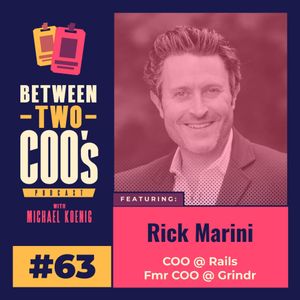
Rick Marini on Between Two COO's
Between Two COO's is hosted by Michael Koenig. Subscribe on Apple Podcasts, Spotify, or wherever you listen.
More on M&A

The COO's Execution Playbook
Frameworks, templates, and hard-won lessons from operators who've been in the chair. Every Tuesday.
No spam. Unsubscribe anytime.