Rick Marini on the Day-One Speech That Turned Grindr Around
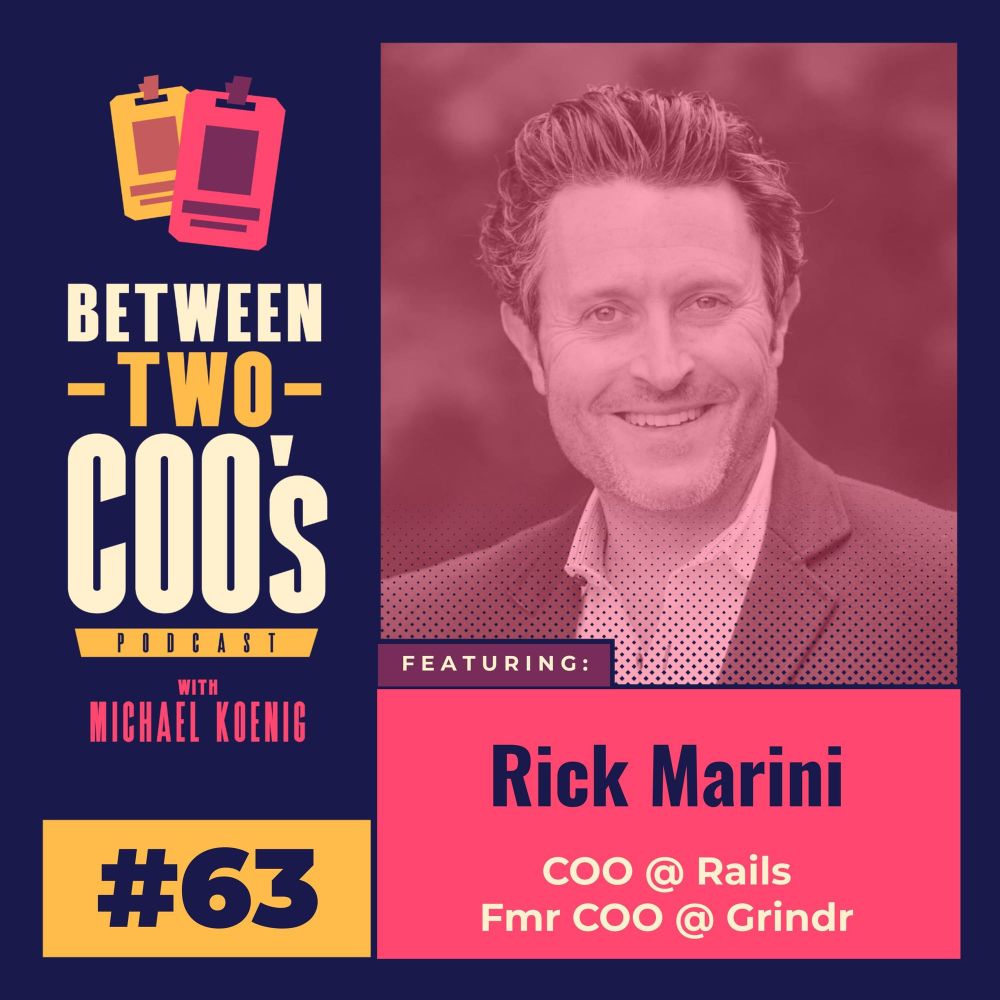
Most executives spend their careers chasing the CEO title. Rick Marini went the other way. After co-founding Tickle and running BranchOut as founder and CEO, he took the COO seat at Grindr, walked into a company where five people held all the equity and the Glassdoor rating sat at 18 percent, and helped lead it from a forced sale to a $2 billion debut on the New York Stock Exchange two and a half years later.
He and Michael Koenig get into how he knew the COO seat was his, what a great chief operating officer actually does, the day-one speech that reset Grindr's culture, and the fight-or-flight pivot that saved Tickle in the dot-com crash.
Topics Covered
- Good CEO, great COO (0:00)
- Introducing Rick Marini (0:27)
- Where do I add the most value? (1:30)
- The realization and what got better (3:26)
- The $600 million Grindr acquisition (8:35)
- Day one: earning a broken team's trust (10:57)
- The $2 billion IPO callback (12:45)
- CFIUS, TikTok, and forced sales (15:25)
- Tickle and three months of cash (17:55)
- Fight or flight: the IQ test (21:28)
- What repeats: team, TAM, differentiation (24:17)
- Moats in the AI era (26:40)
- Grizzled vets vs rookie founders (29:57)
- Crypto, Rails, and perps (31:34)
- Waymos, AI, and what's next (34:13)
About Rick Marini
Rick Marini has spent 26 years founding and operating consumer technology companies. He co-founded Tickle in 1999 with James Currier, growing it from three months of cash at the bottom of the dot-com crash into the fastest-growing site on the internet, and later founded BranchOut, a professional network that reached 800 million profiles and raised $49 million.
In 2020 he joined Jeff Bonforte and Gary Hsueh to acquire Grindr after CFIUS forced its Chinese owner to sell. As COO he ran seven departments and helped lead the company from an 18 percent Glassdoor rating to a $2 billion debut on the New York Stock Exchange two and a half years later.
Marini has been an angel investor in 60 companies, 15 of them unicorns, started Protocol Ventures, the first crypto fund of funds, in 2017, and is now co-founder and COO of Rails, a crypto perpetuals exchange.
Frequently Asked Questions
What is the difference between a CEO and a COO, according to Rick Marini?
Rick Marini, former COO of Grindr, frames the difference as vision horizon versus execution. Great CEOs like the ones he partnered with see ten years out, while he sees two, and the COO's job is to execute against that longer vision. He describes the COO as multi-talented, execution-focused, and responsible for a wide span of functions, with some vision but far more responsibility for delivery.
Why does Rick Marini say he is a good CEO but a great COO?
After running BranchOut as founder and CEO, Marini landed what he calls a good exit but not a great one. Working beside James Currier at Tickle and Jeff Bonforte at Grindr showed him what great CEO vision looks like, and he realized his brain and skill set are built for execution. He argues you have to be honest about where your best fit in the company is and where you add the most value.
What does a chief operating officer actually do, according to Rick Marini?
In Marini's telling, a COO puts out fires, addresses issues, and buffers the CEO from noise the CEO does not need. At Grindr he ran seven departments, more than anyone else in the organization, drawing on earlier experience across finance, marketing, and HR. He says the role requires working extremely well with the CEO and executing on the company's vision.
Why was Grindr forced to sell to new owners?
CFIUS, the Committee on Foreign Investment in the United States, forced Grindr's Chinese owner to sell over concerns about sensitive user data. Marini notes the data could be used for blackmail, and because the app is GPS-enabled it could even expose troop movements. Many typical blue-chip buyers stayed out of the process because it was a gay dating site, which gave his group the opening.
How did Rick Marini and his partners reset Grindr's culture?
On day one, Marini, CEO Jeff Bonforte, and CFO Gary Hsueh told employees the closed, fear-driven culture was over: everyone would get equity, leadership would be transparent, and as three straight guys running the biggest gay dating app on the planet they would rely on employees at every level to teach them the community. Marini says the previous ownership held information so tightly that only five people had equity and the Glassdoor rating sat around 18 percent.
What happened when Grindr went public?
Two and a half years after the acquisition, Grindr listed on the New York Stock Exchange at a $2 billion valuation. Marini's head of marketing found him on the NYSE floor and told him every promise from day one had been kept, with employees standing there as shareholders. The stock briefly touched $70, and Marini told employees not to do the calculation because it would come back down, which it did.
How did Tickle survive the dot-com crash?
Tickle was an advertising-based business down to three months of cash when its lawyer advised winding the company down. Marini and co-founder James Currier chose to fight and launched a PhD-validated IQ test, the one test users would pay for. The revenue got recycled into marketing, and by the end of 2000 Tickle was the fastest-growing site on the internet and won a Webby Award.
How does Rick Marini decide when to keep fighting versus shut down?
He says you have to be realistic: sometimes founders and investors can see it is not going to happen and it is time to move on. At Tickle, he and Currier believed they were one degree off rather than wrong, with people taking the tests but ad revenue failing, so the fix was a subscription product to prove the thesis. The conviction was specific, not generic fighting spirit.
What does Rick Marini look for in startup teams?
Smart people with good judgment who work extremely hard, have high integrity, and bring real expertise. He hires experts, aligns on goals, gives them vision and tools, and refuses to micromanage. After the team he looks at whether the total addressable market is big enough and whether the founders can prove why they will be number one.
How does Rick Marini think about moats in the AI era?
He agrees AI makes it dramatically faster to stand up a company, so he looks for two markers: a network effect that grows more powerful as it scales, and a product people love enough to pull out a credit card for. He contrasts that with leaky-bucket CAC-to-LTV arbitrage. Grindr is his example: 85 percent unaided brand awareness, marketing spend that barely mattered, and about $200 million in revenue by the time he left.
What are crypto perps?
Perps, short for perpetuals, are derivatives similar to options: instead of buying the underlying asset, traders bet directionally on whether it will go up or down, often with leverage. Marini says perps have become the hottest part of the crypto trading ecosystem over the last year or two, while cautioning that neither crypto nor perps should be anyone's entire portfolio.
What is Rick Marini working on now?
Marini is co-founder of Rails, a crypto perpetuals exchange. He has been investing in crypto since 2014, after Naval Ravikant introduced him to Bitcoin, and started Protocol Ventures, the first crypto fund of funds, in 2017. He believes traditional finance is finally bridging into crypto and that disrupting massive markets simply takes time.
Mentioned in This Episode
Listen & Subscribe
Apple Podcasts · Spotify · YouTube · Amazon Music · RSS
About Between Two COO's
Between Two COO's is the execution intelligence podcast for operating leaders. Host Michael Koenig (betweentwocoos.com · b2coos.com) sits down with COOs, presidents, and founders to talk about what it actually takes to run a company. Michael is the founder of Helm.
Full Transcript
Show full transcript
Rick Marini: I think I'm a good CEO, but I know I'm a great COO. Everybody wants to be the CEO, right? I mean, that's the sexy job and exciting and you're the big dog. You have to really be honest with yourself and say, “Well, where's my best fit in the company? Where do I add the most value?” I landed the plane, but not to the degree that I hoped. I might see two years out, they're seeing 10 years out. That's when you can say, “Okay, I'm gonna be a great COO.”
Michael Koenig: Hello, and welcome to Between Two COOs. Today I'm joined by Rick Marini. Rick has been through a few different waves of tech. He started Tickle back in the dot-com era, nearly ran out of cash, then turned it into one of the biggest sites on the internet. He later founded BranchOut, one of the early professional networks, and then more recently he helped acquire and scale Grindr, where he came in, reset the company, and helped take it public. He's also been an active investor along the way. But the reason I wanted to have him on is something he said when we first spoke. He said, “I think I'm a good CEO, but I know I'm a great COO.” And that's not something you hear very often. So what I wanna get into today is that idea, how you figure out where you actually create the most value, what a great COO really does, and how those CEO-COO partnerships actually work when they work. Rick, welcome to the show.
Rick Marini: Thanks, Michael. Great to be here.
Michael Koenig: So let's talk about that. You said something when we first talked. You said you're a good COO, but a great COO, and most people don't say that out loud. Why?
Rick Marini: When you say it that way, it didn't sound as humble as I meant it. All I meant to say is...
Michael Koenig: It was humble.
Rick Marini: Well, you know, I've been blessed to have different roles in my career over the past 26 years of running companies, right? I started my career as a co-founder and CFO, and I was a CMO. At BranchOut I was a founder and CEO. And at Grindr I was COO. So I've had the experience and gained some perspective, and hopefully with age, some maturity. 'Cause I think everybody wants to be the CEO, right? I mean, that's the sexy job and exciting and you're the big dog. But I think you have to really be honest with yourself and say, “Well, where's my best fit in the company? Where do I add the most value?” And also when you get to work with the people that I've been able to work alongside, two of my best friends, James Currier, when we co-founded Tickle, and Jeff Bonforte when we ran Grindr. Sometimes when you see what a great CEO looks like, you realize, whew, they're seeing things that I didn't. Right? I might see two years out, they're seeing 10 years out, in terms of their vision. And then I think it's humbling a bit, but you can say, “Okay, well, where can I be complementary to that incredible CEO?” And for me, the way that I'm kind of built, my brain and my skill set really is on the execution side. So it's great to partner with people that you love and you trust, and again, those two of my best friends who have the vision and the ability to be great CEOs, and realize I can be complementary in my skill set in terms of execution as, I hope, a great COO.
Michael Koenig: Well, I wanna reassure you, when we talked before, it came off, you're a very humble guy. I can attest to this. Listeners, Rick is a humble guy. But it's a very insightful moment, and I'm wondering, when did that click for you? Was there a specific moment where you realized that, or was it just more gradual?
Rick Marini: Well, when James and I co-founded Tickle back in 1999, so this is early days, Web 1.0, I had never been an entrepreneur before. I had really come from investment banking before going to business school. So I didn't really know that world, and becoming an entrepreneur, right? So I learned a lot in that process. And then with BranchOut, I felt like, okay, I am ready. I'm ready to be CEO. And listen, BranchOut had 800 million profiles. We raised $49 million, so I did a lot of the things that CEOs do. You can raise a lot of money, you can get a lot of users, you can attract and retain a great team, and I did all of that, and I felt pretty good. We didn't have the exit. We had a good exit, but not a great exit. And I think that was one, you know, hey, I landed the plane, but not to the degree that I hoped on that one. And then, in meeting and working with Jeff, I got to see his vision and his thinking. And when we were in a position to buy Grindr, it was pretty clear that, yeah, I've done the CEO thing, but I think you're gonna be better at this. And I know when I was kinda number two to James at Tickle that I did a great job there, and we were so complementary. So at that point it was like, you know what? I think you're the right guy for this, and I know I can be the right guy for this part. And then Jeff and I were just completely complementary in terms of our skill sets. And I think that's important also as you're starting a company. A lot of people will be coming out of business school or wherever, and it's just two engineers or two sales guys or two businesspeople. It's like, no, no, no, you want complementary skills, so one plus one equals three.
[Sponsor segment omitted.]
Michael Koenig: It's a tough complement to find, the yin and yang, and we're certainly gonna talk about that. I'm curious, staying on this topic though, once you had that realization, what actually got better? Once you leaned in?
Rick Marini: I think, you know, I'm someone who wants all the information, especially the negative, right? Because in my role as a COO, a lot of it is putting out fires and addressing issues, and sometimes buffering the CEO, who doesn't really need to know all of that, right? So I'm someone who wants all the information, and all the information might be, again, that realization of, okay, I'm best in this lane. So I think when you realize that, and you realize where am I going to be most valuable and where am I going to be able to progress in my career the fastest and really the farthest, that's when you can say, “Okay, I'm gonna be a great COO.” And then it's a matter of having all the pieces, and there's a lot of pieces, and we can get into that, about what I think being a great COO takes. But, you know, also I knew that I had started my career in finance. I had run marketing, I had run HR, I had run a lot of other functions as well, and I knew that I had that experience. So when we were acquiring Grindr, I ended up having seven departments under me. So I had more departments than any other person in the org. But I had experience in all of those, right? And I also knew, by the way, I'm not a software engineer. There's no way that I should be clearly head of... I'm not the CTO. And you kinda know where your strengths are and where they're not, which is important, too. But I think, yeah, having the perspective of, what have I done? What have I covered? And now what do I feel good about being able to do, let's say, at Grindr, with seven different groups. I think a COO is multi-talented, execution-focused, works really well with the CEO, definitely has some vision, but really it's more about having a lot of responsibility to execute on the vision.
Michael Koenig: Inherent in what you've just said, though, and getting back to ego, to have that realization is a low ego moment. It's understanding what you're good at. You've had experience in so many different realms of running a business, I think is very common with the COO, and it's one of the things that makes you great. It's also understanding, at least in my case, I'm pretty bad at those other things if I just do them. And I know enough where I can hopefully provide some good leadership. Well, let's talk about the Grindr acquisition. We're getting into this a little bit before I wanted to. You've had so many hits in your career, like unbelievable hits, a lot of turnarounds. And we'll talk about Tickle, but the Grindr one is particularly interesting because that was a massive win. Take me through it. When you approached sort of this situation, how do you then go in, you've spent $600 million acquiring a company, and how do you go in? What do you do next?
Rick Marini: Well, Grindr was an incredible experience for us. It was about a three-year journey, and so many incredible learnings to share on that. So if we step back, by the time we got there, Grindr had been founded about 13 years prior by a guy named Joel Simkhai. He sold it to a Chinese company, and this background's important to answer the question. And the Chinese company, they really ran it like a black box. There was only five people that had equity. Nobody knew the numbers. Nobody knew what was going on. All the information was so closely held. And I think the Glassdoor rating was something like 18%, and the app rating was also around like 1.8 or 1.9, which, by the way, one is basically a zero. So we're like: Wait, how does this iconic brand with about 100 million of revenue and 45 million of EBITDA, so super healthy business, how can they be doing this bad on the app rating and the management team? And as we dug in, we realized the Chinese ownership, they didn't care about the community, they didn't care about the tech, they didn't care about the product. They just bought it, and they doubled prices, and they made a bunch of money in the couple years that they owned it. CFIUS, the Committee on Foreign Investment in the US, forced a sale because they were worried that the Chinese were getting all of that data, and that could be used in negative ways. So when we finally got the deal, and it was a long process through CFIUS, when we finally got the deal and we said, okay, Jeff's gonna be CEO, I'm COO, and our other partner, Gary Hsueh, is CFO, we went in there, three straight guys who are now running the biggest gay dating site on the planet, hands down. No one is even close. So I remember that meeting still on day one. We had to come into a meeting with a super negative culture, and many of the employees are part of the community, the gay community. And we come in, and they don't know us, and we came in, to go back to the beginning, very humble. We came in and we said, “We understand, or we think we understand, what the culture is today, and we care about culture, and that is not gonna be the culture going forward. We are going to be transparent. Everyone is gonna get equity, and we know that we're three straight guys. We know consumer subscriptions, but we know we don't know the gay dating community. We don't know the different norms. We don't know the nomenclature. We are going to rely on you at every level of this organization to help us. And we need to earn your trust.” And it was such a 180 from the situation they were in with the Chinese, which was basically a battered situation. They were just getting beat on. And I remember one of the employees telling me the CFO yelling at them about, “You're just lucky to have jobs.” And it was exactly the opposite of the way that we operate, right? We don't operate by fear. We want to be inclusive. We want people working towards a shared mission and goal. We have high yet attainable goals. We are gonna all work hard together, but we are gonna be all rowing in the same direction. So that day one meeting, to set the tone of, we understand that we're not from this community, but we're gonna rely on you, we're gonna earn your trust, you're all gonna get equity, that was really a time where the employees said, “Wow, this is gonna be totally different.” And let me fast-forward, because two and a half years later, we took the company public, spoiler alert, for $2 billion on the New York Stock Exchange. My head of marketing, who reported to me, came up to me on the NYSE floor and he said, “Remember on day one, two and a half years ago, you said everyone's gonna have equity and we're gonna be transparent and you're gonna earn our trust?” He said, “On day one, I didn't believe it. I didn't know you, but it was too good to be true.” And he said, “Every single thing you said on day one, as of today, you achieved it. We're all here as shareholders of this company going public.” And that is something that I think I'll remember forever. We went in with the right message. We executed on what we said. We did what we said, and then we were able to all enjoy that exit in the end together.
Michael Koenig: Inherent in the success in the story you just shared is a high degree of humbleness. When you think about it, you're coming in, yes, you know the subscription business, so you bring the business and operational aspect of it, but you're going into a sector, or specifically a product, that you wouldn't necessarily use yourself. And so to have the success that you did, you have to rely on the team, and I think that is a testament to leadership as well. It's a phenomenal story. It's also the short timeline from acquisition to IPO at, what? It jumped from like $15 opening price to like 70 bucks at end of day trading. This is insane. That's crazy. You obviously priced too low.
Rick Marini: Well, it came down from 70. It did touch 70, and I was telling everyone, “Do not do the calculation. Don't go buy a car or a boat or a house or whatever you're thinking. It's gonna come back down.” And it did. But no, listen, it was an incredible outcome for everyone, for the employees, the investors, the management team, and the community. I mean, the New York Stock Exchange, I'll give them credit, they had rainbows everywhere on the New York Stock Exchange that day. They really embraced Grindr and the community that day. It was a wonderful day, and we're really proud of the work that we did.
Michael Koenig: And now CFIUS you mentioned, for listeners that don't know that, I believe it's the Committee on Foreign Influence in the US.
Rick Marini: Foreign Investment in the US, yeah. Foreign Investment. That's it. It's a governmental organization that is kind of a watchdog to ensure that US IP or data doesn't get out of the country, isn't in the hands of foreign nationals that could use it for negative purposes. Grindr, as an example, there's a lot of data in there that might be used for blackmail, or because it's GPS-enabled, you could follow troop movements, because you might know there's a Grindr user in that troop and they've got Grindr on, and you could follow them. So the US government forced that sale, and I'll tell you, it's so funny. Because it's a gay dating site, a lot of the typical buyers, the blue chip buyers, were not in the process. There was always someone super conservative on the investment committee that was like, “We can't touch that one.” So we were very lucky that we were able to get in there, 'cause normally we don't get to play at that size.
Michael Koenig: And there's something in the Grindr story that feels very relevant right now. You were in a forced divestiture situation. You came in and you actually owned and operated the company. Compare that to something like TikTok, where you might get the distribution but not the algorithm. As an operator, how different are those two situations?
Rick Marini: Well, we always love when we have control. We also like to write our own code. We don't like to use outsourced... It's not always for security. It could also just be, if something breaks, you wanna be able to fix it. And with TikTok not having ownership, or maybe even access to be able to make any tweaks to that core algorithm, I would expect would be frustrating for that ownership and that management team. Now, TikTok's algorithm is pretty darn good, so they have built something that seems to work. But with Grindr, we definitely enjoyed a situation where we controlled the entire stack and we could make all the decisions relevant to the company.
Michael Koenig: I mentioned Tickle before. Let's chat about it. You mentioned being down to about three months of cash at Tickle, but the interesting thing, you raised your round the day before the dot-com bust, and in that stretch of those three months, what did you finally understand that you hadn't before? Because you turned it around.
Rick Marini: Well, let me give some context for your listeners on how we got there, so they'll understand, like, wow, that feeling must have been tough given the trajectory. So when we started Tickle, James and I were classmates at Harvard Business School. We took the Myers-Briggs test first year, and back then in 1998 or 1999 when we took it, it was pencil and paper. You send it, and then three months later you get your results, and you kind of forgot you took it. But at Harvard Business School, with lots of competitive people, all of a sudden everyone starts opening up. “Oh, I'm an INTJ, you're an ENTF,” and we start to realize, ooh, there's something here. This is really connecting people. And then James, the visionary, James Currier said, “Hey, with this internet thing,” you know, this is 1998, it's still early days, “we could make this fun and immediate results and viral,” and all the things that the internet could allow, that you could take a test like the Myers-Briggs. So that was the original spark. So we raised a little bit of seed money from some HBS professors and some others in Boston, just to be able to get a team of, like, six people, and we start building these tests, including some PhDs. We kind of redo our version of the Myers-Briggs. We do anxiety tests and depression tests and all these serious tests. Turns out those are not viral. Nobody wants to hear how depressed you are, and it's probably not something you wanna share with the world, maybe with your spouse or your best friend or siblings or whatever. So we had the good idea, but we were down the wrong track. So these are the tough days of Tickle. That first six months was tough. And then we were like, okay, we've got to reset this. Let's make it fun. Let's make it viral. So we asked our PhDs on staff, “Can you create a test that is, what breed of dog are you?” And they're like, “Really? I'm a PhD from Duke. You want me to...” And I was like, “Yes.” So they said, “Okay, based on these personality characteristics, you would be a German Shepherd or a Collie or whatever it is.” And that test took off. And that was in January of 2000. We went from no traffic at all to explosive traffic. Now all of a sudden, VCs are finally picking up our call. But we talked to 30 VCs and got nos from everyone, because they were just like, “I don't really understand these tests. I don't know why they would ever get big.” Finally, Andrew Anker and David Hornik from August Capital said, “We get it. We get this. We understand,” 'cause they were media guys. “We understand how this can get big.” And they invested in us. So we raised a total of about $9 million, and we're like, okay, we're going to Silicon Valley. We're in this crappy office in Cambridge, Mass. When the snow melted, it actually flooded, literally, and the servers we had up on bricks. It was tough. Anyway, so we come out to Silicon Valley. We have $9 million. Two guys from small-town New Hampshire. This is like, we made it. And we get a nice office in a crappy area. And we hired, like, 30 people, and we're like, we did it. We're going. Here we go. And then the dot-com crash. It's clear this is not a blip, this is a crash. And then all the advertising dollars just kind of went away. Nobody was advertising on the internet, and we were an advertising-based business. So all we see is a cash balance depleting, depleting, depleting every month, with very little revenue trickling in. So we got to a point of having three months of cash. Our lawyer said to us, “Hey, I think you gotta think about winding this company down, paying some severance and any outstanding accounts payable.” And that was the moment. It is fight or flight. Are you going to be pragmatic and say, “Yeah, you're probably right. We didn't make it. Go back to New Hampshire”? James and I looked at each other and we said, “We're fighters. We are gonna fight until that last moment.” And in that three months, we found a new test, the IQ test. And what's different about the IQ test is, any of those other tests that I mentioned, you could ask a friend, “Hey, am I depressed?” Or, “Hey, who's my celebrity match?” Or whatever the fun ones. But the IQ test needs to be validated by a third party. Again, we had PhDs on staff, so they created a PhD-validated IQ test, and that was the one test that we actually charged money for. And it just took off. Took off. Then I could take all that revenue coming in, recycle it back into marketing in a product that's working. And because of that, we went from three months of cash the beginning of 2000 to the end of 2000 being the fastest-growing site on the internet and winning the Webby Award. And it was really that one test. When your back is against a wall, fight or flight, and we chose to fight, and we got lucky that we got it right.
Michael Koenig: It's crazy because literally the world is crumbling that you're in, right? Silicon Valley, dot-com. I think to New York 2000, you know, 2008, right? And here you are coming out of this quite strong. How do you know when to keep fighting versus when to shut it down?
Rick Marini: Yeah. And listen, I think you have to be realistic on that. So there are plenty of companies... Listen, I've been an angel investor in 60 companies. I've been fortunate to have 15 unicorns of that 60, but I've had zeros along the way, of course. And there are times when the entrepreneur, maybe the investors, see this just isn't gonna happen. It's not working, and sometimes it's just time to move on. And for James and I, we knew we had something. We really believed that. And we felt like we were just kind of one away, like we're so close, like we're kind of one degree off here. And so for us, again, being realistic, it wasn't just, okay, are we fighters or are we gonna bail? It was like, we know that this is going to work. We know people are taking our test. We're just not generating a lot of ad revenue. Can we find a subscription product with one test that we can prove this out? And so we had the right thesis, and fortunately we found the right test.
Michael Koenig: That's phenomenal. Well, you've been through multiple cycles now, different companies, different markets, different roles. What actually repeats?
Rick Marini: I think what I've seen repeats is, both as an investor and an operator, it starts with the people. It always starts with the people, right? Having a great team. A great team can pivot, and there's a million stories in Silicon Valley about teams that have either done kind of micro pivots or complete pivots. So it always starts with a great team. What I look for in a team is, I want smart people with good judgment that are willing to work super hard, that have high integrity and expertise in their areas. Because I like to hire experts and just say, “Hey, I'm not gonna micromanage you. We're gonna be aligned on goals, and provide the right vision and the right tools to get there, and then you gotta run fast, and let's do this together.” So it starts with a team. The next is the TAM. Is the total addressable market big enough for this idea? Because a lot of companies are really interesting, but they become lifestyle companies, right? So as an investor, you're trying to think about, is the TAM big enough that there's a real business here. And then what's your differentiator? Why are you gonna win? In Silicon Valley, we say ideas are easy, execution's hard. But I'll talk to a company, or I'd have to do this for myself if I'm starting, and they're like, “We've got this unique idea. We're gonna do this.” And I'm like, “That's great, but what if there's five other companies in Silicon Valley already with that same idea, working on this idea in a garage somewhere, that you don't know about?” And they're like, “Wait, are there?” I'm like, you shouldn't be afraid if there are. You should know, yeah, I don't care if there are, because I know how to win, and here's my special sauce. Here's my moat. Here's why I'm going to be the one. Because often, when you're an angel investor, and again, if you're an operator, you gotta think the same way. If you're disrupting a market, 80% of the value may accrue to number one, 15% to number two, and then the long tail shares the rest. So if you're not gonna be number one, unless it's a massive TAM like Uber and Lyft. Uber was the big one; Lyft, the TAM was big enough that there was still a business there for number two. But you've gotta really believe and prove that you are the number one, and if there are five other companies, I don't care. I'm number one, and here's why I am going to win. And investors want that, but you can't just say it. You gotta be able to prove it.
Michael Koenig: You talked about moats. It's hard to look at software these days and go, what is an actual moat? Because with Claude Code, I can stand up a new business tomorrow. Granted, I still think it's very hard to run a business, but in terms of moats now, how do you think about this?
Rick Marini: I mean, there's different ways to create a moat. But I agree. AI is clearly changing things, and the ability to stand up a website in a weekend is very different than it was even five years ago. So I think that AI is enabling people to go much faster, for sure, but it doesn't mean that sloppy code is going to end up being a big company someday. So I think you still have to have the vision of, where is that greenfield? What can I do with AI tools? Or just, what am I going after? So I think you're always gonna have to have the vision. In terms of moats, if you're starting early... 'cause established companies can have a moat around maybe their brand. Everybody knows Budweiser or Coke or Ford or whatever. You have to continue to earn that moat, but maybe there's reputational moats. But I think coming in as a new entrant to a space, one of the things that you wanna do is try to build up a network effect, right? The larger the network, the more powerful it becomes. If you have the ability to do that and attract a lot of people to your service, and build a service that people love so much that they're willing to pull out a credit card and say, “I love this. I can't live without it. I need to pay you something for it.” I think if you can do those two things, you probably have a sustainable business. Those are the two kind of markers to me. Are you attracting people, and not just, oh, it's a CAC LTV game and a leaky bucket, and we get a bunch of people, but we leak 90% of it out. That arbitrage game is tough. Businesses can be built that way, but I'm more interested in companies... Grindr's a great example. I had marketing under me. We couldn't make marketing work. It was 85% unaided brand awareness. It is their community, for the gay community in particular. They want to be there. This is where they want to be and to interact, whether you're there for dating or just friendship or finding someone to hang out with. You're in a new city and you wanna understand, where do I go? Where do I hang out? So many great network effects there. And by the time we left, we were generating 200 million of revenue. So people clearly will pay for it, because you're adding value. So those are the two things. If you can attract people because they love it, and not because you paid them to be there, and they'll pull out a credit card 'cause they love it, then you've got a real business.
Michael Koenig: And now, because it's so easy to stand up a website and a company, execution and the operators, the people that you're backing, becomes all the more important, because ideas will shift overnight. And so what do you look for in those people that you look at and back, aside from saying, “Hey, we're gonna be number one”? You can say that and have wishful thinking versus be realistic.
Rick Marini: Well, it's interesting, because I'll put my investor hat on. I can meet an entrepreneur that's been there, done that three times, and that's definitely interesting, to be like, okay, you have a lot of industry knowledge here. You have a big network of people that you could bring in as either employees, advisors, board members, and that's super interesting. Also, it can be interesting, like a Mark Zuckerberg who has never done it before. He's in college, and he has a different perspective than many of us in Silicon Valley may have, right? Because we've done it, but we kinda know the way that we did it, and that may not always be the right way to do it today. So it can go either way in terms of the grizzled vet versus the rookie who doesn't know any better, and may make some mistakes along the way, but may see things that we didn't. 'Cause, you know, go with Zuck. He's in college. I wasn't in college when he started Facebook, right? I don't know what college kids are doing at that point. So it can go either way on that. But at the end of the day, I think you wanna back, I'll go back to, smart people with good judgment that have some kind of insight into a big TAM that you believe they can execute against. And that execution is everything from vision to attracting and retaining the right team, being able to raise money. There's a lot of things that a CEO or a senior team has to be able to do, whether you're investing in them or whether you're the team that's actually operating the business.
Michael Koenig: Well, let's talk about where you're putting your energy right now. You've shifted gears quite significantly into crypto. What excites you about it? Maybe first give me the rundown of what you're working on, and I wanna hear all about the things that have attracted you to that.
Rick Marini: Well, I've been in crypto actually for 12 years. So I started investing in crypto in 2014. A friend of mine, Naval Ravikant, got me into crypto early days, told me about Bitcoin, and it took me a little bit to get it. He had got there quicker than me. But that was my first kind of entrance in terms of the timeline. Then I started the first fund of funds in crypto in 2017, called Protocol Ventures, and now I'm the co-founder of a crypto perps exchange called Rails. So I've been fascinated by crypto for over a decade. I think the store and transfer of digital value is an incredible thing, for lots of reasons. And it's still fairly early days. I think TradFi is starting to bridge into crypto, finally. But it has taken some time. But anytime you're disrupting massive, massive markets, it can take time. So, yeah, I think crypto is very exciting. And crypto perps has taken off to be a really important and hot area within crypto.
Michael Koenig: Yeah, real quick, quick rundown of crypto perps?
Rick Marini: Oh, what is it? Okay. So perps are perpetuals. I should have said crypto perpetuals. Perpetuals are basically, it's a derivative, so it's almost like option trading. You're not buying the underlying asset. That would be considered spot trading. Crypto perps is really, you are betting directionally: is this going to go up or down? Kinda like option trading, like a lot of people are familiar with option trading with public equities. So perps are that. Do I think Bitcoin, or whatever asset, is gonna go up or down? And then you're making a bet, and you're often using leverage in crypto to be able to really double down, triple down on your bet.
Michael Koenig: Yeah, I'm not an options trader.
Rick Marini: Listen, it's definitely not for everyone, clearly. It's a portion of your portfolio. I would tell anyone, including myself, crypto should not be all of it. Crypto perps should not be all of it. But I will say, in crypto trading, crypto perps has become, over the last year or two, the hottest part of the crypto trading ecosystem.
Michael Koenig: Yeah, it's been really interesting to follow. Well, Rick, I gotta ask, it's my favorite question. We've all been in the seats now where we've had crazy stories, where we see something new and we're like, I really never thought I'd see that. Do you have one you can share?
Rick Marini: Well, because I live in Silicon Valley, I get to see things before a lot of others, right? So as an example, a couple years ago with Waymos, autonomous driving. The first time you get into a Waymo and there is no driver in the front. And I know they're expanding, but we've had them here for a few years, and we use them all the time. When you get in the back seat and there is no driver there, there is no safety driver, there is no one in there, and you've already said in the app, I'm going to this address, and you get in, and it flawlessly gets you there. It is amazing now. And it's just magic. And now my wife and I take them all the time, and actually my wife prefers them over Uber and Lyft, because you don't have to deal with a driver and any kind of safety issues, or maybe whatever issues, playing the radio too loud. It is such a nice experience. And we all knew someday this is gonna happen. But to have that as a normal part of our life, and using Waymos all the time, and you see them in San Francisco all the time, 'cause the reason is they're always driving. Unlike us, we go to our destination and we're there and we're done. They're always on the road, so in San Francisco you just see them constantly. It's like every other car is a Waymo. So it's just become such a normal thing. That, to me, has been such a cool thing over the last couple years, to be just normal in our lives, to have a car without a driver take us places. So that's number one. Number two is what's on everyone's mind right now, the impact of AI. Not just being able to stand up a website in a weekend, but all the ramifications of where this takes us. And these are things that we talk about in Silicon Valley constantly. Most dinner conversations right now will end up including that topic. And we don't know yet. But the impact of AI will probably be similar to, even greater than, the internet in the late '90s, mobile after that. And everyone, their phone is such an important part of their life, and access to data and information around the world. And I think AI is gonna have a different but similarly impactful impact on our life, and we just don't know where that's all gonna go. We didn't know where the internet was gonna go, and overall it turned out to be an amazing, amazing thing. And I think AI will be, as long as we have the right guardrails and we do the right things to manage this.
Michael Koenig: Yeah, it's incredible. I have torn down my entire personal tech stack of 20 years, and I have rebuilt it all on markdown files, and now AI is running my life in ways I never thought possible. It's insane. Well, Rick, this was great. I appreciate you coming on. Where can people go to keep up with you these days?
Rick Marini: You can find me at Twitter, @rmarini. That's probably... LinkedIn, easy to find. Yeah, so I'm out there. And Michael, this has been a pleasure. Thank you for the insightful questions and taking an interest in what I've done. I hope there were some tidbits in there for your audience to learn from, but I really appreciate talking to you today.
Michael Koenig: Yeah. A bit of a masterclass. This was absolutely phenomenal. Well, thank you, Rick, and thank you to you all for listening to Between Two COOs. Tune in next time, and until then, so long.
More on Leadership

The COO's Execution Playbook
Frameworks, templates, and hard-won lessons from operators who've been in the chair. Every Tuesday.
No spam. Unsubscribe anytime.