The AI Bubble Has a Due Date. It's 2029 | Paul Kedrosky, SK Ventures
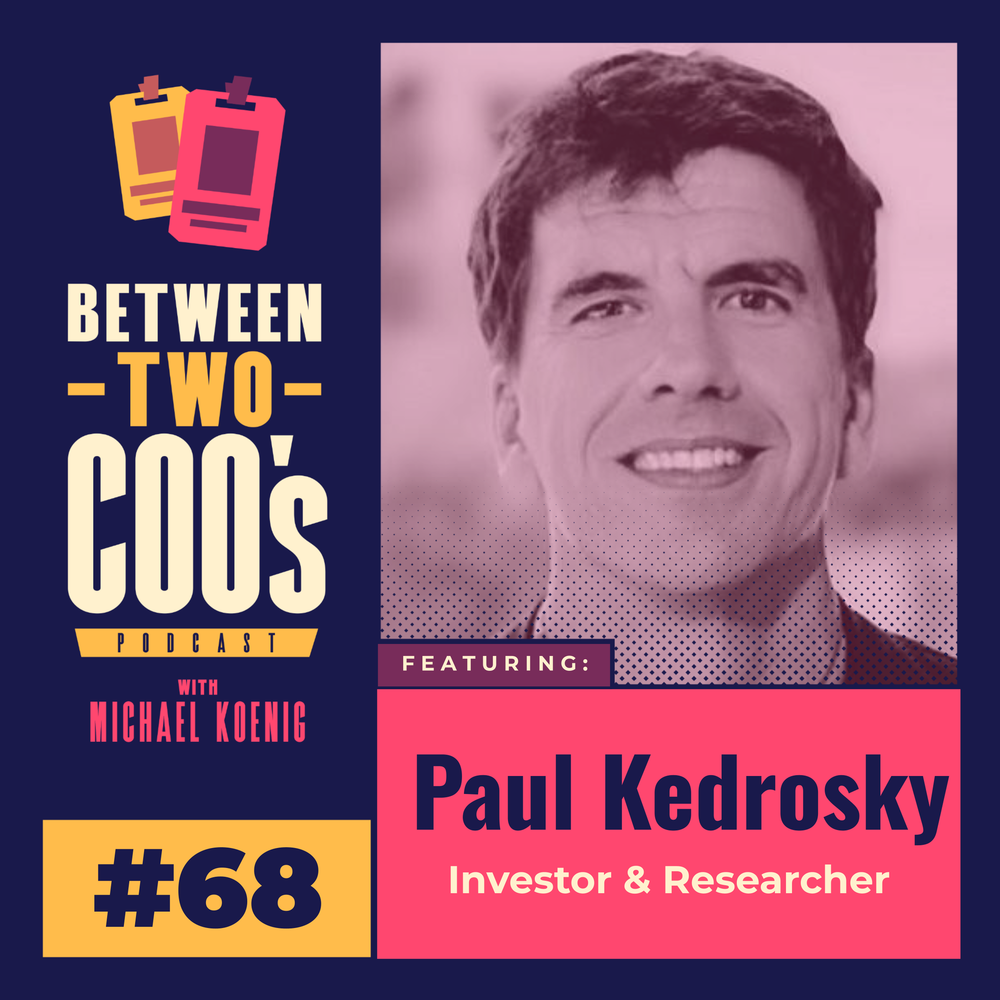
Depending on the quarter, somewhere between 30 and 70 percent of US GDP growth is coming from one thing: spending on AI data centers. Paul Kedrosky noticed it about 18 months ago, when the underlying economic data looked weak and the headline number did not. People told him he was wrong. He kept pulling the thread.
Kedrosky is managing partner at SK Ventures, a fellow at MIT’s Initiative on the Digital Economy, and a former Wall Street equity analyst who thinks in systems. In this conversation he lays out the money map. A year ago the hyperscalers were paying for the buildout out of their own cash flow. In the last two quarters more than 60 percent has come from outside: debt, private placements, and special purpose vehicles. That debt has a maturity date, and a lot of it lands around 2029.
None of this makes AI a fad. He calls it probably the most consequential technology of his lifetime. The question he cares about is a separate one: what happens when fixed debt obligations are tied to a commodity whose price falls 60 to 80 percent a year. The last third of the episode is for operators. What you give away when you use these models, which vendors may not be around in four years, and why the way developers use AI says little about how the rest of your company will.
Topics Covered
- Cold open: the AI bubble comes due in 2029 (0:00)
- AI capex is driving US GDP growth (1:14)
- Canals, railroads, fiber: the historical pattern (3:07)
- The 1920s parallel and the index fund bet (4:44)
- AI debt is crowding out other borrowers (5:21)
- Does this end in a recession? (6:32)
- The money map: cash flow to external financing (8:00)
- The 2029 maturity wall (11:00)
- Tokens: the first hyper-deflationary commodity (13:19)
- Why coders are unrepresentative early adopters (15:48)
- Anthropic, Meta, and customer concentration (17:51)
- Circular financing (20:34)
- Why token prices keep falling (22:13)
- Is demand for intelligence insatiable? (24:33)
- The slop economy and the productivity question (26:30)
- Is anyone safe building on top of the models? (29:24)
- Open weight models and what quant funds do (31:54)
- Three ways this hits your company (33:52)
- Doing 2008 again, at a larger scale (37:28)
- Where to find Paul Kedrosky (38:46)
AI money map
Michael mentions this map in the episode. It shows how money moves through the AI buildout: what customers pay, who finances whom, and the obligations that connect them. Solid lines are operating payments. Dashed lines are financing or support. Click the image to open it full size.

About Paul Kedrosky
Paul Kedrosky is co-founder and managing partner of SK Ventures, an early-stage venture firm, and a fellow at MIT’s Initiative on the Digital Economy, where his research focuses on AI and the future of work. He consults with major asset managers and is a regular on-air contributor at CNBC and Bloomberg. His writing has appeared in The New York Times and The Wall Street Journal, and he publishes a newsletter at paulkedrosky.com.
Before venture capital he worked as an engineer, in sales, and as a sell-side technology equity analyst on Wall Street. He holds a PhD, with research on risk, adoption, and path dependence in finance and technology. He approaches markets as systems, the same lens he brought to the global financial crisis, and he co-hosts a weekly show with former Twitter CEO Dick Costolo.
Frequently Asked Questions
Is the AI bubble going to burst?
Paul Kedrosky of SK Ventures says there has never been an episode of spending on this scale that has not ended in a major recession, if not a depression. He is careful to say that this is not a claim that AI is useless. He calls it probably the most consequential technology of his lifetime. His point is that an allocation this large always ends in massive over-allocation, and the debt now spreading to insurers and sovereigns is the usual precursor.
How much of US GDP growth is coming from AI capex?
Kedrosky says that depending on the quarter, anywhere from 30 to 70 percent of US GDP growth has been driven by AI capital spending. He noticed it about 18 months ago, when much of the underlying data looked weak while the economy looked strong. He compares it to the canals, the railroads, rural electrification, World War II rearmament, and the fiber optic buildout, each a single category of investment that came to drive growth.
Who is paying for the AI data center buildout?
A year ago, Kedrosky says, more than 80 percent of the spending came from the hyperscalers’ own free cash flow. In the last two quarters more than 60 percent has come from external financing, which means special purpose vehicles, investment grade and non-investment grade debt, and private placements. Outside investors want a specific yield for a specific duration, so the buildout now carries fixed obligations that do not shrink when token prices fall.
What is the 2029 maturity wall?
Kedrosky describes an explosion of debt issuance over the last 18 months, much of it in new financing structures on roughly five-year terms. That puts a large refinancing wave around 2029 and 2030. Asked whether it will all get refinanced, his answer is no, and what does get refinanced will be on prohibitive terms. He compares it to the mortgages written around 2006 that all reset at about the same time.
Why does Paul Kedrosky call AI tokens a hyper-deflationary commodity?
He thinks of data centers as token factories and of tokens as the first major new industrial commodity in 50 years. Unlike copper or iron, their price only goes one way. On a quality-adjusted basis he says token prices are falling 60 to 80 percent a year. At a 70 percent decline a model company needs roughly 500 percent unit growth just to stand still, and something over 1,000 percent a year for a decade to justify current valuations.
Why are software developers a misleading signal for AI demand?
Kedrosky says the early heavy users of tokens are largely coders, and coding is expansive: a small prompt turns into thousands of lines of code that get refactored again and again. Most white-collar use is compressive, like summarizing a morning’s email or adjusting a slide deck. Extrapolating from developers to everyone else overstates how much the rest of the economy will consume.
What is circular financing in AI?
Chip makers, cloud providers, and AI labs invest in one another and buy from one another. Michael Koenig asks how anyone can judge real demand when the money goes in a circle, and Kedrosky’s answer is that you cannot. He calls it the most interlocking circular financing he has ever seen, more so than mortgage-backed securities, because one company can be customer, supplier, investor, and provider of credit at the same time.
Why do AI token prices keep falling?
Competition is only part of it. Kedrosky says the technology went from the lab to a billion users faster than anything before it, so efficiency gains are lying everywhere. He cites an NVIDIA compiler engineer who said nobody cares about a gain unless it is 25 percent, along with better caching and mixture of experts models. In his words, competition is the icing, and the structural gains are baked in the cake.
Is demand for AI really insatiable?
Kedrosky says you can claim insatiable demand for anything that keeps getting cheaper, and that does not make the returns worth it. Much of today’s coding demand is a one-time refit of old code. He points to National Bureau of Economic Research work showing an explosion in new apps while usage, measured by reviews, declines. He calls it the slop economy: vast amounts of everything, and for the most part nobody cares.
Is it safe to build a product on top of OpenAI or Anthropic?
Kedrosky’s answer is that no one is safe, and it will get less safe. Using a model tells the frontier company what works, and those companies are under pressure to move up the stack into higher margin businesses, especially as they go public. He compares it to the early days of Windows, when Microsoft absorbed whole product categories into the operating system, but more systemic because AI is a general purpose technology.
Do open weight models protect your data?
Somewhat. Kedrosky notes that a hosted open weight model still generates metadata about what you are doing. His advice is to watch the companies that care most about information leaking, the quantitative hedge funds. He points to the job listings at Hudson River Trading and Jane Street as evidence they are rebuilding frontier model capability in-house so that nothing escapes.
How should a COO manage AI vendor risk?
Kedrosky gives three points. First, de-identification does not work well, so assume you are, as he puts it, dancing naked in public when you work with these models. Second, watch who your partners are. He names CoreWeave as his favorite example of a heavily indebted provider, and says long-term commitments to companies facing the maturity wall are a bad idea. Third, do not plan around how developers use AI, because they are not representative of everyone else.
Should operators be cautious while AI money is flowing freely?
Michael Koenig suggests a scarcity mindset, and Kedrosky agrees but says that telling people to be careful is too mild. The recent past is not representative of what is coming. His operator checklist is short: build a secure environment where the company can keep doing profitable work, choose good partners, and decide what to do about technology leaking.
Mentioned in This Episode
- Paul Kedrosky
- MIT Initiative on the Digital Economy
- National Bureau of Economic Research
- CoreWeave
- Hudson River Trading
- Jane Street
- Stratechery by Ben Thompson
Listen & Subscribe
Apple Podcasts · Spotify · YouTube · Amazon Music · RSS
About Between Two COO's
Hosted by Michael Koenig · betweentwocoos.com · b2coos.com
For more on OKRs and operational excellence, visit Helm.
Full Transcript
Show full transcript
Paul Kedrosky: Depending on the quarter, anywhere from 30% to 70% of US GDP growth was being driven by a single thing, and that single thing was AI CapEx, which is just historically so wildly unusual. More than 60% is coming from what's euphemistically called external financing. So external financing just means it's coming from anywhere but free cash flow, and that then of course metastasizes debt across the economy. It's now showing up in all the usual places like insurance companies, sovereigns, everywhere else. So in about 2029, we'll hit a maturity wall. There's never been an episode where we've had this spending on this scale where it hasn't ended in a major recession, if not a depression.
Michael Koenig: How could these decisions affect a company that is not in this data center AI lab?
Paul Kedrosky: At least three different ways.
Michael Koenig: Hello, and welcome to Between Two COOs. I'm your host, Michael Koenig, and if you're hiring, setting budgets, or choosing AI suppliers, listen closely. My guest is Paul Kedrosky of SK Ventures and MIT Fellow, advisor to major asset managers, a CNBC contributor, and co-host of The Dick & Paul Show, which I recently discovered, and it's awesome. I asked Paul here to help us understand the AI money map, whether this massive build-out can pay off, and what happens if it doesn't. And then for us, how operators need to be thinking about this. Paul Kedrosky, welcome.
Paul Kedrosky: Hey, thanks for having me.
Michael Koenig: Help me understand the scale and investment going into AI because you hear numbers like billions and trillions. And eventually those numbers really stop meaning anything. What's actually being built, uh, and h-how big is this compared with other major investments in the economy?
Paul Kedrosky: The reason I got sort of interested with this in general is I'm kind of a systems guy, so I like to think about, you know, broad systems in terms of, you know, complexity and risk and consequences and so on. It was the same way I approached the global financial crisis, the same way I approached this, it's the same I've approached other sort of financial episodes. And so one of the things that got me interested in this more than a year ago now, maybe 18 months ago, was noticing that the US GDP was behaving strangely. And one of my fundamental views about everything, and it goes to back to when I was in grad school and it goes forward, is one of the, the most important realizations is first to, to watch yourself and notice what you're noticing, right? So always this kind of meta noticing phenomenon is really important. It's not, it's not just like I see this, but I see this and it's so interesting that I'm actually find myself becoming obsessed with it. And so this meta noticing is really important. So I noticed that I was noticing something weird about the US economy, that a lot of the underlying data seemed weak, but yet the economy was doing really well. And so I got to thinking about, well, what's, what's structurally changed that's causing this? And so long story short, I realized that... And this is now like, you know, 18 months ago, and people thought I was full of shit when I started first started saying it, was that depending on the quarter, anywhere from 30% to 70% of US GDP growth was being driven by a single thing, and that single thing was AI CapEx, which is just historically so wildly unusual. As you would probably know, the US economy is big. And so when you have something as large as the US economy, which is measured in trillions, and the GDP growth, which it, it is, you know, in the order of, say, 2%, and 50% of that is a single category, that's worth sitting up and taking notice because historically that's been wild unusu- wildly unusual. We can go back historically. There's a pattern of these kinds of moments, these paroxysms in terms of what the economists call in many sylla- many syllables, non-residential fixed investment. So, um, this non-residential fixed investment approaching these kinds of levels happened back with the canals, happened in the 18th, 19th century, happened with the railroads, happened with rural electrification in the '20s, um, happened with World War II rearmament, as it turns out, of course, in the 1930s, um, uh, happened again with the fiber optic bubble. To a lesser degree in a public sector driven, it happened with the build out of the interstate highway system. So these are all moments that have this same characteristic of a single category of economic activity in a sense eating a huge chunk of the economy and becoming a primary factor in driving economic growth, okay? And the reason why that's important, among many other things, is that One, I, I use this analogy too often, but it's kind of like the idea that, you know, my dog barks when the mailman approaches the house, and then the mailman leaves. Mm-hmm. Right? And so the dog's like, "I nailed that. I got the mailman to go away." And the problem is the dog model of causality is broken, right? He doesn't realize that if he doesn't bark, the dog-- the, the mailman would also go away. Same thing applies to measures to GDP. So if you don't understand what the factors are that are actually driving GDP and how anomalous they are, you're liable to think anything is actually driving GDP growth, like tariffs, like some aspect of economic policy. You're liable to look to any of the usual drivers of GDP growth and think, "Aha, I've done it." The thing that a policy change, this is kind of classic motivated reasoning in financial economics terms. The thing that I wanted to ch- to move the, the needle in the economy is the thing that's moving it. I'm a hero. Look at me. And of course, the reality is that's not at all the case. We have this very unusual moment, in many ways analogous to the 1920s, when a single sector is 40% of the S&P 500. More than half of S&P growth driven by 15 stocks. If you own an index fund, you're essentially a leveraged bet on AI. Um, it's more than half of the GDP growth. These, these are-- This-- The last time we had this kind of episode where that kind of concentration was going on in financial terms was in the '20s. So all of this is to say that that's why this is interesting. It's not interesting because it's a big number. It's not interesting because, you know, I don't know, AI bros drive me crazy or whatever else. It's interesting because this consequential and that consequentiality leads to a bunch of different things, and I'll just end with one of them, which is like, not least of which is this bizarre phenomenon that the level of, um, fundraising is, is specifically debt finance fundraising around AI CapEx is so large that it's squeezing out other quality issuers. So in Europe, for example large issuers who are investment grade are being forced to time their issuance around AI CapEx, which is bananas. And the same thing has happened in the 10-year Treasury and in longer duration Treasuries, which at the margin, there's an element of squeezing out, which has been causing Scott Bessent to have to do this unusual exercise of trying to chase yields, um, and promise future purchasing because of this problem that CapEx is so large. The-- And the, and the credit quality at present of the hyperscalers is so good that they're able to offer reasonably compelling yields. And it's like given the chance between owing debt from the US government and debt from a hyperscaler at comparable yields, I'm like, "Okay, so I'm out. I'm gonna buy the hyperscaler debt," which is causing problems in the Treasury market. All of this is wildly unusual but incredibly important once you start thinking in systems.
Michael Koenig: You know, there's, there's so much concentrated investment, and you likened it to the 1920s the last time we saw that. Well, that ended up in disaster.
Paul Kedrosky: Yeah.
Michael Koenig: Um, you know, should we all be, uh, preparing for, for the worst?
Paul Kedrosky: Of course. Yeah. I mean, that would be-- it would be silly not to. There's never been an episode where we've had this spending on this scale where it hasn't ended in a major recession, if not a depression. So that's not being gloomy. It's not being like, uh, some kind of, you know, doom fanatic or whatever else. It's just saying that whenever you have these kinds of allocation on this scale, it is always consequential. It doesn't mean that what we're building isn't useful. It doesn't mean that, I don't know, abandoned assets can't-- might one day come back to life and be important. The point is an allocation on this scale always ends with massive over-allocation. It always ends with what we're seeing right now, the, the increasing syndication of debt outside of the people who are most consequentially exposed, you know, sort of the collapse of some of the barrier, the post GFC barriers with respect to debt syndication, um, and without having a stake in the actual syndicated instrument. And that then, of course, metastasizes debt across the economy. It's now showing up in all the usual places like insurance companies, sovereigns, and everywhere else, where people are like, "I don't know what the hell is going on inside of data centers. It could be hide and go seek competitions for all I care, but boy, oh boy, is the yield ever great." And so this is always all of the hallmarks and precursors of these kinds of moments. So yes, absolutely. I mean, there's-- It would be the most unusual episode of its size and scale if it didn't end that way.
Michael Koenig: Let's back up to the money map.
Paul Kedrosky: Sure.
Michael Koenig: Um, help me understand it. You talked about debt financing, but where's the rest of this cash coming from? How much comes from money these companies are already generating? Um, how much is coming from borrowing or selling investors a stake in the business?
Paul Kedrosky: Yeah. So this is the one of the many wacky parts of this story is that a year or so ago, when I first started talking noisily about this stuff, I got scolded a lot for it, for saying like, "The hyperscalers are really smart. They have prodigious cash flow. Almost all of the investing, more than eighty percent of it, is coming from their cash flow." And so Well, euphemistically, you know, don't worry your pretty head. Less euphemistically sh- you know, shut up, Paul, because this stuff, this, this... You don't need to worry about it. Well, who are you to tell them how they should spend their free cash flow? If they see a reasonable return from spending it, they should do it. Now, of course, there's lots of times when companies spend free cash flow on stupid things. I th- look, look for example at, you know, Meta's VR adventure, you know, Meta's VR adventure, which was wound down unceremoniously and everything else. There's-- Companies do this all the time. So the, the notion that somehow you get a hall pass because companies are just really good at knowing what to do with free cash flow is ridiculous. Now, so that's, that's point one is it's just a nonsensical argument to begin with. But of course, what's happened over the last 12 to 18 months, we've gone from the, the preponderance of the money coming from free cash flow of the hyperscalers to now in the last quarter, last two quarters, more than 60% is coming from what's euphemistically called external financing. So external financing just means it's coming from anywhere but free cash flow. It could be, uh, special purpose vehicles. It could be, uh, straight up fundraising in the form of, uh, investment grade or non-investment grade debt raised on the markets. It could be private placements. A host-- There's a host of ways you can come up with the money. The point is, is that we went from almost all of it becoming, being smart money coming from smart hyperscalers investing out of prodigious free cash flow to do this, to now the, the majority of the capital coming from, uh, external financing. So that's the big huge transition. Of course, what's interesting, and this is back to the motivated reasoning problem again, is the exact same people who a year ago told me I shouldn't worry about it 'cause it's all coming from free cash flow, well, are now saying, "It's okay, don't worry about it because it's all coming from smart outside investors." And it's like, my dude, this is not the way this game works. This is just... What's the old line? This is tennis without a net, right? I mean, you're playing a game with absolutely no basis for any of us to say, you know, who wins and who loses because everything anyone does is definitionally okay. So that's been the big change in the last year is the transition of the sources of capital as we're approaching, you know, trillion dollar levels of annual spending, um, on, on, on AI CapEx, that it's coming increasingly from outside. And that, of course, creates all kinds of new consequential problems because those outside investors, unlike your own free cash flow, those outside investors are looking for a specific yield and that yield is tied to the credit quality of the issuer and it has a duration, right? And it has other s- and it has other terms in terms of renewals, uh, take or pay c- uh, clauses, all kinds of other consequences. And so what that means is that in this unusual world of AI CapEx, as you're building tw- forward, you're also creating fixed obligations in future because your interest rates don't change just because, oh, I gotta br- I, I wanna pay less because token prices have fallen. I wanna pay less because of this or that or the other thing. But you've created a fixed basket of obligations and, and it's even more unusual that if you remember back in the financial crisis, one of the reasons why things got... If you ever saw "The Big Short" or anything else, one of the reasons why things got so, so, uh cliff-like was because of this explosion of mortgages that went out in the 2006 period, all of which hit a maturity wall at around the same time. So it wasn't just that there was a trickle of mortgage over 30 years that all reset slowly over the next 30 years, right? In this kind of, you know evolutionary way. No, there was an explosion of mortgages as these markets went towards more external financing, which is what we're seeing now. And I'm talking about the, the mortgage markets. And once that happened, there was an explosion of issuance, the emergence of products like, you know, uh, default swaps and, uh, mortgage tranches, and all of that had to be refinanced at almost the exact same time. So you hit this maturity wall. The exact same thing's happening now. There's been an explosion of issuance in the last 18 months, in part driven by the emergence of all of these new exotic financing structures. So in about 2029, we'll hit a maturity wall, um, a five-year maturity w- wall that'll sort of take us out '29 to '30, where all of this stuff has to be refinanced, especially anything that's not-- that's tied to the sort of classic Oracle style five-year GPU, um, um, backed lease, as opposed to a pure operator lease around, say, like a 15-year powered shell kind of lease around the actual facility. And all of that will have to be refinanced. Will it all get refinanced? No freaking way. And then if it does get refinanced, it'll be refinanced at prohibitive terms. So you're seeing-- we're seeing the already, about a year and a half from now, the same kind of maturity wall for refinancing that we saw in the financial crisis. So in financial crisis terms, you know, we're kind of sitting in 2025, '26, looking at '27, '28 and saying like, "I already see this coming." And it's perverse to me that no one talks about it, but yet, you know, here we are.
Michael Koenig: All right. This better pay out.
Paul Kedrosky: Sorry, that's a whole bunch of inside baseball stuff, but it's really important.
Michael Koenig: A lot of inside baseball. This better pay out then. W- what has to be true about the AI adoption and customer spending for the build-out to earn a reasonable return?
Paul Kedrosky: So you can look at it, like, just on base terms, almost in a pseudo-mathematical way that what's really unusual, if you think about data centers, what they produce, it's not hide-and-go-seek competition. Spoiler. It's, um, it's tokens, right? I mean, it's tokens that are being produced inside of these things. So you can think about them as token factories. But the really thing, and tokens I've often argued are, are the first truly majorly new industrial commodity in the last 50 years. You know, if you put them with copper, you know, tungsten, iron, uranium, whatever, it's a new industrial commodity, okay? Let's just for, for, for, for conversation purposes sort of assert that. But what's really unusual about tokens is they're the first hyper-deflationary industrial commodity. No other prior... All other prior commodities go through episodic waves driven by supply, demand, and discovery of technologies. They go up and down and everything else. There's a series of, you know, famous bets back to the 1980s with, or 1960s with Paul Ehrlich, betting on the prices of commodities is kind of a mug's game because all kinds of things affect them. What's structurally true about tokens is they're deflationary commodities, and you, it, it's nothing new for me to assert that. On a quality-adjusted basis, you'll see, uh, data from Epoch, Microsoft, anyone else, that they're falling anywhere from 60% to 80% a year in terms of price. So it's mathematically straightforward to say all else equal, what does that mean if I'm Anthropic, I'm a frontier model company? What does that mean in terms of the kind of growth, unit growth required to deliver a Wall Street level return expectation, uh, given that my underlying commodity is seeing a declining price? So you can think about it in those terms. So let's just take away for, for a moment, let's pretend they're not able to invent new models that they can charge higher prices for, okay? And let's p-take that away for a second. So if you approach it that way, you can say straight up, "If I'm seeing a 70% year-over-year price decline in tokens," to answer your question, "to stand still, I need a roughly 500% year-over-year growth." Okay? Just to stand still, okay? But to deliver... So to deliver, uh, uh, the kinds of returns that justify the valuations we're seeing for these companies, leaving aside return on capital and everything else, because honestly, that's just an impossible exercise. But let's say to be viable companies that don't get absolutely brutalized by Wall Street, because these are all coming public, um, you probably have to deliver anywhere in for at least the next decade, something in excess of 1,000% growth a year. Is that realistic? It would be the first commodity in history to do it. Um- Right. So, you know, kudos to us if we can pull it off. It seems wildly unlikely, and in particular unlikely because, and this is a point I make all the time, that the early adopters of, of, of tokens, if you will, in the context of harnesses are, are largely coders. And so extrapolating from the behavior of developers to the behavior of others in the economy is really misleading because coding has this unique property of being expansive in terms of its token use. A small prompt explodes into thousands of lines of code, which in turn has to be refactored, readjusted, um, over and over and over. Whereas if I'm producing a PowerPoint for my boss and I say, "Hey, is this cool? Does it work?" It's like, "Yeah, okay. It's kinda close. Let's maybe change, change that to purple." It's not... It, it it's more compressive or even think about it in terms of using one of these agentic tools to look at your e- your emails in the morning. It's looking at your emails and it's giving you the gist of it. It's compressing a bunch of tokens into a smaller number of tokens, which is the exact opposite of what coding does. So the risk here is that mathematically you can model out what the growth has to look like, and at the same time, that the early users are l- highly unrepresentative of the next generation of white collar users because of this kind of dichotomy between expansive and compressive users. Now again, these are all very... The world is much less black and white than the way I'm describing it, but it's a nice way of kind of characterizing how Almost in venture capital terms. Like I make this joke all the time to people. People will show up to me and say, "Paul, this is perfect for you, this, this idea, this startup," to something else. And I'm like: Oh my God, I'm so sorry. You're fucked. And he's like, "What, what do you mean? What do you mean? Why, why?" I said, "Because I'm a complete weirdo. If it's perfect for me, there's probably no one else on earth who wants it," right? And so the exact same thing, thing is true almost in any early adopter, and you know this from your own, um, from your own companies. That the early adopters are, are really unrepresentative of the people who show up later. And so this, th- in some sense, the early adopters here are not just unrepresentative in terms of their behaviors, they're unrepresentative because they're so overpopulated by this one unique group of developers who has this... And, and we saw this yesterday. I don't know if you saw this story yesterday. It was hilarious. It was floated around that Anthropic had run a, a, an ad. Did you see this? Um, trying to hire a, a s- a sales rep for what they called one of their mega customers, which turned out to be Meta. And B- Business Insider, I guess, saw it and called them up on this, is like: Wait a minute. You're paying someone half a million dollars a year to sell into Meta, who's we now kn- who in the same context it was disclosed, is in doing an ex- an excess of hundreds of millions of dollars of revenue a month, uh, on path to doing 10 billion in revenue. Well, wait a minute. Anthropic's total revenue run rate is $50 billion. If you're telling me that Meta is on a, on a run rate to 10 billion, you have a single customer, and they ain't doing PowerPoints, who all of the-- who is doing 25%, 15% to 25% of your revenue just in coding. That is really an important data point because it suggests that the, the dependence in these early days of these companies on developers is really outsized. And so insofar as you buy the argument of this unrepresentativeness of the early customers, that makes the likelihood of being able to hit the, hit the knot in terms of Uh, making payments on these, on, on the ongoing debt obligation as we approach this refinancing wa- maturity wall in two or three years, even two or three years, even more suspect. And, and again, this is my point, thinking of this in terms of systems and thinking, rather than just saying, "Oh, wow, cool thing on Product Hunt." I mean, I, I don't give a fuck. Yeah. I mean, I, I look at this in terms of a system and the consequence of the system and what the implied assumptions are under the hood, and can those be violated? So the response people make usually is, "Well, yeah, sure, but we're constantly producing new models, and the frontier prices are like, you know, much higher than this." And they're not seeing the same kinds of deflationary pressures. The, the truly ed- you know, the Astras and others are not seeing the same. But that's not the point, right? The preponderance of the marketplace are n- in the auto marketplace, for example, are not driving, I don't know, Bugatti Veyrons, right? You know, they're not driving some exotic million-dollar sports car. And those things, I grant you, are getting better very, very quickly, but they're not the majority of the usage. And the exact same thing is true in tokens. There will always be opportunities to use the most exotic models. But if you talk to people, for the most part, in kind of a Pepsi/Coke taste test kind of way, once you bury a model in a harness, people are like, "I have no frigging idea which model that is." Right? Right. Right. And that's super important because that's one of the drivers of this commodity pressure, in addition to technical changes that are, that more or less lock in this, this continuing parabola down- well, downward parabola of, of the s- of this price decline, which in turn creates all the phenomena that I'm describing in terms of, you know, the, the, the, the consequentiality of this maturity wall that's coming and so on, the e- in the context of this deflationary commodity we call tokens.
Michael Koenig: I do wanna get to this next one, which is about circular financing.
Paul Kedrosky: Mm-hmm.
Michael Koenig: We see chip makers, cloud providers, and AI labs are investing in one another, and those companies are buying from one another. So if I give you money and you use it to buy what I sell, how do we judge the strength of the underlying demand?
Paul Kedrosky: We can't. Next question.
Michael Koenig: Okay.
Paul Kedrosky: You can't. You can't. I mean, and so- Yeah. So- And this is why, you know, I, I mentioned earlier the example of the Meta uh, O- um, sorry, the Meta Anthropic thing, whereas, you know Meta or Anthropic had put up this, this job ad, and it's like, and it's not r- it wasn't just that they're paying the dude, like, I don't know, 485 grand or whatever it was. It's that the notion that I am so dependent on a customer who's also my competitor and also potentially a source of capital insofar as they're launching data centers and I'm training my models, and then it's like I, uh, i-it's all interlocking, and so this is the impossible problem here is you can't. I mean, people try. Bloomberg has tried. I've done some various modeling of it. But the reality is that this is the most interlocking circular financing I have ever seen, much more so than uh, mortgage-backed securities was. Um, but they didn't even try back in the railroads. There is no historical example that's on par with this in terms of the level of, uh, of circularity and, and interlocking flows where a, someone can be both a customer, a supplier, you know, an investor, a provider of credit, an attestee. I mean, all of those roles get played at once. Mm-hmm. It's like, like a run amok Dungeons & Dragons game where I'm all the characters, right? It's like, what the hell? So.
Michael Koenig: You know, I've been trying to make sense of this. Um, I sent you this map, and I'll link to it so that listeners can really see, like, just how convoluted this is. Yeah. And how, you know, just everything is so tied together, and how could this possibly be viable? Um, especially, you know, competition keeps driving down, uh, prices.
Paul Kedrosky: Not just competition, but, I mean, there's more obviously, right? I mean, and maybe you're gonna go there, so I should I should shut up. But I mean, it's, it's, it's not just competition, it's that this, this, these technologies went from lab to a billion users faster than any technology in history. So, like, I was talking to a compiler engineer at NVIDIA recently, and he was making the point that he used to be at, uh, he used to be involved with Java. I guess that's at Sun. And he was saying that, you know, "If we could find like, you know, I don't know, half a percent efficiency, 1% efficiency gains in the context of our compiler design, we'd have a pizza party." He said, "Here at NVIDIA," he said, "If we're doing AI compiler work and we're trying to find efficiency gains, if I can't find 25%, no one gives a fuck." Because but not because we're so much more aggressive, it's because the gains are sort of out there lying everywhere in terms of because of the, the speed with which this stuff came from, if you will, from lab to market. It wasn't just that, you know, from 2018 to 20, you know, to today, we're almost a decade since the original Transformers paper. It's that in terms of just whenever we saw it instantiated in the form of ChatGPT and in a commercial application, it's only a few years and it went from a few, you know, millions of users to billions of users, or hundreds of millions anyways. And so the opportunities for efficiency gains, uh, you can think about it at the server end as in, like from an AWS standpoint in terms of serving this sort of stuff. But you can also think about it in terms of architecturally, where things like, you know, caching has become much better. We're better at pulling from cache. We're much more efficient at, um, mixture of expert models and some of the ways of not having being forced to light up the entire model as we go along. And so- the path for becoming more, for continuing to drive token prices is not just competition. Competition is like a, like the icing on the cake. The, the structural gains in token prices are baked in the cake, right? And so they're coming whether you, whether we want, well, whether you want it or not, uh, you probably you should want it. But the point is, is if you're, if you have a debt obligation tied to a deflationary commodity, you're probably a little bit more, little bit less keen on structural price declines.
Michael Koenig: It seems to me, and, you know, maybe this is cliché at this point, but that a lot of this has this assumption that the demand on intelligence is not only insatiable but uncapped.
Paul Kedrosky: Right.
Michael Koenig: Uh, do you have a response to that?
Paul Kedrosky: Yeah. I mean, that's the old line of like someone sees a great big pile of shit and starts digging and you're like, "Why are they digging?" It's like, "Well, there must be a pony in there." And it's like, well yeah, but sometimes it's just a big pile of shit. And it's like, well yeah, but it's possible. And then they don't find one in there so they said, "You know what I need to do? I need to be- build bigger piles of shit because eventually there'll be a pony in one of them." Yeah. And it's like you have your causality all messed up, my friend. It doesn't work that way. So sure, there is an insatiable demand, but you could say there's an insatiable demand for many things whenever they're structurally programmed to become cheaper and cheaper. It doesn't mean that the economic returns are so, so, so consequential that it justifies, you know, th- this, you know, wildly aggressive token use. And so, and again, um, in the early days it's so unrepresentative because there's been all, there's all kinds of, um Uh, work that wasn't done for years in terms of actually bringing code up to speed, not just like, you know, some old C++ stuff, but you can think back to financial stuff. Mm-hmm. I was talking to people inside of a very large investment bank recently where they're like, "We have all kinds of code we haven't touched in 25 years because everyone's terrified of it." Yeah. It's like, "Who the hell knows," right? But just r- you know, going through that, re-scoping it, re-architecting and making changes, and even bringing that up to speed has, has real gains. But of course, this is all largely a one-time phenomenon, obviously. I'm not gonna be continually doing that. So it's kind of like, you know, a seismic refit, if you will, of the, of the coding economy if that was one way to think about what's gone on right now. And it's great, and it's important, and it's overdue, and not just from a, an efficiency standpoint, from also a security standpoint. But it is a, a pro- you know, a canonically one-time phenomenon, that aspect of it. So it's not that we're gonna, gonna be continually finding giant libraries of billions of lines of code that I need to refactor. That's not gonna be going on for 50 years. It's not the case, right? So what all of this hinges on, you know, continued productivity gains, not just in coding, but across the board. And of course, the early data is really bizarre. Like for example, if you look at regional, National Bureau of Economic Research data, there's been an explosion in the number of new apps produced. They've been doing really good work on showing how we've had this explosion in the number of, uh, apps produced in the A- both the Android, the, the, in, in the Android store and the Apple store. And yet usage, as measured by reviews, is on sharp decline. So we've got this, these, these twinned parabolas of rapidly improving, increasing numbers of apps being produced, and absolutely no one giving a rat's ass, right? And so this is a little bit of what we're seeing is, right, it's kind of the slop economy in a sense, where we're producing vast amounts of everything, but for the most part, nobody cares, right? And so it doesn't matter whether it's PowerPoint presentations. I talk to people inside of major investment banks. I was talking to someone the other day who was saying like I-- he asked me to, to guess what the major usage they're finding in terms of, uh, using models inside of the bank is. And I said, "Well, I don't know," like I'm trying to think of something smart. I said, like, "Analysts are doing it for analyzing companies." And he said, "Eh, kinda." And I said, "Okay, uh, salespeople are using for contacting customers." And they're like, "Eh, sort of." I said, "Okay, I give up. What are you guys using this stuff for?" Yeah. And he said, "It's all junior investment bankers producing bullshit pitches for their bosses so they don't have to stay up all weekend. And we have hundreds more investment decks as they try to pitch their banker bosses on transactions that'll never get done, and they're just... It's just PowerPoint production," right? So stepping back a second, what's the productivity gains from producing all of those PowerPoint pitches? Probably negligible, because most of the deals never got done in the first place, and now we have even more deals that won't get done. And there's a lo- uh, you know, what the data suggests from the National Bureau of Economic Research and others, at least in these initial days, is there's an awful lot of that going on. There's an awful lot of things being produced- That are perfectly high, you know, perfectly decent and probably wouldn't have been done otherwise, but it's not clear there's a strong rationale for why it's being done in the first place. And again, and this is a point I make all the time, this doesn't mean that AI is like, you know, some Beanie Baby or whatever, pick your latest thing that's-
Michael Koenig: Right.
Paul Kedrosky: It's a tre- it's a tremendously important technology, probably the most consequential of my lifetime, um, up there with elec- you know, rural electrification in the '20s in terms of its likely overall consequentiality. But that's a completely separate question from whether we're about to, you know, you know, uh, blow up a large slice of the economy because of the overproduction of tokens and the data's, the debt associated with it
Michael Koenig: Right, and the overproduction of all of those mediocre presentations are just getting popped back into ChatGPT and Claude to just give me a summary of this so I don't have to read the whole, you know, 50-slide presentation.
Paul Kedrosky: I know. Over and over and over, I see this c- I see this constantly. It's this bizarre, like arms race of compression, and, uh, which just makes absolutely, it makes it all just seem per-
Michael Koenig: Expansion, then compression.
Paul Kedrosky: Yeah, yeah, yeah, yeah, yeah, yeah. It all just seems starts to seem like, uh, you know, like business theater, so.
Michael Koenig: My former Automattic colleague, uh, Ben Thompson, has drawn a parallel to telecom. Um, specifically the companies that are funding the infrastructure don't necessarily capture the value created on top of it. Can OpenAI and Anthropic earn enough by selling access to their models? The answer here we have is no. Do they need to move further into applications and start continuing to compete with their own customers? And we can see this with Figma, et cetera, but, you know, is anyone safe who's, who's building on top of them? And do they need to, you know?
Paul Kedrosky: No one's safe, and you've seen that even with the the, the rumblings this past week of the, you know, possible leakage of deidentified data in the context of solving the, some of the Navier-Stokes problems, um, in mathematics where there was the allegation that some deidentified data made it back into OpenAI researchers' hands, which told them this was an interesting open problem, which in turn they threw, I don't know, what was it? Like 50 million of Compute at or some number like this. Uh and, and then tried to get precedence by launching a, by releasing a, a, a finding faster than the research did, and the claim is that they, it was based on deidentified data from the researchers themselves. So at all levels, building on top of models is very fraught right now, not just because they can use deidentified data potentially, which is obviously problematic, but also because of the innate pressures of building at the, the building at the infrastructure level will inherently push them up into higher levels of the, quote, "stack," if you will, to try and find higher margin activities, and those higher margin activities will increasingly eat what's sitting on top. It's a much more systemic version of what used to happen in the early days of Windows when, you know, Microsoft would accidentally eat entire sectors by adding that to the operating system, you know, whether it was adding a browser to the operating system way back in the day or I don't even remember any of the old examples. But there are so many where Microsoft steadily added things to the OS. And so, um, it's the same sort of phenomenon, but much, much more systemic because of the nature of what is truly a GPT, a general purpose technology that can... has no limits within reason in terms of what parts of the economy it can enter into. So building on top of these things is inherently fraught because of this, this you're giving, you're giving signal. You're giving signal to the frontier model companies about what works, and they know that. Mm-hmm. And so as they continue to look for, and will be under immense pressure to look for as they go public, uh, these other opportunities in s- specific verticals, everything is fair game. So no, it's n- it's n- it's not safe, and it will be less safe.
Michael Koenig: Does building on open weight protect you at all?
Paul Kedrosky: So yes, it protects you somewhat. I mean, uh, uh, um- the, the, you know, there's all kinds of issues here with respect to open weight and open source and who controls it and where the actual data goes as you're actually using these models. So if I'm using a hosted open weight model, uh, you know, the, there, there is still metadata being generated about what I'm doing, and so is that really any safer? So the way I look at it increasingly is look at what the smartest people are doing who have a, are very thoughtful about the utility of their data. And who are some of the smartest people in the world when it comes to that stuff about being very careful to not have other people piggyback on what they're doing? And that is quantitative hedge funds. Quantitative hedge funds live and die by making money on tiny information edges based on compute, hoping that no one else knows exactly what they're doing. So they are very careful to try and make sure that they mask what they're doing. And if you watch, like, go to places like, um, Hudson River Trading or Jane Street, one of these places, look at their careers page, okay? Look at what they're hiring people to do. And what you'll see very quickly is, A, I think these people have more engineers than Google does, which is astonishing. Like, it truly is astonishing how many engineers... Like, JPMorgan now has more engineers than Google does. But look at these Hudson River Trading, look at Jane Street, who are some of the most aggressive technology-driven, AI-focused companies out there. Basically what you're seeing, if you kind of look at, I think it says 200 job openings at Hudson River, they're essentially trying to recreate the frontier model world in-house. Because, and the reason is because they know, because they know what it's like to live in a world where there's limited information edge and people can rely on data exhaust to clone what you're doing or get a signal about what you're doing or mimic what you're doing, that there's very limited upside to having that escape, and so this is what they're increasingly doing. So it's really instructive to look at what some of the leading edge predators, if you will, are doing and seeing how they're hiring, because that's what they're doing.
Michael Koenig: Well, uh, let's bring this back to, uh, to someone running a company and listeners. You know, it's easy to hear these enormous numbers and think, "Yeah, they know what they're doing, they're smart. We've already poked holes in that. Um, but I'm just gonna go focus on my business." How could these decisions affect a company that is not in this data center AI lab?
Paul Kedrosky: Yeah. So at least three different ways. One is the one we just finished talking about, which is that you're giving off signals in the context of using these models, and insofar as what you're doing is in any way leverage to something that could be easily mimicked from that signal, then you're just inviting someone to do it, right? So right away, be very aware of that phenomenon straight up, and don't rely on, you know, naive notions of de-identification to think that that's gonna make any difference. It does not. There are various people playing at making that better, but it doesn't, the point is right now it doesn't matter. So you're essentially, you know, you're dancing naked in public when you're working in, with these models, okay? And so that's really important to realize as a, in a practical terms as an operator on these things that, you know, the de-identif- de-identification doesn't work very well and, and won't for some time, and maybe never will, because it's not in their best interest, quite honestly, for it to ever work very well. The second issue is it's more li- uh, it's, and this goes back to the global financial crisis, is paying close attention to who your partners are because they may not be there tomorrow. In the context of a large crisis in this maturity wall as we look forward, what's likely to happen to some of the more debt-ridden, um, hyperscalers? CoreWeave is my favorite example. And be very careful about being over-committed to companies who are most likely to see the most aggressive repricing of their debt loads, because in four years they may not be there. Three years, they may not be there. So long-term commitments to people facing a maturity wall as an operator is a really bad idea. Because I plan to be around in four years, but they don't look like they will be. And, and, and it's foreseeable that they'll, uh, the kinds of pressure they'll be under. So it just, uh, some straightforward planning will tell you that you need to pay close attention because of the nature of this fairly predictable wall of refinancing coming that will s- structurally reprice the debt that all of these companies are holding, and many of them are in very tenuous positions in terms of their ability to refinance it at anything like current rates. So I, you know, so those, those are at least, you know, two of the reasons why it's really, uh, I think really, really important to, to care. And the third is that This i-, again, this idea that the early users of these technologies are really unrepresentative of what's coming, uh, in terms of other uses and things. And to really not get sidetracked by what's happening with respect to the prodigious use inside of coding and have that... And fishing around saying like, "There must be another place where I... Another stack of shit that I can find a pony in based on the big pile of shit being produced by coders." It's not, it's not at all representative for the structural sort of dichotomous reasons of this expansive versus compressive. Again, doesn't make it useless, it just means that these people are not giving you a good signal about what the future might look like.
Michael Koenig: So even though, uh, money seems to be flowing really freely right now, CEOs, COOs, y- you should actually be maybe operating with a, a scarcity mindset here to protect yourself further down the road.
Paul Kedrosky: So absolutely true. So yeah, I think that's a big part of it. You wanna tell people to, to, you know, to be careful about things. But I don't even think, like simply saying be careful is like, for me is too anodyne. So I like to, you know here's why things are going to change, and here's why the recent past is not representative of what's coming, and this is what you need to think about. And, and get away from all the noise, from all the hypers, and the arm wavers, and the venture capitalists, and all these other things. And as an operator, think about I'm trying to create a secure environment in which we can continue to profitably do what we're doing. I want good partners, I don't want my technologies to leak, and what am I gonna do about that?
Michael Koenig: It seems almost silly to ask my final and favorite question, which is we've all been in the seat before where we've seen something completely bonkers and thought to ourselves, "I never thought I'd see this." Do you have one ch- you could share with us? But that's been this whole episode, right?
Paul Kedrosky: Yeah. Yeah, it's kind of the whole episode. My life is like saying, "Honestly, we're doing this again?" It's, that's by everything I feel like. Yeah. Yeah. But yeah, I mean, you know, like I said I think earlier, I, I even, even back to like I, I was convinced that we wouldn't go right back into a world of aggressive over syndication of s- of dodgy debt, uh, for, for e- for eons, and here we are. We're doing it again. I was like literally watching as the, uh, the SEC released a no action letter in August saying, you know, "One, two, three, go. Uh, off you folks go." And I'm like, wait a minute, wait a minute, wait a minute. Am I the only one who, who was like paying attention 10 years ago? Or 10 years, 15, almost, almost 18 years ago now when we were, when we did this before, and it's like we nearly blew up the world, and it's like we're doing it again, and we're doing it at, to be clear, vastly larger scale. You don't wow, I, I just shake my head. I have no idea. I don't un- I can't even begin.
Michael Koenig: Where do we put our money that's safe, aside from under the mattress?
Paul Kedrosky: Under someone else's mattress who you really trust.
Michael Koenig: That's pretty good.
Paul Kedrosky: Yeah, yeah. That's it. That's all I got.
Michael Koenig: Well, uh, Paul, this has been awesome. I, I really appreciate you helping me understand this. Folks, don't panic, but maybe panic a little. To the listeners out there, I hope you have, uh, a better understanding here of how the dollars are flowing and what this means for your decisions. Paul, where can people go to keep up with you and, you know, continue as this thing goes crazy?
Paul Kedrosky: Uh, so paulkedrosky.com is where I put out most of my stuff, and then obviously I, you know, my, my, my buddy Dick Costolo, former CEO of Twitter, and I have a, a, a regular almo- I guess it's weekly now, podcast-y thing. Hate the word podcast. A show, a thing, where we, where we make fun of each other and talk about this stuff, and we both come at this with a lot of scar tissue. So it's, it's, you know, I think, I hope it's intermittently useful to people.
Michael Koenig: It's fant- but it, it's fantastic, uh, because, you know, you guys have such great chemistry, and obviously I'm assuming there's a long friendship behind that. Um, I, uh, when I was driving my girls to school this morning, I said, "Girls, it's gonna be a really boring ride. We can't listen to music. I really wanna listen to this, uh, this episode." And then I unpaused it, and it was a moment of the two of you laughing. And, and I think it's Dick's laugh because, sorry Dick, because my girls just went, "That's the funniest laugh I've ever heard. What do you mean this wasn't gonna be amusing?" So there you go.
Paul Kedrosky: That's great. Please don't tell Dick that. He'll, it'll go straight to his head, and he'll be even more insufferable than usual.
Michael Koenig: Okay. Well, I don't know him, so no worries. Dick, don't listen to this.
Paul Kedrosky: Okay. We're clear.
Michael Koenig: All right. Wonderful. Well, I'll drop links to, uh, to everything we talked about. And Paul, thanks again.
Paul Kedrosky: Yeah. Thanks, Michael.
Michael Koenig: And thank you to you all for listening. Tune in next time, and until then, so long.
More on AI

The COO's Execution Playbook
Frameworks, templates, and hard-won lessons from operators who've been in the chair. Every Tuesday.
No spam. Unsubscribe anytime.