Riikka Söderlund, Katana COO, on Why AI Won't Know Your Product Exists
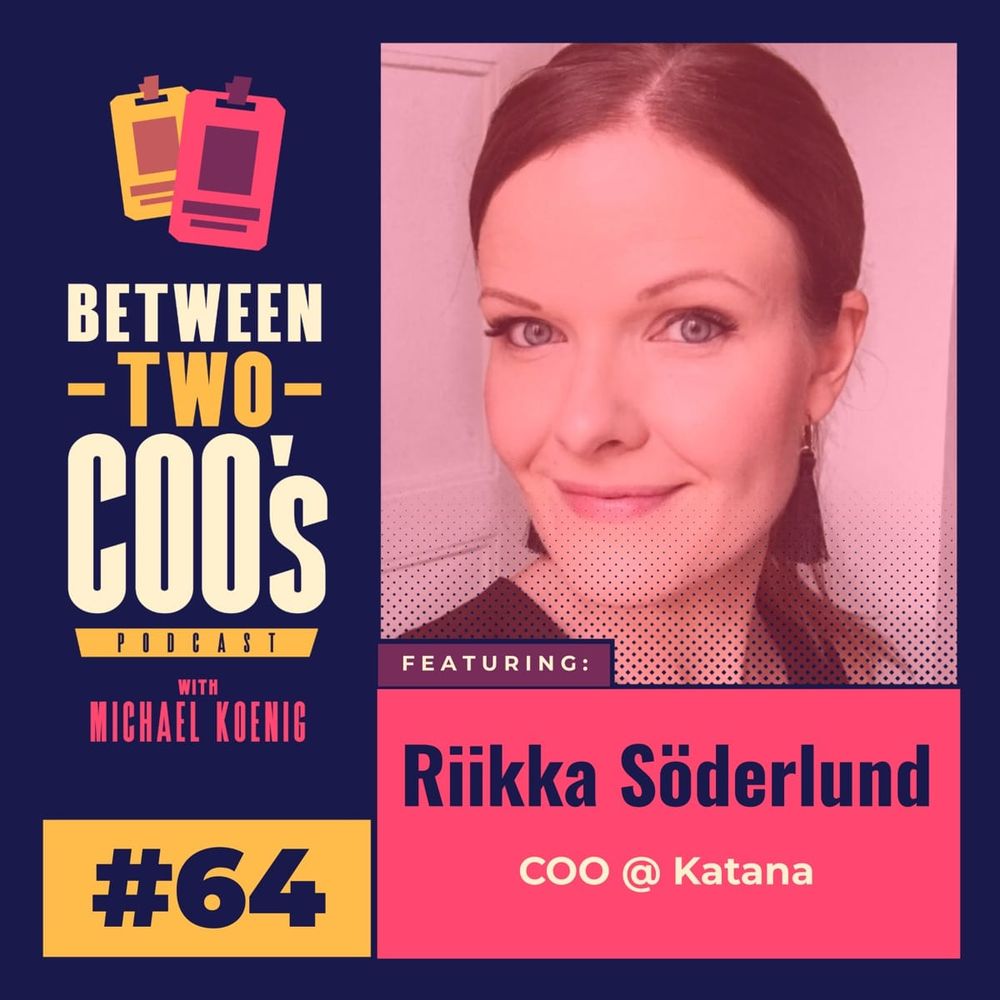
Riikka Söderlund is the chief operating officer at Katana Cloud Inventory, and she is the first COO on this show to arrive from marketing rather than sales. She spent two decades building brands before she ever ran an operation, and she makes the case that the skill which transferred was narrative building, because the COO job is mostly influence.
She and Michael Koenig also get into what AI search is doing to product discovery. Her position is blunt: an AI chat cannot read your branding or your homepage, only your product data, and a product that is out of stock does not get surfaced at all. Shopify reported AI referral traffic to its stores growing 13-fold quarter over quarter, which makes this a near-term operating problem rather than a forecast.
Along the way: why she runs OKRs in six-week increments instead of quarters, why Katana opened its API to any AI a customer chooses while SAP closed theirs, and the brand that discovered it had been selling at a loss.
Topics Covered
- Cold open (0:00)
- Introducing Riikka Söderlund and Katana (1:04)
- From Helsinki PR to Vogue and Oprah (2:12)
- Why old-era marketing skills became rare (3:55)
- What COOs should learn from marketers (6:05)
- Storytelling, listening, and internal communication (7:24)
- Founder gravitas versus learned operator skill (10:37)
- Training to be a COO before the title (11:53)
- Running Katana day to day (14:15)
- Goal setting and the six-week sprint (15:22)
- Physical goods, SAP, and the market gap (19:16)
- The golden era of creativity and branding (25:01)
- Product metadata is the new SEO (30:35)
- AI search and the internet economy (33:44)
- Opening the API while SAP closed theirs (36:33)
- Training for product management (38:06)
- The brand that didn't know it was losing money (42:02)
- Harry Potter and the invisible inventory (43:43)
About Riikka Söderlund
Riikka Söderlund is the chief operating officer at Katana Cloud Inventory, where she runs the commercial side of the business. Katana is a Finland-based platform that helps small product businesses manage inventory, manufacturing, and multi-channel sales, with merchants in over 70 countries and more than $3 billion in gross merchandise value flowing through it.
She spent two decades in marketing before moving into operations. She started in Helsinki ad agencies, then spent a decade in consumer marketing, including a period running digital and communications for a Finnish beauty brand exporting into the United States. She joined Katana as VP of marketing and later served as CMO before taking the COO role.
She is a communications major by training, and she treats narrative building as the skill that transferred most directly from marketing into operations. Her argument is that the job of a COO is largely influence, of teams, customers, partners, and boards, and that the discipline of packaging a message is what makes that possible. She is currently training in product management for the same reason she once trained in revenue operations, which is that she expects the role to need it next.
Frequently Asked Questions
How do you become a chief operating officer without a sales background?
Riikka Söderlund trained for the role before anyone offered it to her. She moved from traditional brand marketing into growth marketing, then revenue marketing, then revenue operations, getting progressively closer to where the money actually comes from. Her view is that if you can run the operation of how money flows into a business, you can run any operation in it. She also taught herself Salesforce while still a VP so she would understand the tooling, the funnel, and conversion firsthand.
What does a COO actually do day to day at a company like Katana?
Katana Cloud Inventory serves small and medium-sized businesses, so there is no long enterprise sales cycle. Riikka Söderlund describes talking to hundreds of customers every month, which makes her job largely about capacity. She has to make sure marketing, sales, customer success, and support can all absorb that volume, and that every one of those interactions produces a positive business result.
Why is internal communication the most important leadership skill?
Riikka Söderlund argues that without it nothing else functions. It is how you get people to rally around a mission, execute efficiently, and be held accountable while still being motivated. She studied communications, which she says is why it seems obvious to her. Her point is that it has very little to do with building presentations or arguing eloquently, and much more to do with listening.
Why run OKRs in six-week sprints instead of quarters?
Katana uses the traditional Google OKR system, reviewed quarterly but not necessarily reset quarterly. Riikka Söderlund executes against them in six-week increments because four weeks is too short to see impact and eight weeks is too long in a fast-moving business. Her deeper reason is that key results describe an outcome and say nothing about execution, so she has her team break each one into six weeks of things they will actually try.
What can operators learn from marketers?
Narrative building, according to Riikka Söderlund. The ability to work out what the real value proposition is and package it compellingly. She notes it does not only affect how you go to market, it affects how you operate internally, because a COO is constantly positioning the company to its own teams and facilitating the story the company tells itself.
Why won't AI search show a product that is out of stock?
Riikka Söderlund says AI search engines are actively learning and will not surface a product that cannot be bought. Her phrase for it is game over. This makes stock accuracy a discovery problem rather than just a fulfilment problem, because an inventory error now removes you from the results entirely.
What is product metadata and why is it becoming the new SEO?
Product data is the only part of a store that an AI chat can read. Riikka Söderlund points out that ChatGPT, Claude, and Gemini do not care about product photography, branding, or how good a homepage looks. They care what the product is, what it costs, what the dimensions are, and whether it is in stock. That makes structured product data the surface that determines whether a brand appears at all.
How much traffic is AI actually sending to ecommerce stores?
Riikka Söderlund cites Shopify's most recent earnings call, which reported that AI referral traffic to Shopify stores grew 13-fold from the previous quarter. That is quarter-over-quarter, not year-over-year. She frames the consequence as a direct parallel to search ten years ago: if your brand does not show up in ChatGPT, does it exist to your customers?
Is anyone actually shopping inside ChatGPT yet?
Riikka Söderlund does not think so, outside some specific markets and brands. Her argument is that it does not matter yet, because those AI searches are already driving traffic to Shopify and Amazon. She expects the shift in where transactions happen to take a long time, noting it took roughly 20 years for ecommerce to overtake brick and mortar.
Why did Katana open its API to AI tools when SAP closed theirs?
Riikka Söderlund says it was never an executive decision at Katana, it was in the platform's design from day one. Customers have always been able to connect their own accounting systems and CRMs. Extending that to any AI they choose followed naturally. She frames it as a values choice: customer data belongs to the customer, and Katana should not lock them out of their own inventory data.
Why has SAP remained the inventory management leader since 1974?
Riikka Söderlund calls it fascinating that no real competitor has emerged in fifty years. Her explanation for the gap is cost and implementation time. SAP runs to hundreds of thousands of dollars and months of setup, which puts it out of reach for small brands entirely. Katana was founded nine years ago because its own founders, then running a physical products business, went looking for software to manage their inventory and found nothing.
What is the difference between a founder's authority and an operator's?
Riikka Söderlund observes that many founders have gravitas inherently, so people want to listen to them and follow them without the founder having to think much about it. She describes herself as an operator rather than a founder, someone brought in when a company wants to grow. For her the same influence is a learned skill, and she is blunt that an operator will not get far without communication ability.
What happens when a company does not know what inventory it has?
Riikka Söderlund has seen it go both ways. The worst case she describes is a brand that did not know it was selling at a loss because its cost of goods sold was negative, which did not end well. The best case was a brand this spring that found $40,000 of inventory it had simply misplaced. Her question for operators is direct: how can you be a COO if you do not know what you are operating with?
Mentioned in This Episode
Listen & Subscribe
Apple Podcasts · Spotify · YouTube · Newsletter
About Between Two COO's
Between Two COOs is hosted by Michael Koenig. betweentwocoos.com · b2coos.com
Michael is building Helm at helmapp.ai.
Full Transcript
Show full transcript
Riikka Söderlund: If your product is not in stock, then AI search is not going to surface that. They are smart, they are actually learning, so they are not going to show your product, and that's it. Game over. If you think of ChatGPT or Claude or Gemini, it doesn't care about your pretty product pictures. It doesn't care about your branding. It just cares about what the product is, what it costs, and most importantly, is it in stock. Shopify told us in their last earnings call that the AI referral traffic to Shopify stores was growing 13-fold from the previous quarter. If your brand doesn't show up in ChatGPT, does it even exist to your consumers? What AI enables us to do is generate infinite amounts of mediocre content, mediocre ads, mediocre branding, because anybody can do it. AI isn't really good at sparking that emotion, so it really does come down to people. It gives opportunity and space for really good creative ideas again.
Michael Koenig: Hello and welcome to Between Two COOs. I'm your host, Michael Koenig, and today my guest is Riikka Söderlund. She's the chief operating officer at Katana Cloud Inventory, a Finland-based platform that helps small product businesses run their inventory, manufacturing, and multi-channel sales. But there's nothing small about Katana, with merchants in over 70 countries producing over $3 billion worth of gross merchandise value flowing through the platform. Think of brands you've discovered on TikTok, the candle company on Shopify, the supplement brand on Amazon. There's a good chance Katana is running their ops behind the scenes. Now, what caught my attention about Riikka is her path. She spent two decades in marketing, Helsinki ad agencies, then a decade in consumer marketing, then VP of marketing, then CMO at Katana, and now she runs the entire commercial side of the business. I've talked to a lot of COOs, as you know, on the show, and I don't think I've ever met one with a marketing background. Most go-to-market COOs come from sales. And so Riikka thinks that's a missed opportunity, and she makes a compelling case for why. Riikka, welcome to Between Two COOs.
Riikka Söderlund: Thank you so much. Happy to be here.
Michael Koenig: Now, a decade ago, you were on your way to a meeting at Vogue in New York. Walk me through what your job actually was back then.
Riikka Söderlund: Oh, you've been stalking my LinkedIn. Yes. Yes, I was.
Michael Koenig: I do my research.
Riikka Söderlund: So I used to work for this Finnish beauty brand doing exports to multiple countries, US being one of them. I was the head of digital and communications. So back then it was kind of a hybrid role. We called it PR. Bloggers weren't a thing yet. YouTube wasn't really a thing yet. So a lot of it was still traditional public relations. So my job was to, every time we had a product launch, go and present the product to all the major publications like Vogue.
Michael Koenig: And now, I think you landed that customer on Oprah as well. What was the product? What'd you get on there?
Riikka Söderlund: Oh, the product was this amazing body butter. It was Oprah's Favorite Things, 2014 or something. Those were good times.
Michael Koenig: And so was there the Oprah moment of, like, you get body butter, and you get body butter, and you get body butter.
Riikka Söderlund: Exactly. Exactly. So you can just imagine that the product was sold out the next day, and we could not get more shipped from Finland to the US for that holiday season. So a massive PR win that didn't really materialize in sales because we weren't prepared.
Michael Koenig: And Katana's going to be on Oprah as well. You get an ERP, and you get an ERP. That'll be something.
Riikka Söderlund: I hope so.
Michael Koenig: Yeah, yeah. Well, look, I think we actually talked about this, and I'd like to think that I'm the inspiration for that LinkedIn post. But you told me that the old-era skills didn't just become useless, that they became rare. Expand on that. What do you mean?
Riikka Söderlund: Yeah. So coming from a marketing background, learning how to build brands, how to tell stories when you couldn't do it online and on social media, that skews things, but also amplifies things, that forces you to tell a certain kind of a story. Having that kind of good old, old-school narrative-building skill has been incredibly helpful, not just for marketing. But essentially what it is, it's influencing people. It's influencing teams, it's influencing customers, it's influencing partners. So that ability to just kind of package things and craft a compelling message, incredibly useful to this day in my role as the COO of Katana.
Michael Koenig: Especially, I would imagine, with things that take up shelf space.
Riikka Söderlund: Oh, for sure. Exactly. It does apply to digital products as well. So I think a lot of marketers and COOs selling digital products don't have that physical product background, so they're kind of reinventing how you package digital. But the principles are the same. Humans are the same, psychology is the same. And at least for now, it's people selling products to people, not agents selling to other AI agents. So for now, those skills are valuable.
Michael Koenig: [Newsletter segment omitted.]
Riikka Söderlund: Yeah, I think the biggest part, honestly, is that narrative building and the ability to communicate your offering, your value. What really is the value proposition? And then package it in a compelling way. I think that's by far the biggest thing. Of course, it helps if you have advertising skills, content skills, all skills help. But that is really the game changer, because it doesn't just impact the way that you operate your business. It also impacts how you as a COO operate internally with your team, because you are constantly also packaging yourself and the product or the company and positioning it to your teams and sharing that, facilitating that narrative that the company tells internally. So just from things like how do you orchestrate, how do you organize teams, and how do you make them work well together? Those skills of really sharing a story and getting everyone to run towards that happy ending, incredibly helpful.
Michael Koenig: Well, that's really interesting. Now we're getting into leadership. And I'm curious, how do you do it? What works?
Riikka Söderlund: Oh, if I knew what works, I'd be a millionaire. I discover what works anew every single day. I don't think it's any one thing, and I think it is also incredibly situational. I think some of those universal skills are around storytelling. But the most important skill around storytelling is listening. You can't tell a story if you don't know what the other side cares about. So listening to your coworkers, listening to your executive team, listening to your board, and really understanding what they're saying, what they're asking, because most of the time they're not saying what they're actually asking. And then interpreting that. I think that is by far the most important leadership skill that I use every single day.
Michael Koenig: Well, this is interesting, because now we're talking about internal communications, which is something that is really ignored at, let's call it, less mature companies. And then also something that unless you specifically come from a communications background is more of a skill that's picked up in seasoned executives. So aside from listening, how do you approach that? How do you motivate? How do you hold accountable? What goes into that?
Riikka Söderlund: That's really interesting that you obviously speak to so many COOs, that you say that internal communication is overlooked. Because that was honestly the first thing that comes to my mind when you ask about leadership skills. It is the most important leadership skill. If that doesn't exist, then what else is there? Like, how else do you get people to rally around your mission and actually execute and be efficient? How do you hold them accountable if you're not actually also motivating them? So it's all about internal communication. My marketing background is actually, I've studied communication, I'm a communications major. So that's probably why it is so obvious to me that it has to start there. And again, it has very little to do with things like building presentations or being able to eloquently make your case, and much, much more about just listening, understanding what is it that people actually care about, and then using that as the motivator to get them to work towards that mission that you've set.
Michael Koenig: Yeah, I mean, look, if we look at some of the more successful executives and CEOs and founders, what do they all have in common? They're incredible salespeople. I mean, look at Elon Musk, Marc Benioff. These are some of the most successful salespeople in the world ever. Right?
Riikka Söderlund: Yes, very true.
Michael Koenig: And it's all about communication, not only to their team, not only to their customers, not only to investors.
Riikka Söderlund: Yeah, very true. I guess a lot of founders have that inherently, to have that kind of gravitas that people just gravitate towards you. They want to listen to you, they want to follow you. I'm not a founder. I'm an operator. I'm someone who is brought in when you want to grow a company, when you want to scale. So it is a learned skill in my case. And I guess that's where the difference comes from. If you have it inherently, if you are a founder, perhaps you don't have to put that much thought into the craft of internal communication. But if you are an operator like me, then good luck trying to do it without communication skills.
Michael Koenig: And so to all of our listeners, I guess, go watch some Tony Robbins. I mean, he's got to be the best, right?
Riikka Söderlund: That's a good start. That's a good start. Honestly, also just the basics of storytelling, because how do you tell a compelling story? It is an actual science, and there is a lot of research around it. So the basics are fairly easy to learn.
Michael Koenig: Well, when we spoke earlier, I asked you about how did you learn to be a COO, and you told me that you trained for it before anyone had actually handed it to you. What did that look like?
Riikka Söderlund: Yeah, I think that's the best way to get any job that you want. You have to just start doing it. No one's going to come and knock your door and say, hey, would you like to. Obviously you have to position yourself for it. In my case, because I come from marketing, it was kind of moving from that traditional brand marketing space into growth marketing, which then comes to revenue marketing, which then becomes revenue operations, understanding where the money actually comes from and how to optimize those parts of the business, which then translates to COO skills. If you can run the operations of how money flows in, then you can also run any operation in the company.
Michael Koenig: What did you learn about the operations around how money flows?
Riikka Söderlund: What did I learn?
Michael Koenig: Yeah. Like, what are some of those things that, because this is a skill, right? This is a skill that you're expanding on, and the way you just described it, it was the bridge from marketing to operations.
Riikka Söderlund: Sure.
Michael Koenig: So what was that? It sounds like the pivotal step in your journey there. What did you learn? How did you learn it? What surprised you?
Riikka Söderlund: Yeah, for sure. It wasn't any one single moment. I've also, for the last eight, nine years now, worked in B2B SaaS, so a function like revenue operations has kind of naturally been born while I've seen it been born. But as you also start to understand where the world is going, then of course you train yourself. So I, for example, did train myself to be a Salesforce specialist so that I can actually be a revenue operations specialist. While I was already in a VP role, I wanted to understand, what are then the basics? How does this work? How does the tooling work? How does the funnel work? How does conversion work? So of course there are some hard skills there as well. Mostly it's honestly just curiosity to see where the world is going, and understand what your role, what your next role in it could be.
Michael Koenig: Well, now you're in the seat. How does Katana run day to day? What's the operating cadence look like for a SaaS company with 1,500 customers in 70 countries?
Riikka Söderlund: Yeah, there is an incredible amount of complexity, because Katana is meant for small and medium-sized businesses. Then that means that it's not this big, huge enterprise sales cycle that we have. It is literally hundreds of customers that we talk to every single month. So then what I need to do is ensure that our marketing and our customer success, our sales, all of our support teams have literally just the capacity to run that volume. So it is a lot about kind of understanding how do we optimize for that volume. And obviously that's also changing now with AI, how we can optimize those customer interactions. But that's where it really boils down to, those customer interactions. How do we make sure that all of them result into a positive business impact?
Michael Koenig: Now we're getting back into some of the leadership aspects to it. I always like to think that leadership is about, one, aligning and communicating expectations, communicating the story, and then holding people accountable to the expectations that we have set. How do you go about doing that in a company like Katana? What is the goal setting and execution system that you use?
Riikka Söderlund: Yeah, we use OKRs, the very traditional Google OKR system, that we review every quarter, don't necessarily set every quarter, because a lot of the initiatives might run multiple quarters or might actually be shorter. So we try not to be bound by calendars. That's one thing. I personally love to execute OKRs in six-week sprints, and my team will recognize that there's a six-week plan that I always ask them to do. Four weeks is too short. You can't see an impact in four weeks. And eight weeks is too long, because things are starting to already change. In a fast-paced business, six weeks is the absolute optimal execution timeline for any smaller scale pivot that you want to do. But then, of course, annual planning we do together with the executive team to set the annual high-level goals for the whole company.
Michael Koenig: That's really interesting. Six-week sprint. I mean, OKRs are generally run on a quarterly basis. You're doing every six weeks. You just mentioned that you have certain things that run quarter to quarter across multiple cycles, and yet you're doing it in six-week sprints. What does that look like?
Riikka Söderlund: Yep. So a lot of the changes we want to make in the business or growth initiatives we want to execute are big, hairy, scary projects. So obviously we want to break them into smaller pieces. And I find that just breaking them into these are the key results we want to see, that actually still misses the executional layer. So then in order to make sure we actually get to those key results, I ask my team to break them into six-week increments of how do you, for example, increase our pipeline to this big scary number? What are the different things you're going to try in those six-week increments? Because if I allow them to do it for a whole quarter, we're losing time. You can see if things work in six weeks.
Michael Koenig: Got it, got it. Okay. So it's more on the tactical level of what are we going to try across the quarter to see if we can catch things that are working and catch things that aren't, and course correct. Clever.
Riikka Söderlund: Or build. It doesn't have to be something that we are trying or testing. It might be something that we're changing. Maybe we're changing our sales methodology, and that takes six months. But you can still kind of slice it down to six-week increments in the execution side of it, because OKRs don't really, they just set the direction. There is nothing about execution in them. So having that kind of bridge between this is the objective and the key results we're aiming at, and then this is the plan of execution, and in six weeks we're going to all see what worked, what didn't, share those learnings. That's been a good process, at least for us at Katana.
Michael Koenig: That's wonderful. Yeah, I like to think of those as milestones, but what you're introducing is a bit of a testing framework and hypothesis framework along those milestones to accomplish those key results. So that's pretty cool. I like that. Very interesting.
Riikka Söderlund: Probably from my marketing background. That's how you do any marketing campaign. So I learned it from my marketing days.
Michael Koenig: Okay. That's clever. Now I see. So this whole marketing thing, you actually have some experience. No, I'm kidding.
Riikka Söderlund: Exactly.
Michael Koenig: Well, one of the reasons why I was really excited to have you on is physical goods are incredibly complex. It is so much easier to build and distribute software, which is still really, really difficult. Let's talk about Katana. What does Katana actually do for customers running that candle inventory across Shopify and Amazon, TikTok, and wholesale?
Riikka Söderlund: Exactly. Well, that's essentially it. We tell the brand what inventory do you have? How much, in which warehouse is it? How much of it is free to be sold in any of those channels? When do you need to reorder or manufacture more? What materials you might be missing in order to then manufacture it, which you need to then order from your supplier to actually get it done in time for that big fall sale you have in September. So running that whole operation, it really starts with just visibility. So that's the very first thing that Katana does, and what customers usually come to us asking for. They just want to know what inventory they have. That's the first step. And then we get to actually running the operation.
Michael Koenig: Well, physical goods have been shipped and sold since commerce began. How is Katana changing that? And I ask because we spoke previously about this, and SAP's been around for 50 years, from the '70s, and they're still the leader here. And obviously things change, and those are big ships which take a long time to change as well. So where does Katana fit into this?
Riikka Söderlund: Yeah, exactly. SAP has been the market leader for inventory management since 1974. What other software can you think of that's been the market leader since 1974? There aren't any. It is fascinating that there aren't any real competitors to SAP. Katana is not competing with SAP quite yet, because we are filling the market gap that is in the small and medium-sized businesses. If you want to buy SAP, you're looking at hundreds of thousands of dollars and months' worth of implementation. So most small brands can't even consider something like that. And that's really how Katana was born. Our founders were, back then, running a physical product business, were trying to find some software to help them run their inventory. Turns out there isn't any. So nine years ago, they decided to found Katana. That's how we got started.
Michael Koenig: Amazing. And you've called Katana a COO tool for your business, for those businesses that are too small to have a COO. When you watch your customers, what patterns do you see that kind of map back to how you think about your own role?
Riikka Söderlund: Yeah, it is fascinating. When we talk to a customer for the first time, they usually only then see what their workflow actually is and how their operation is actually running, because they come to us when they're growing and it isn't feasible anymore to manage their inventory in a spreadsheet or a piece of paper. So they haven't actually ever linked everything together or connected the dots of what I just described. If you sell this candle here, then I need to back order this raw material there in order to manufacture it in a third place, and then ship it to the fourth one. It is a lot of complexity that really only gets visualized when you come to Katana. That's why it really all starts from just seeing your operation. But then of course, what Katana ultimately does is help you optimize that operation. So save on lead times or save on costs. Make sure that your cost of goods sold is actually feasible, shorten lead times, never be out of stock when you're selling, things like that. So those are then, of course, the more traditional operational facets of Katana.
Michael Koenig: I'm curious, what is an example of a success story with Katana that took this complexity and then simplified it? Because again, getting back to actually moving, manufacturing real-world goods is so complex.
Riikka Söderlund: Yeah, some of my favorite success stories are really the ones where we have a founder who just gets back some of their time or gets back money because they're not buying just-in-case stock. So those are the kind of emotional success stories. But obviously we have a lot of the, I'm going to call them very hard successes as well. Because honestly, if you're a brand that's trying to sell to Amazon or Walmart or CVS, they're not going to buy from you if you have stockouts. You need to be able to tell these big chains every day what is available to ship and how long does it take. If you want to take that step, you have to have some kind of an inventory management system.
Michael Koenig: Fascinating. It's a world I know literally nothing about, so that's why this is so cool.
Riikka Söderlund: I've never spent time thinking what happens before that product gets to the shelf of my local grocery store. It never even crossed my mind. A lot of things have to happen for that product to be there.
Michael Koenig: That's incredible. Wow. Well, that's pretty cool. Let's get into AI here. How do I want to kick off this topic? I think when we talked, you called this the golden era of creativity and branding, and that kind of, for whatever reason, to me feels counterintuitive in an AI-dominated conversation. Why?
Riikka Söderlund: Yeah, I totally hear you. It is counterintuitive. But if you think about it, what AI enables us to do is generate infinite amounts of mediocre content, mediocre ads, mediocre branding, because anybody can do it. And just the sheer volume is starting to tire our brains. So the things that actually stand out, those are the ones that are going to actually then catch people's attention. This isn't new. That's how branding has always worked. If you have that one really good idea, if you have that ability to really connect the dots and build something that sparks an emotion in a person, then you have something golden. AI isn't really good at sparking that emotion, so it really does come down to people to create those ideas, those concepts, those brands. And because a lot of brands are defaulting to generic AI branding and content, it gives opportunity and space for really good creative ideas again.
Michael Koenig: Let's go into this a little bit more. As I think about it, sort of each technological inflection point that we've seen, going back to dot-com, right, has made it more accessible for people to take their novel ideas, their novel products, and get distribution. And we've seen this just exponentially compound over time, from dot-com to Web 2.0 to mobile, now AI. And with each one of these, the market gets denser and denser and denser. And even if you have creativity, it's becoming more and more difficult to even stand out and get attention. How do you think about that? How should brands think about that?
Riikka Söderlund: Yeah, it's definitely harder to get attention if you are in the mass market. So if you are trying to sell to everyone, then yes, my God, that has become difficult. And unfortunately I think it's only the big brands that will survive in a really, really mass market environment. But because of the distribution mechanisms you just described, smaller brands have the opportunity to reach niche audiences, and those niche audiences can actually now be of a size that is carrying a good-sized small business. Like, if you think about it, previously it was really just your community, or maybe your country, maybe your county. But now you can actually sell products globally. You can find that community globally, and you can sell products and ship products globally. So that expansion of target market allows smaller brands to have a voice as well, as long as they know exactly who they're talking to.
Michael Koenig: Well, but let's go even further than that. The tool proliferation, the ease of creating something and putting it on the web means that all of these niche markets are getting multiple entrants constantly, especially now. So even if you're targeting a niche market, the density is just getting more and more and more. So how do you stand out? And this applies whether you're making candles or whether you're making enterprise software.
Riikka Söderlund: Yes, exactly. So then let me ask you, is it a creative idea if you are selling something that already has a dense market?
Michael Koenig: Maybe it's novel. Maybe it's got a different spin on what's going on.
Riikka Söderlund: Exactly. So then somewhere there is an audience who is interested in that spin. Or if there isn't, then you didn't really do your market research the way that you should have.
Michael Koenig: That's fair.
Riikka Söderlund: The Cannes Lions is happening next week here in Europe. So it is again the festival of creativity that for the first time now also celebrates AI in creativity. So I think we'll get a lot of good ideas there for both B2B technology and CPG brands, because admittedly marketing has been a little lost in the past, I'm going to say, five to 10 years. The digitalization of all of it has made everything more or less the same. But there's definitely now some kind of emerging trends and different ways of approaching, especially consumer marketing, that are super interesting. So I'm eager to see what comes out of the festival this year.
Michael Koenig: You previously told me that product metadata is becoming the new SEO. What does that mean?
Riikka Söderlund: So if you are a product brand, if you're selling those candles on Shopify, chances are that your consumers are now searching for it with AI. They're not actually clicking your ad or going to Google, or even if they are going to Google, then those Google AI search results already give them the answer and they don't actually have to come to your site. So everybody who is running an online store knows this. Traffic is going down. There is less and less and less people coming to sites, because you get your answers already in whatever AI chat that you use. So then product data is the only thing that is legible for an AI chat. If you think of ChatGPT or Claude or Gemini, it doesn't care about your pretty product pictures. It doesn't care about your branding. It doesn't care about how beautiful of a homepage you have. It just cares about what the product is, what it costs, what the dimensions are, and most importantly, is it in stock. This is the super important piece, because if your product is not in stock, then AI search is not going to surface that. They are smart, they are actually learning, so they're not going to show your product if you are out of stock. So then that's it, it's game over.
Michael Koenig: Well, the LLMs are learning very quickly. Now, most people, I think, especially outside of the tech bubble, are still trying to figure out what the heck AI is. For me, it feels like we are so far away from regular non-tech people shopping through ChatGPT using an agent to buy. Why should an SMB care about AI commerce now?
Riikka Söderlund: Yes, and I'm absolutely there with you. I don't think people are yet shopping inside the LLM, though that is possible in some markets and with specific brands. But what we do know is that those LLM searches drive then that Shopify traffic or Amazon traffic. Shopify told us in their last earnings call that the AI referral traffic to Shopify stores was growing 13-fold from the previous quarter. So it's quarter-over-quarter growth. So just the sheer amount of traffic that AI is now driving is getting bigger than Google. And because Google is going down, because those AI search results are showing you the results already there on Google's page, you don't actually have to go to the brand page. So brands should think about it just like they did think about Google 10 years ago. If you don't show up in Google, does your brand even exist? So the same is now true with, if your brand doesn't show up in ChatGPT, does it even exist to your consumers? While we might not be shopping on AI yet, we sure are using it. We sure are using it. The user numbers are huge, also outside of the tech bubble.
Michael Koenig: Let's go a little bit further and think about the future a bit. Essentially the internet economy is the blue link economy. And what I mean by that is advertising. Now, should the predominant buying path change from clicking on blue links on the top 10 search results on a Google page to searching for products that are within an LLM, what impact does that have on just the overall internet economy?
Riikka Söderlund: Again, I don't think that's the point where we're at yet. I think for now, it's really just those products, you get information about them. ChatGPT shows you the pictures, it gives you the links. So for now, it's still more discovery. And that discovery has always also been a function of internet economy. Not every transaction happens, you see an ad and click a link. There's always been that element of discovery as well. So I think that's going to continue, at least on the side, for, I'm going to say, a long time. I mean, it did take 20 years for e-commerce to actually overtake brick and mortar. So we might be looking at decades before the actual shopping function will take over the website as the destination of that shopping function. But I think those are going to start to happen. So I think what's more important is just following the pace of it, seeing how fast will that start to happen. And especially if you are a smaller brand and you are reaching a niche audience, you really need to know what that audience is doing and not care so much about the overall broader market.
Michael Koenig: So to those brands selling out there, don't panic, because what we're seeing right now is that yes, tech changes overnight, especially right now. However, consumer behavior, purchase behavior does not change as quickly. So you've got plenty of time. But start thinking about it.
Riikka Söderlund: Exactly. And I think a lot of brands are thinking about it, because Google has been such a dominant force in driving traffic to any e-commerce store, and that is declining. So every COO and definitely every CMO out there is panicking of, where do I get those people now to the site, because Google isn't delivering anymore like it used to. So this is the way. You just need to be careful with how much effort you put into it. You don't want to go all in quite yet. But I think brands are aware of the shift.
Michael Koenig: Something interesting happened recently. You and SAP are essentially making opposite bets on AI access to your systems. SAP closed their API to protect their own copilot, whereas Katana has opened it up. Tell me about that decision and why you think SAP missed the boat on this.
Riikka Söderlund: Okay, it wasn't actually even a decision. Honestly, it wasn't even an executive discussion. It's built in Katana's DNA from day one that the platform has to be extendable to whatever use case our customers have. So from day one, we, for example, have allowed customers to connect their accounting systems or connect their CRMs. Of course we are. Why would we be forcing them to use a specific set of tools? They know their business better than we do. So then extending that to API as well, and allowing them to use whatever AI they want on top of their data. It was obvious for us. I think that last piece, of course, that's a bit of a values choice. We at Katana, we do believe that our customers' data is their data. We shouldn't be locking access from them to their own inventory data. As you can imagine, it is an incredibly powerful tool if you can just connect Claude to your inventory data and have those conversations of, where is my shipment of candles? How long will it take? How long did it take last month? What's happening there? That's conversational inventory management. Absolutely the future for small brands, at least.
Michael Koenig: Well, earlier on in this conversation you said that you try and understand where the world is going so that you can train for it. What are you training for now?
Riikka Söderlund: Oh, that's a good question. I am training for product management, because I think building products, working in tech companies, working in SaaS, building products has so fundamentally changed. Like you mentioned Lovable, obviously Claude and Claude Code is changing. I can now, with no technical skills, build a SaaS product if I want. So understanding how the fundamentals of product management work and how products are built, that really helps me run the overall commercial operation at Katana as well.
Michael Koenig: Well, what have you learned? What has surprised you? What's something that you want to shout from the rooftops?
Riikka Söderlund: I think the one thing I learned and that I was incredibly happy about was that a lot of the fundamentals are actually exactly the same as in marketing. So it is about listening to the customer's voice and understanding the customer needs, and then building for those needs. So it is just two sides of the same coin, where in marketing I was communicating to those needs, in product building I'm actually building to those needs. So understanding both sides, I think that was incredibly helpful. But then there is already a lot of literature and training and podcasts and courses out there around how AI is changing product management, and which parts you really should automate and build intelligence around. And what the caveats are where you shouldn't do it. And I think for any SaaS operator, those are just basic operating information now in this day and age.
Michael Koenig: Well, you mentioned customer interactions just now. You mentioned previously how AI is optimizing your customer interactions. What does that look like right now at Katana?
Riikka Söderlund: At Katana, what it looks like is we have all our customer conversations recorded, transcribed, and they go into our overall semantic layer, we have a data pool. So I can have a conversation with our customers continuously. So we have all that rich data of not just these were the three features that customers asked, but also their actual business operational pain points, their sentiments stored. So it gives us this incredibly valuable treasure trove of understanding of not just what to build, but how to interact with them and make that experience as effective and easy as possible.
Michael Koenig: I actually built a company back in 2014 that used natural language processing to analyze customer conversations. And now it's just so much easier to do it.
Riikka Söderlund: Exactly. And it really is the ease of it. I mean, we of course have used tools like Gong for years to actually record them and do tracking if competitors are mentioned or things like that. But just the semantic layer of understanding the sentiment. Like, what is it? What are the things we're not looking at? What are the questions that I am not asking that I should be asking? Having that intelligent conversation with that customer data just opens a lot of doors, and it definitely has opened my eyes to better customer understanding.
Michael Koenig: Fabulous. Well, Riikka, you knew this question was coming. It's time for my favorite one. In the seat, we've all had those moments where we've seen something just off the wall, totally crazy bonkers, and thought to ourselves, I never thought I'd see that. Do you have one you can share?
Riikka Söderlund: I kind of touched on this already. I think one of the things that has been just crazy operating at Katana is that brands and companies really don't know what inventory they have. They truly don't know. And sometimes that's incredibly tragic. So probably the worst example of this is a brand that literally did not know that they were selling at a loss. They did not know that their cost of goods sold was negative, and that didn't end well. So that's a horror story that I've seen. But obviously then, thank God, I have those happy ending stories as well, where just this spring, one of the brands that we started working with, they found $40,000 worth of inventory they did not know they had. They had just misplaced it, tens of thousands. And you can imagine, for a small brand, that is game changing. So that to me, because I come from a world of marketing where everything is visible. I know exactly what ads in what platform, what emails are going. I know everything. Not having visibility, my God, how can you operate? How can you be a COO if you don't know what you're operating with? So to me, that is absolutely bonkers.
Michael Koenig: That's crazy. As you're talking about visibility and not knowing what you have, for whatever reason I just thought of, and this is a deep one, a deep track, Harry Potter. In the books, at Flourish and Blotts, that's the bookstore, he stocked the invisible Books of Invisibility, and they never found them.
Riikka Söderlund: That is true. That is exactly. It sounds so crazy that it's almost like from a Harry Potter book, but it happens for real. It's insane.
Michael Koenig: Yeah, and so the guy at Flourish and Blotts, what did he need? He just needed Katana. I'm clearly such a nerd. No, this is what happens when you have young children and they're getting into Harry Potter. I mean, you know, you read with them.
Riikka Söderlund: I know the feeling.
Michael Koenig: Yeah, yeah. The invisible Books of Invisibility. Riikka, this has been fantastic. Thank you so much for coming on. Where can people go to keep up with you?
Riikka Söderlund: You can always follow me on LinkedIn, Riikka Söderlund. And obviously just reach out to katanamrp.com. We'll be happy to chat there.
Michael Koenig: Thank you to you all for listening to Between Two COOs. Big thank you to you, Riikka. Tune in next time for our next COO chat, and whatever the next Harry Potter reference may be. Or perhaps I'll move on to the Lord of the Rings.
Riikka Söderlund: Exactly. Happy reading.
Michael Koenig: Happy reading. And until next time, so long.
More on AI
The COO's Execution Playbook
Frameworks, templates, and hard-won lessons from operators who've been in the chair. Every Tuesday.
No spam. Unsubscribe anytime.