Wade Foster, Zapier CEO, on Why AI Is a People Problem, Not a Tech Problem
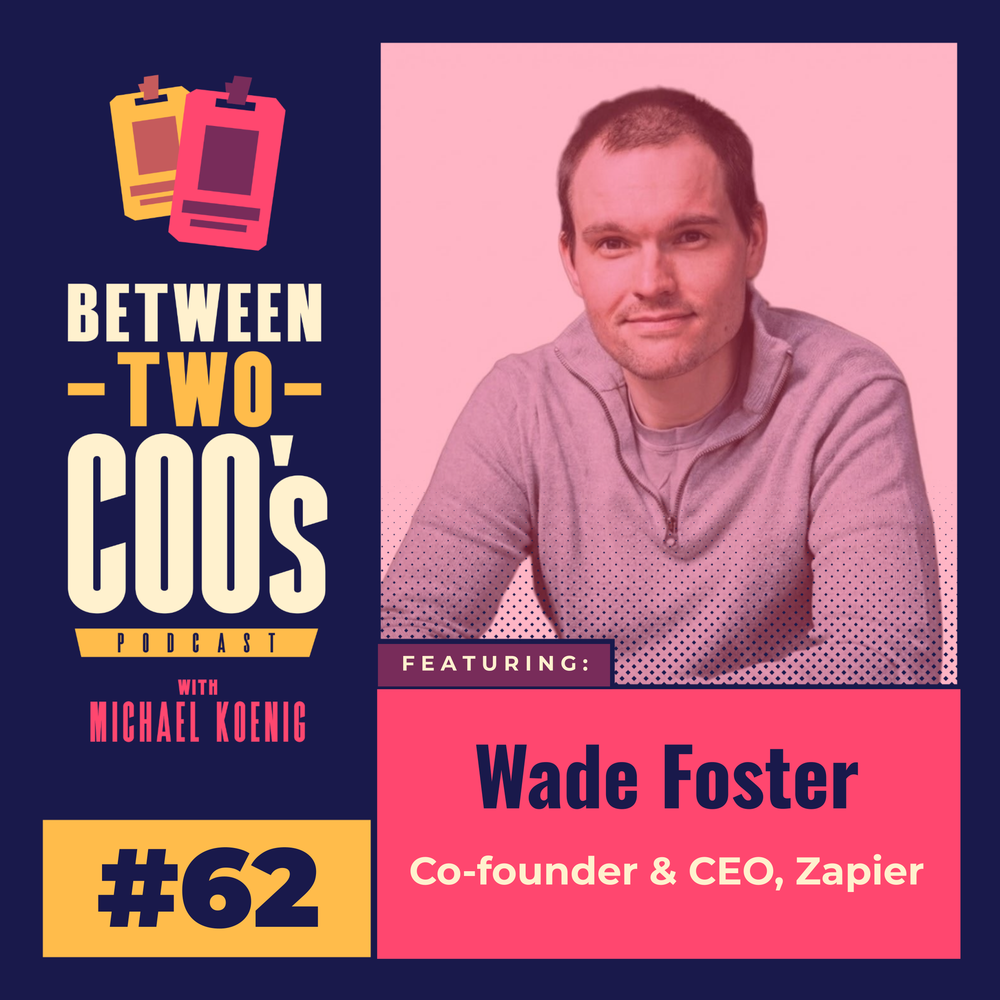
Michael Koenig talks with Wade Foster, co-founder and CEO of Zapier, about running the same company for 14 years without ever naming a COO. Foster explains that Zapier raised only about a million dollars in seed funding after Y Combinator, which gave him and his co-founder room to make long term decisions, including a 2024 pricing change that gave revenue back to customers in exchange for compounding market share over a decade.
The conversation covers Zapier's 2023 “code red” after GPT-4 launched, when the company paused work for a week to run a hackathon and get everyone building with new AI APIs. Foster describes why AI hits closer to Zapier's core automation mission than earlier shifts like mobile, and why the company waited until late in its AI journey to name a chief people and AI transformation officer rather than assigning AI ownership to one person from the start.
Foster also breaks down why he has never hired a COO at Zapier, calling external executive hiring a coin flip and arguing that the role lacks a fixed job definition. He explains that any future Zapier COO would likely be someone who grew up inside the company through multiple roles rather than an outside hire parachuted into an unfamiliar business.
Topics Covered
- Introducing Wade Foster and Zapier (0:00)
- From startup problems to long term stewardship (1:38)
- Customer friendly pricing and packaging change (3:34)
- GPT-4 code red moment (6:48)
- How AI differs from past tech shifts (8:58)
- Bringing AI mindset to non-tech companies (10:52)
- Delayed push into mid-market enterprise (13:54)
- Avoiding stagnation like Belichick (17:02)
- Pattern matching versus learning from younger founders (19:55)
- Creating a chief people and AI officer (22:11)
- Choosing AI versus deterministic automation (27:36)
- Deterministic workflows versus agentic decisions (30:26)
- Defining reliability for AI workflows (33:51)
- Why Zapier has never had a COO (38:08)
- Famous duos and CEO COO chemistry (45:10)
About Wade Foster
Wade Foster is co-founder and CEO of Zapier, the workflow automation company he started at age 24 and has led for 14 years. Under his leadership Zapier grew to 850 people and a multi-billion dollar valuation after raising only a seed round following Y Combinator. Foster has guided the company through technology shifts including mobile and the 2023 arrival of GPT-4, and he leads Zapier's ongoing push to embed AI into its products and internal operations.
Frequently Asked Questions
Why does Wade Foster say AI adoption is a people problem at Zapier?
Wade Foster explains that once Zapier's employees became excited about AI, the real bottleneck was not technology but organizational change: role changes, org structure, and change management. He says Zapier was not having a technology problem, it was having an operationalization and people psychology problem, which is why the company eventually put its chief people officer in charge of AI transformation.
Why has Zapier never hired a COO?
Wade Foster says Zapier has never named a COO not because the company avoided the idea, but because he believes an externally hired COO would lack the deep contextual knowledge needed to succeed at Zapier. He notes that if Zapier does eventually name a COO, it will likely be someone who joined as an IC, director, or VP and learned the business piece by piece over time.
What does Wade Foster think about hiring executives from outside a company?
Foster describes executive hiring as roughly a coin flip, calling it a well known industry statistic that outside hires succeed about half the time. He argues this risk is even higher for a COO role because there is no standard job definition, and the new hire is often asked to learn multiple unfamiliar functions on day one.
When did Zapier call a “code red” over AI?
Zapier called a code red in spring 2023, shortly after GPT-4 was released. Wade Foster says the jump in capability between GPT-3.5 and GPT-4 in just six months convinced him AI represented both a major opportunity and a major risk, so the company paused normal work for a week and ran a companywide hackathon focused on the new APIs.
Why did Zapier wait to name someone in charge of AI?
Wade Foster says Zapier deliberately avoided naming a single AI owner in 2023 because doing so early would have let everyone else assume AI was “that person's job.” Instead, the company ran hackathons and show and tell sessions so the entire company understood that adapting to AI was everyone's responsibility.
Who leads AI transformation at Zapier now?
Brandon, Zapier's chief people officer, took on AI transformation in addition to his people role toward the end of last year, according to Wade Foster. Foster says the move made sense because Brandon had already successfully reskilled the people team around AI, and the remaining AI challenges were about organizational change rather than technology.
How does Wade Foster decide when to use AI versus deterministic software?
Foster says if a problem can be solved with plain deterministic software, it usually should be, because that approach offers better reliability and lower cost for mission critical tasks. He looks for cases involving unstructured data, like large blobs of text, or decisions with too many forks in the road to fully script, as the clearest signals that AI is the better tool.
What does “reliable enough” mean for AI in a business workflow, according to Wade Foster?
Foster argues that AI has not really changed the calculus on reliability. He compares it to how companies historically set quality assurance thresholds for human customer support agents, saying the question is still whether a workflow hits the business's quality bar, regardless of whether AI or humans are doing the work.
What mistake does Wade Foster say Zapier made in its growth?
Foster says Zapier waited too long, until around 2020 or 2021, to seriously pursue mid-market and enterprise customers, even though the opportunity was visible as early as 2017 or 2018. He attributes the delay to comfort with Zapier's self-serve, product-led growth roots and admits the company was being cautious rather than aggressive.
How much funding has Zapier raised?
Wade Foster says Zapier went through Y Combinator and then raised a seed round of a little over one million dollars, which remains the only primary capital the company has ever raised. He credits this minimal funding with giving him and his co-founder more freedom to make long-term decisions rather than optimizing for short-term fundraising milestones.
What advice does Wade Foster give to non-tech companies adopting AI?
Foster says leaders in non-tech industries, such as those working in the physical world, still need to personally get hands-on with AI tools even if AI plays a supporting rather than central role in their operations. He points to a Silicon Valley pattern of pairing AI-focused founders with domain experts in old-line industries to rebuild those businesses with better margins and lower costs.
What is Wade Foster excited about in AI right now?
Foster says he has been using Claude Code for less technical tasks and has connected it to Zapier's MCP integration with his calendar, email, Slack, and documents. He believes connecting everyday tools into AI systems will be a major theme in 2026, even though he says the learning curve is still too steep for most people today.
Mentioned in This Episode
- Zapier
- Acquired podcast
- Y Combinator
- Claude Code
- Zapier MCP
- EVE Online
- The Hard Thing About Hard Things
- The High Growth Handbook
Listen & Subscribe
Apple Podcasts · Spotify · YouTube · Amazon Music · RSS
About Between Two COO's
Hosted by Michael Koenig · betweentwocoos.com · b2coos.com
For more on OKRs and operational excellence, visit Helm.
Full Transcript
Show full transcript
Wade Foster: Started the company when I was 24. 14 years in, I still feel like I'm pretty young. The thing is the world doesn't stay static. The world changes around you. People study how you work. They pay attention to what works, what doesn't. They develop new techniques because they're trying to beat you. If we're gonna be the automation company, that means AI is going to be priorities one, two, and three for the foreseeable future.
Michael Koenig: Hello, and welcome to Between Two COOs. I'm your host, Michael Koenig, and today I'm joined by Wade Foster, co-founder and CEO of Zapier. Wade has been building the same company for 14 years, and that alone makes him an outlier. Most tech startups don't make it past year five, and fewer still grow into a multi-billion dollar business and have taken as little funding as Zapier has, and even fewer do it without losing their identity along the way.
Michael Koenig: Zapier is best known as the workflow automation layer behind modern work. Millions of people use it to connect thousands of tools, and those workflows now power billions of actions every month. But what interests me most isn't just what Zapier does, it's how the ca- company has managed to last. Over the years, Wade has led Zapier through multiple technology waves, market shifts, and internal evolutions.
Michael Koenig: AI is the latest one, and a big one, but it's not the first stress test. What makes this conversation interesting is how durable companies absorb change without thrashing, breaking trust, or losing coherence. So this isn't a conversation necessarily about hype or tools or predictions. It's about what Wade has learned by staying in the seat for 14 years, what had to change along the way, what didn't, and how that shows up today in the way that Zapier thinks about workflows, automation, and AI.
Michael Koenig: Wade, thanks for joining me.
Wade Foster: Thanks for having me, Michael.
Michael Koenig: At what point did you stop feeling like there were startup problems and start feeling like a long-term stewardship problem had to be addressed?
Wade Foster: Well, I, I'm not sure I've ever felt like the startup problems disappeared. Um, you know, we're still as hungry as ever for, you know, making the product better, getting new customers.
Wade Foster: Like, that, that, I don't know that that ever goes away. You know, something clicked for me maybe in the pandemic, partially through... Maybe it was because I started having kids. I'm, I'm not sure. Where I started to think about decisions over a much longer time horizon and saying- Yeah, I, I, I... Well, I'll tell you another thing that helps.
Wade Foster: I'm a huge fan of this podcast Acquired. I don't know if you listen to these guys. Yeah. Fabulous. Um, and so you just sort of listen to those episodes, and they, they do deep dives on just these enduring businesses. And there's just some common themes around how principled the, those companies are run. And, you know, I think I was always, like, maybe predisposed to thinking that way, when most people are just so unwilling to do so. You know, they're, they're trying to make a quick buck.
Wade Foster: They're trying to flip the thing. They get tired. They get bored. Um, you know, they get distracted. Like, there's just a lot of things that cause people to not go long. And, you know, I sort of looked at where I was at and thinking, "You know, we're in a really unique spot," because I started the company when I was 24.
Wade Foster: You know, 14 years in, I still feel like I'm pretty young. And, like, you know, another 14 years is not, that's not insane. Like, that's, that's kind of normal. Um, and it felt like we ought to start looking at s- certain decisions and thinking about it that way. I can give you a really concrete one. We made a big pricing and packaging change in January of 2024.
Wade Foster: Very customer-friendly. We gave tons of revenue back to our customers because we just sort of looked at it and said, "You know, if we keep going about this the way we're going, um, maybe we make more money in the short term." But over the next decade, I felt like it would compound a lot better if we gave a lot more value to our customers.
Wade Foster: We'd earn more market share and, you know, 10 years out from now, we'd be in a better shape. Maybe the, the next two years might not look as good, but I was okay with that because I'm making a decision for 10 years down the line.
Wade Foster: [Sponsor segment omitted.]
Michael Koenig: I love that And I'm curious, you've made a lot of decisions, and maybe my funding information is incorrect, but you have not raised significant venture capital.
Wade Foster: Yeah. We did, uh... We went through YC. Yeah. And then post-YC, we raised a million dollar and change seed round. Yeah. And that's the only- Yeah... primary capital that's been raised.
Michael Koenig: Which is absolutely crazy. And so there's a lot of control still that you and your co-founder have, I imagine.
Michael Koenig: How much of that longer term thinking do you think is a result of having that ability to not necessarily optimize for the next two years? "Oh, I need you guys to IPO, I need you to exit," things like that. H- has that played into your ability to think about having an enduring company?
Wade Foster: I, I mean, I, I think it has.
Wade Foster: Um, you know, o- obviously there's plenty of venture-backed companies, even public companies, that have been able to think long term, but I also know tons of peers that are in positions where they're having to make short-term decisions. They're trying to get the next quarter, they're trying to get- Yeah... to the next fundraising mile, they're trying to get to certain things.
Wade Foster: And you can see them struggling with, you know, certain product decisions or certain sales or marketing decisions or certain pricing and packaging. Pricing and packaging was always one of these, where you're like, "Ah, I can make more money just by like, you know, raising prices on existing customers and doing some things that maybe don't feel crazy cu- customer friendly, and I'll make more money."
Wade Foster: But is it gonna be the right thing in the long haul? And you can see everyone struggles with that. Everyone struggles with those decisions. I mean, look, even we struggle with them, but I just think because we don't have that same, you know- Board member or venture person like breathing over our shoulder saying like, "Hey, you gotta do it," we, we probably have a little more fortitude to say, "Hey, let's play.
Wade Foster: Let's go long here."
Michael Koenig: Yeah, I love that.
Michael Koenig: Now, founders often talk about those near-death moments with, you know, fundraising scares or traction cliffs. Was there ever a moment where Zapier w- wasn't necessarily about to die financially, but you felt like it might lose its way? I
Wade Foster: mean, r- right now I think is a really interesting time, honestly.
Michael Koenig: Hmm.
Wade Foster: Um, you know, we called a code red in, uh, spring of 2023 when GPT-4 came out, in part because of the, the, the delta in improvement between 3.5 and 4 was so big, and it was only six months between those two releases. So we looked at that trend line, two trend lines I guess, and said, "Wow, if this is where the world is heading, there's an opportunity here and there's a risk here."
Wade Foster: And so we, we wanted to just jump on it. Um, called a code red, had the company, but paused everything in the company for a week, ran a hackathon and said, "Hey, everybody's needs to be building with these APIs. They need to be playing with these tools. They need to be understanding the art of possible here."
Wade Foster: Because I think this is what the next chapter of automation looks like, and if we're gonna be the automation company- That means AI is going to be, you know, priorities one, two, and three, you know, for the foreseeable future. So that, that, that was one time where it was like, "Huh, what's, what's this gonna look like?"
Wade Foster: And honestly, I still think, like, I think we figured some things out, but I, you know, I don't know that anyone is out there feeling like they've figured it all out. I mean, you even look at the, um, all, all the big dogs, you know, the OpenAIs, the Anthropic, the Googles of the world. It feels like they're all just passing the baton around on who's, who's in the lead, who's doing the best stuff.
Wade Foster: You know, one moment you think it's OpenAI, then it's Google, then it's Anthropic, and you're just like, you're not really sure who's, who, you know, who's the belle of the ball at this moment.
Michael Koenig: Yeah. So interesting. And especially, I'm sure there, there were signals, um, there were other moments within the company, uh, and building where you had all of these different tech m- tech moments happen, mobile, et cetera, et cetera, uh, really basic ones that you have weathered.
Michael Koenig: What feels different becau- from your perspective and vantage point of having that endurance, what feels different about this?
Wade Foster: Well, I think a- automate, like AI just is a new way to automate, and so it just hits at the core, like, mission and premise of the company in a way that, you know, say mobile didn't as much.
Wade Foster: Um- Mm-hmm... you know, with the mobile wave, like, we were so young that it was just, it didn't, it didn't much matter one way or the other. And most of the automation work we were doing was for white collar knowledge workers who were mostly sitting in front of desktop and laptops and just, you know, logging into SaaS products and things like that.
Wade Foster: And so, you know, mobile was there and, you know, people did stuff, but it was just not the predominant form factor of how white collar knowledge workers were, were automating their day-to-day. Whereas with AI, like, th- this is just an entirely new way that you can deliver automation. And so that, that, it hits at our, it's, you know, it's at our doorstep in a way that maybe some of these other shifts w- ha- haven't been.
Michael Koenig: Well, with a lot of those other shifts too, you end up having to say no to a lot of things. Has there been anything that you have said no to with AI? I
Wade Foster: mean, there's definitely things that we haven't done. Um-
Michael Koenig: Mm-hmm
Wade Foster: You know, I think our, our, our philosophy at the, like at the be- at the outset of this was try everything.
Wade Foster: Like- Yeah... we don't, we actually don't know, like what... There's so much to learn. There's so much to figure out. People can build stuff so quickly now. And you know, I think that we, we get, I get critiqued, we get critiqued about that sometimes internally. We're like, "What i- what is the thing that actually is, you know, gonna be the one?"
Wade Foster: But, but I do think y- you know, you're just kind of at a moment where y- you do need to have this experimental mindset. You do need to have this beginner's mind. And I, I don't feel like you're at this way point where it's like, "Ah, we 1,000% know the winner. Say no to-" Mm... "everything else. Focus on this one thing and milk it for all it's worth."
Wade Foster: Um, I j- I just don't know that we've... we're at that part of the, the, the story yet.
Michael Koenig: Yeah. And I think, uh, uh, as I was prepping for this, I'd listened to a bunch of your podcasts and in one you said, and I'll have to drop it in the notes or something, but you said, "We still don't have God in a box yet." Which I loved.
Wade Foster: Yeah.
Michael Koenig: But you struck on something interesting, which is the workplace headspace, uh, the growth mindset. Now, a lot of examples that we talk about come from tech companies that already live in software and workflows. A lot of our listeners aren't necessarily within tech itself. So for companies that aren't necessarily tech native, maybe older organizations, industrial companies, professional services, what's your advice for getting AI into the workplace headspace before rolling out tools or automation?
Michael Koenig: Because you can't necessarily have a hackathon. What does a hackathon even mean in some of those companies?
Wade Foster: Well, yeah. I, I mean, obviously, you know, if you're doing sort of white collar work, digital work, et cetera, AI i- is gonna be so critical. Um, you know, if you're moving steel beams around or, you know, s- uh, in the physical world, like AI's gonna be a part of that, but it's, it's gonna be more of a supporting role versus like the s- maybe the ce- central cast perhaps.
Wade Foster: I, I still do think that, you know, if, and you're in one of these organizations- You, you do need to be the type of leader that's figuring out what's possible with this technology. You need to put your hands on it. You need to figure it out yourself. Because if done well, I do think you can use it to disrupt old school industries.
Wade Foster: And those are, if, uh, you know, if you do that right, you can eliminate waste from that business. You can improve your margin profile. You can lower costs for customers. Like, those are all things that can disrupt your business. Um, in fact, there's like a playbook in Silicon Valley that is, like, starting to, to pop up, which is, you know, you take these, you know, really smart AI-pilled founders, and you pair them up with a domain expertise who knows an old school industry like the back of your hand, and that founding pair can come in and create the new version of, you know, the, the premier company in this old school space and, uh, deliver it at just like a much, much better experience.
Wade Foster: And so if you're in one of those industries, like, I think you wanna do that yourself instead of let somebody else go build the, the new company.
Michael Koenig: Now hopping, hopping out of AI, and we're, we're gonna come back to it, but hopping out of AI, um, I, I wanna return to your learnings over these last fourteen years.
Michael Koenig: Um, you know, we talk a lot about these zero to one and hyper-growth companies. Most of the company building, though, lives in that long middle. What problem took you the longest to realize was actually maybe stymieing your growth?
Wade Foster: So the, one of the things I wish we would've done sooner is that we would've focused more on, uh, mid-market enterprise. Um- Hmm... you know, I think we had an opportunity probably twenty seventeen, twenty eighteen where we could've been very aggressive to go chase that, and we didn't do it. Um, you know, we stayed kind of in our PLG root, roots, self-serve, um, you know, much more of that, like, kinda consumeration of business software approach.
Wade Foster: And it took us until probably about twenty twenty, twenty twenty-one to sort of wake up and say, "Oh, wow, there's like a big opportunity here. We're kinda sleeping. We're being a little dogmatic." In some ways, honestly being chicken, um, about, like, the opportunity here. Um- Let's go get after it. And he just lost valuable time by not, not saying, "Hey, let's go get after it."
Wade Foster: So that's, that's one that comes to mind.
Michael Koenig: That's a difficult decision and transition to make, especially when you've been doing something for so long. How do you go about changing that mindset, that behavior of, well, let's not be chicken? And, um, just out of curiosity, w- why were you chicken? What was, what was holding you back?
Wade Foster: Well, you know, I think, uh, there's a certain comfort in the business you know. I'm like, "Ah, I'm good at this. Um, I, I... it's familiar with this." Well, like, uh, m- maybe a good analogy would be our, our, uh, I don't know if you're a football fan or not, um, but, uh, Bill, Bill Belichick and the, the Patriots, right? Just iconic coach, arguably the best coach of all time.
Wade Foster: Um, but by the time he left the Patriots hadn't really updated his play style, and he wouldn't- Hm... he wouldn't win it as much. And now you see him at North Carolina, like, oh, rough first year. Yeah. Good point. Um, and you know, I think this is something that all leaders struggle with, which is that, you know, you kind of come up in an era, and there's things you're good at, and you're like, "Man, I know I can win this way.
Wade Foster: If I play this way, if I approach the work this way, I'm gonna be excellent. I'm, I'm an N of 1 doing it this way." But the thing is, the world doesn't stay static. The world changes around you, and over time, people study how you work, they pay attention to what works, what doesn't. They develop new techniques, et cetera, because they're trying to beat you.
Wade Foster: And, you know, if you're fortunate, like Bill Belichick, you can do that for a decade. But eventually, there's an expiration period on how you go about that work. And so, you know, I think that's what's really important for a leader is, y- you know, even when you're at the top of your game, you still gotta be looking for an edge.
Wade Foster: You still gotta be innovating. You still gotta be thinking about, what's the next act? What's the next way we stay on top? Because that, that's how, you know, you earn customers loyalty over and over and over again. And you know, I think you, you asked, like, how did we learn to, you know, maybe stop being chicken on this stuff.
Wade Foster: H- honestly, it was just kind of like recognizing that fact- Hm... and going, you know, like, there is a huge opportunity out here, and, you know, we're just... we're being comfortable. Like, why are we, why are we being comfortable? Let's go push and challenge ourselves. Let's go do something, you know, unique and chall- Like, that...
Wade Foster: It's more fun to work that way, so let's, let's get out there and do that.
Michael Koenig: You know, over those 14 years, you as a, a CEO, as an executive, you have grown and matured.
Michael Koenig: Um, I'm sure you've had incredible mentors. I'm sure you've learned a lot of things the hard way, like, like most of us. But, you know, what parts of early Wade had to go away for Zapier to keep scaling?
Wade Foster: The, the first one I can remember is, you know, again, started the company when I was 24, and, you know, young enough to think that, like, um, eh, I'm smarter than everybody.
Wade Foster: But, uh, you know, starting a company has a way of making you realize, like, you're not that smart. 'Cause, um, you just... You make so many choices, you're wrong so many times that you realize that what separates, you know, the best is... A- and what makes them so smart is that when they're wrong, they just change their mind so fast so that they- Hmm
Wade Foster: they actually seem like they're right a lot. The reason... Th- like the, the best way to be right a lot is, one, you can just be right the first time, or two, when you're wrong, just change your mind. And, um, if you do that, you actually are, like, right a fair amount. Um, and so I think there was a little bit of, you know, humbling that, that I had to go through to realize, okay, um, my, my job is not to be the smartest person in the room.
Wade Foster: My job is to just figure out what are the smart ideas, what are the best things, and how do you, you know, put more arrows behind them. Uh, and so I think that was, like, one of the first things that I kinda had to go figure out and learn is just how to, you know, just, just be a lot more open-minded about, you know, what I know and what I don't know.
Michael Koenig: So it sounds like also, um- There's a certain degree of judgment that develops over time to be able to look at those ideas that, you know, m- maybe you had that weren't great, and then be able to, to change them and, you know, say yes to different things. Like, that is a profound shift, though.
Michael Koenig: You know, uh, there's a s- there's a certain part of, of judgment that comes with knowledge and experience, and allows you to, one, evaluate which ideas to pursue, but also, two, know when to recognize when something's not working. What does that look like in your, your world?
Wade Foster: I, I think the, the more you do this, you, you have the benefit of just, like, pattern matching.
Wade Foster: Like, you've just seen a lot of different stuff. You can pull a bunch of ideas from different industries, different experiences, et cetera. Um, and it gives you, uh, you know, a sort of way of thinking about the problem in a particular way. And that can be just, like, a really valuable asset, because you can, you can sort of draw on that experience.
Wade Foster: But you also have to be really careful about it, too, because, um, that experience can fool you when the playing field shifts. Um- Mm... you know, think about, like, the age of AI, and you're like, "Well, you know, maybe the way in which teams work is, like, totally different now." And so, you know, am I running a playbook that actually is kind of dated now?
Wade Foster: Um, and, and you kind of just have to, you know, constantly, like, keep yourself in check on that. Um, and that's where I do think it is helpful- To still go spend time with younger founders, you know, f- folks earlier in their career, and just see, like, what, what are they doing that's different than you? Um- Yeah
Wade Foster: you know, they may not have all the experience, but, you know, they've, they just coming out of a different environment and a different era and a different way of working that feels obvious to them. It feels na- native to them. Like, I think about, you know, when, when we started, like, we were building all these, like, cloud integrations, and we would get quizzical looks around, like, "Why don't you have more, like, on-prem integrations and, like, enterprise sort of stuff?"
Wade Foster: And we're just like, "What are you talking about?" Sure. Like, no one works that way. It, it just felt w- weird to us. Now, obviously, we were clueless. Mm-hmm. Clearly a lot of people work that way. But it kinda just goes to show that, like, these, these young folks, like, they just have a, like, a, a view on the world that just seems so obvious, and you're like, "I, I wanna, I wanna understand that better."
Wade Foster: So anyway, I, like, I think you kinda gotta figure out how to, like, use your experience, use your pattern matching really well, but also, like, continually, like, update your priors and get exposure to things that, you know, you, you may be discounting.
Michael Koenig: [Sponsor segment omitted.] All right. One of the interesting things that we saw, and we're gonna shift gears a little bit here, um, one of the interesting things that I saw, uh, in terms of the AI transformation and, you know, let's kind of buzzy word there, but nonetheless, um, AI sits within the chief people officer role for you now.
Michael Koenig: So it's a chief people and AI officer. Um, tell me about that. Most of the time we see it sitting with tech. Sometimes we see it sitting with operations people- Mm-hmm... I would kind of put in there. Um, ta- uh, tell me about that decision.
Wade Foster: Sure. So yeah, Brandon took that role for us tail end of last year. He's our, uh, chief people officer, now AI transformation as well too.
Wade Foster: But, you know, we started this journey in, again, spring of 2023. So it took us a while before we said, "Hey, we wanna put a person in that role." Uh, even though early on, like, there was suggestions and proposals like, "Hey, maybe we ought to have, like, a centralized person who sort of helps think about all this stuff and, like, kind of guides a team," etcetera.
Wade Foster: We chose not to, um- And yeah, I think in hindsight, looking back on that decision, it, it was probably the correct one. And the reason why is I think had we named somebody like that early on, we probably would have, um, not done a- Mm. Mm-hmm... as good of a job- Mm-hmm... of making sure that- Right... the whole company understood that they have to figure out AI.
Wade Foster: You know, when you name a person, it quickly becomes, oh, AI is that person's job. Um, my job is this other stuff. And I think early on it was so important to recognize it like, no, no, no, no. Every- all of you have to figure this stuff. We need to raise the floor for everybody. This can't be just like this person, this, this engineer's job or this people person's job or this marketer's job.
Wade Foster: It can't, can't be that. All of your all jobs is changing. And so by running hackathons, by, um, you know, doing show and tell, by having people come to the all hands and, you know, again, do show, show off what they're building, we just built this culture where like everybody was like chipping in and getting excited about this and making stuff happen.
Wade Foster: First slowly and then, you know, more, uh, a- as the flywheel started to spin more energy around it. Then it kinda got to a point where It was pretty clear that, like, everybody is, like, pretty stoked about this stuff. No- there's nobody who's like, "We should not use AI," in the company. But the, but the problem started to be different.
Wade Foster: It was like, "Hey, we've got all these ideas," but, you know, some of the, like, bigger ideas, like, they, they involve, like, org change. They involve role changes. They involve, like, these more complex problems. And, you know, me as an individual IC, I can't just wake up and decide, like, we're gonna redo how, like, hiring happens with the company, or we're gonna redo, like, how the entire, like, customer journey works, um, with these tools.
Wade Foster: That's not a... Like, one person alone can't do that. And at that time, Brandon had just done a good j- such a good job of re-skilling and reshaping how the people team had r- was, was running and using AI, and it sort of felt obvious, like, well, we need somebody to help wrangle all the change management, all the logistics, all the, like, org goo around AI.
Wade Foster: We weren't having a technology problem. We were having, like, just, hey, there's this, there's, like, a just an organization, an operas- o- operationalization of this stuff and, like, you know, people psychology issues and things like that. Brandon's already done a great job of this with the people team. Why not just ask him to do that for everybody else?
Wade Foster: Mm. And so that's kinda how we, we got there, um, and why it made sense for us to, to go that way. You know, I think if you have similar, you know, setup as us, that could be the right choice. But if you have different problems, it might not be that your head of people should be the one doing this. It might be that there's somebody else in the company.
Wade Foster: I, I, you know, I think every company's kinda going through their own, um, journey on this stuff, and they have to, you know, think through what are the, what are the bottlenecks they're facing and, and how to think through how to go solve those.
Michael Koenig: I've actually seen it now within some, some other areas, um, mainly because I'm starting to see HR teams be much more experimental with, um, different software and, and options that are out there versus, you know, other teams, for instance.
Wade Foster: It, it kinda makes sense. Like, H- there are, like, very real problems that are showing up on HR's doorstep that-
Michael Koenig: Yeah...
Wade Foster: are directly related to AI. The most obvious is recruiting. Um, recruiting functions everywhere are having a, a heck of a time right now because they're just getting AI slop as applicants-
Michael Koenig: Yeah
Wade Foster: like so much of that stuff. And, you know- I, I understand like how the situation got this way, because as a candidate you're like just so used to like applying for jobs and not getting responses, so you're like, "Well, I'll just use AI to like help me apply to more jobs, increase my surface area." Mm-hmm. And so the whole system just kind of gets borked and you're like, "Well, what the heck are we gonna do about this?"
Wade Foster: You know, there's very real problems that are on the recruiting teams, like right front and center for them, where they're like going, "W- we have to figure this out. This is not a, this is not a luxury that we can just go figure out how to like dabble and mess around with AI. Like, we, we have no choice but to like think through a new way to solve this problem."
Wade Foster: Um, and so I do think that's partially why HR teams are like, you know, uh, getting, getting into the game. It's like they have no choice but to get in the game.
Michael Koenig: Yeah. So interesting. Let's talk about problems to solve. You know, how do you decide which problems actually deserve AI versus those that are better solved with just straight automation or better process design?
Michael Koenig: How, how should companies, how should operators think about that?
Wade Foster: It's a good question. So, you know, my learning over the last couple years is that if you can solve the problem with plain old deterministic software, you probably should. And the reason why is you're just gonna get better reliability, you're gonna get lower costs.
Wade Foster: You know, for anything that's like even remotely mission critical at all, it's probably just a better way to do things. That said, there's a lot of problems that you can't solve that way. And so that's where it gets really interesting. Um, you know, I think a mental model that we had, especially early on, um, but it's still true today, is we, we often just looked back at our, you know, 10 years of running the company and said, "What problems have we always faced that we've just never been able to solve?
Wade Foster: Like, we've just never been able to crack this nut. Um, and m- ca- can we solve it now? Like, is this actually possible because we have a new tool?" That's been a very helpful mental model is looking backwards. Now, as we've gone forward, you start to recognize places that, um, kind of all over the place. You just look at how much of your workday involves working with unstructured data, and that's where AI just really thrives.
Wade Foster: You're, you're dealing with big blobs of text, uh- Yeah... and how can you go wrangle that into a workflow, into a process? And then I often find you're starting to build out, like, these hybrid workflows, where you've got like AI as a piece of the solution that's tied up with like deterministic software or code or, you know, something like that that is like, um, ru- running a very particular way.
Michael Koenig: Yeah, that's interesting. Uh, uh, and you've been very clear about workflows and, and, you know, I'm using agents in the marketing term sense, which is-
Wade Foster: Mm-hmm
Michael Koenig: you know, I think what have become- Everything's an agent. Yeah, everything's an agent right now. They're really like assist- you know, assistants, right?
Wade Foster: Mm-hmm.
Michael Koenig: But, but nonetheless, I, I, I've stopped fighting it. When it first started coming out, I'm like, "No, no, no, no, that's not agentic." Mm-hmm. But, um, but i- in the marketing sense, because that is now the, the verbiage here, um, you know, where do you draw that boundary between deterministic workflows and maybe more a little bit along the agentic judgment?
Michael Koenig: Where, where do you draw that today?
Wade Foster: Well, yeah, I think it's, like, pretty obvious when you start building these tools. Um- Yeah... you know, you've got, um, a, a decision to make, you know. In the, you know, deterministic world, if you want- Those decisions to be made, you have to articulate exactly the decisions. If this criteria is met, then go down this route.
Wade Foster: If this criteria is met, go down this route. If this criteria is met, go down this route. If this criteria is met, go down this route. Works when the world is constrained to a small set of forks in the road, where you're like, "Okay- Mm-hmm... you know, we're gonna do this." But there's a lot of decisions where you don't- you're not maybe arti- able to quickly articulate all the different forks in the road.
Wade Foster: And so when you get to that, you might say, "Okay, I wanna put an AI step in the middle, and I wanna have it make the decision for which fork in the road to go down. And I'm gonna give it a set of examples, where I'm gonna say, 'Hey, if you see something that looks kind of like this, this, or this, I want you to go down this route.
Wade Foster: If it's more like this, this, or this, I want you to go down that route. And if it looks like this, this, or this, I actually want you to check in with me first before you decide.'" And that's helpful, because what AI can do is it can pattern match. It can go, "Hmm, okay, like you didn't actually give me an example that looked like this, but based on what you told me, it very clearly should be down this route, so I'm gonna send it here."
Wade Foster: Or, "Actually- Hmm... it should be down this other, so it very clearly should send it here." Or, "Actually, I don't actually know. It's like kinda like both of these things. Great, I'm gonna check with you." So, you know, that's like a, you know, the decision making, you know, tree is like a very helpful one. Mm-hmm. Um, there's, you know, cases where you're dealing with just like large blobs of text.
Wade Foster: That's a use case that like deterministic software like really struggles with. You're seeing more and more workflows where people will take, you know, go look at like the last month's customer support tickets or like, you know, and categorize them in a particular way and tag all the keywords and like summarize them by themes and, you know, that type of work was painstaking before.
Wade Foster: Um, and- Hmm... candidly, like most people just simply didn't do it. Uh, so that's a really interesting one. Um, you know, if you wanna go generate like emails or memos or documents or things like that, in the past, the way you would see folks generate emails is they'd be using kind of a mail merge style system.
Wade Foster: "Hi, blank. It's nice seeing you today. I reached out because of blank." We've all gotten these emails. They're horrific. Mm-hmm. You like instantly archive these things. Um, now if you give enough context to an AI, you can actually get it to generate an email that's pretty dang good. Now, a lot of folks still don't give it enough context, so you still get kind of AI slop style emails at the other side of it.
Wade Foster: But if you give it enough context, it's better than- 80% of sales reps sending emails? I don't know, like a pretty good chunk. Right. Um, it does a pretty good job, and those are the types of use cases, again, that were just, like, not really possible, or if they were, you did a very poor version of them. So to me, like a lot of the, like, how do you decide when to use AI, it's just, like, looking at the use case in front of you, and it's, it's like, well, there's no other way.
Wade Foster: I have to use it to, to, to do this effectively. Um-
Michael Koenig: Right. I love that, and I, I do wanna call out, you're very generous with those emails that you archive them instead of trash and mark as spam. I mean, that's very forgiving and, uh- Yeah... you know, I, I maybe applaud that. I'm not sure. A, a lot of the AI conversations that we, we talk about today, and we, we started get- you started getting into this, um, are mostly focused around capability, and very few focus on reliability.
Michael Koenig: What does r- at this point reliable enough actually mean when AI is embedded into a real workflow?
Wade Foster: I- it depends on the use case.
Michael Koenig: Yeah.
Wade Foster: Yeah, at the end of the day. I don't think AI has really changed the, the calculus on this at the end of the day. Hmm. Um, it's just a different tool to go solve the problem.
Wade Foster: Um, let's pick customer support. This is an area where a lot of people are trying to deploy, um, AI software right now. Well, old school world- You'd have humans delivering all of the customer support, much of the customer support, and, you know, at the end of a, a call, you know, you would... Or at the beginning of a call, you'd often have, you know, "This, this is being monitored for quality assurance purposes," right?
Wade Foster: Uh, and so somebody is, like, looking at all that data and, like, determining, okay, like, you know, we're hitting a 95% quality threshold or a 99% quality threshold. They're, they're making determinations around, like, what's good enough and what's not. Um, with an AI taking over customer support, kind of the same thing.
Wade Foster: You're trying to look at it and go like, "Well, are we hitting our goals, yes or no, on, you know, these, um, on our quality assurance for customer support?" So I don't think it's actually all that different. You're just trying to look at the business problem that you're facing and say, "Well, did we solve the problem?
Wade Foster: And if we did, great. And if we didn't, well, the quality bar's not high enough yet." Um, so the fact that it's AI or not AI is, it feels somewhat irrelevant to me, um, around, you know, how to think about quality. Like, you know, at the end of the day, humans have a, like, a, a judgment around, like, what is good enough for this task, and then our job is to hit it.
Wade Foster: And how you hit it is you gotta just work backwards from that and decide like, well, what, what role is humans playing? What role is AI playing? What role is, I don't know, some other technology playing? You know, so on and so forth.
Michael Koenig: You just reminded me, I originally reached out to you, uh, just to let you know that I had one of the greatest customer support experiences I've ever had with your team, like hands down, period.
Michael Koenig: And I s- I... It was so amazing, and it was such a team effort, and I was like, "You know what? I'm gonna, I'm gonna shoot Wade a note." And it was just like, "Hey, I just want you to know this." Um, so don't go too far in replacing your customer support folks because they're incredible and delivered such a great experience.
Michael Koenig: What, what's impressing you? And this is, you know, this question will likely not age well. Um, but, but these days, what's really impressing you? [Sponsor segment omitted.] But- Mm-hmm...
Michael Koenig: oh, so great. Um, y- you know, what's, what's impressing you these days?
Michael Koenig: It can be a company, it can be, you know, a thought process. I don't know. It- just something that- Well-... you love...
Wade Foster: yeah, I mean, over the break, I, I think a lot of us, but certainly I got pretty deep into Claude Code, and particularly f- Claude Code for, you know, less, like, technical tasks. Uh, and so I've got it hooked up to Zapier MCP, and I think this is, um, I, I think this is gonna be, like, a pretty important theme of 2026, where you're gonna finally be able to, like, hook these tools, h- hook all your tools up, your calendar, your email, your Slack, your documents, your to-do lists, your call, call notes, et cetera, uh, into an, like, AI system and have it go do work for you- Mm-hmm
Wade Foster: and help you think about your day and move through your day, like, way more effectively. Um, it's still too hard. Um, you know, there's still not enough, like, uh... There's still too much of, like, a learning curve. Like, that initial- Mm... stair step is too high. Um, but man, once you get over it, the experience is pretty, pretty freaking magical.
Wade Foster: Uh, and so yeah, I think that's a big area of focus for us, especially on, like, the Zapier MCP side is, like, how do we make it so it's so much easier for people to get their data, get the stuff that they've got from all these different tools into the context window of the AI so they can go do interesting things with it?
Michael Koenig: Hopping back into, uh, and I know I've kind of bobbed and weaved with this, with this interview here, but hopping back into z- um, Zapier, have you guys ever had a COO?
Wade Foster: Uh, no.
Michael Koenig: I, I, I know. So tell me about that. What, uh, how does Zapier run?
Michael Koenig: What is the operating system, and how are you running, what, an 850-person, multi-billion dollar- Mm-hmm... company without having sort of that connective tissue role, I would say?
Wade Foster: So again, here's, here's maybe... It's not that I wouldn't like a COO. Um- Mm. You know, I think, uh, you know, the, the, the sort of value prop on paper is pretty awesome.
Wade Foster: You know, I think every CEO sort of wakes up and they're like, "Wouldn't it be great if I could have this other person who takes like at least half, maybe more of the, more, more, more of my work, does it better- Yeah... than I do, and is also the parts I really don't like to do?" Um, like- Right... w- I'm like, "Who wouldn't want that?
Wade Foster: That sounds incredible." Um, I watched over, you know, like the 2010s a lot of my peer set, you know, try to, um, hire in these COOs.
Michael Koenig: Mm.
Wade Foster: I'd say most were, like, not crazy successful with it. Um, some were. Some were. But most I'd say probably weren't. And you know, we, we had points in time where I was, like, trying to, like, groom somebody or, like, push that direction, and it never quite panned out that way.
Wade Foster: As I reflect back on that, here's what I think makes that COO job- Mm... really challenging, is, I mean, one- Mm... there's no job definition for what a COO does. Just doesn't exist. The best job definition I have ever heard is that you're the opposite of the CEO. The CEO wants- Yeah... to do this, okay, great, you gotta do that.
Wade Foster: And, like, you just divvy the org up that way, and, like, that's kinda how a COO sort of comes to be. And that's the best definition I've heard, where I'm just like, yeah, that, that kinda makes sense to me. Um, you're sorta co-running the company. Um, one person has one half, the other has the other, and you're kinda, you know, ma- making magic happen based on each other's strengths and weaknesses.
Wade Foster: So by definition, the CEO, there is no, like, one set of skills you gotta go build to, to be a great COO. The second thing I think that makes it, uh, challenging is that, um, oftentimes when folks start to look for this person, they're, like, in desperate need of help. They're like, "Ah, I really, I really could use this.
Wade Foster: I'm getting tired, I'm getting burnt out, I'm getting stretched thin." Company's growing a lot- And then they plop this person from the outside into this role. And now look, um, a lot of folks, executives hiring is just fraught. Like, you know, there's industry s- s- uh, stat you'll see. I think, like, there was...
Wade Foster: There's, I think maybe it was in Hard Thing About Hard Things or maybe High Growth Handbook. I don't, I don't know. But, like, it's pretty common knowledge that, like, exec hiring is a coin flip, 50/50 on it's gonna work out or not. So you've already got that running against you is that external hiring is fraught.
Wade Foster: Right. But then you've also got the fact that you're being tossed into a company, and you're being asked to learn all of these different functions on day one. Um, you know, so if you're, you know, maybe if you're a go-to-market focused COO, you're just like, "Okay, great, I gotta learn s- you know, pre-sales, post-sales, customer support, marketing."
Wade Foster: Like, these are... There's just, like, a lot of different things all at once. Mm-hmm. And there's pr- it's pretty, pretty unlikely that you're gonna be amazing at all of those very quickly. So it just makes it really, really tricky. You know, when I think about this for myself, the, the other way I've, I've reflected on it, um, as I've watched, you know, certain execs come into Zapier and be successful and others maybe struggle, is that- I've, I've sort of tried to step back and ask myself, how could somebody be amazing in one situation and then come into an organization, a new organization, and not?
Wade Foster: Clearly, this is not only about that person's skills, because they, they clearly have skills to be successful in some arena. Why is this arena different? And I, I've, I've kind of tried to put that mirror on myself, where I've said, "Okay, I, I am maybe arguably the best CEO that Zapier could have at this moment in time."
Wade Foster: Um, let's just assume that that's true for a second. It may not be. It's true. Let's assume it's true. Come on. We don't need to
Michael Koenig: assume.
Wade Foster: Uh, but if I were to be hired as a CEO at another company, would I be successful? And when I think about that, I kind of step back and I go, "Hmm, I actually don't know if I would be."
Wade Foster: Like, I think what makes me particularly good at this is I'm one of the founders. I was there at the beginning. I know where all the bodies are buried. I know all the... I know the customer problems inside and out. I know the product inside and out. There's just so much accumulation of knowledge that I have, and I've done a decent of job, like, of learning how to be a CEO sort of along the way.
Wade Foster: Yeah. And as a result, that accumulation of all that contextual knowledge makes me pretty darn good at this. But if you dropped me into another world, I have none of that context. I have none of that understanding. And so the likelihood I'm gonna be successful is probably much, much lower than if I just stayed in this role.
Wade Foster: And so that phenomena I think makes it really difficult to, like, hire a COO and plop them into an organization and have them be successful. So as I think about that, you kind of... I'm gonna close the loop on this, this here. Um, you asked sort of like why Zapier hasn't. It's not because, you know, we, we didn't want it.
Wade Foster: I think just- Hmm... stepping back, we are a weird enough company. We ha- we have a, like, very complex business. I think the practical learning I have is that if, if I am going to get someone into that role, it's because they joined us- as a, you know, an IC or a director or a VP, and then like over time they just learn the business, and then they learn the next part of the business, and then they learn the next part of the business.
Wade Foster: And it's just gotten to a point where I'm like, "Great, go solve the next thing. Go solve the next thing. Go solve the next thing." And I think that's like, you know, when Zapier names a COO, like I think it's pretty likely that it's gonna look like that, um, versus, ah, just g- like give me generic smart person who's just worked at a bunch of smart things out in the world.
Michael Koenig: Yeah, there's no right answer. Yeah. And it, it ha- uh, to your point, um, the COO-CEO relationship-
Wade Foster: Mm-hmm...
Michael Koenig: and the complementary style of it, think of your Eisenhower Matrix, the things you hate doing and suck at, right?
Wade Foster: Yep.
Michael Koenig: Um, th- that relationship is so essential and for Zapier, because you, Wade, have thought about, "This is how I think someone would be successful in this role for this company," I mean, th- that is gonna have to be it.
Michael Koenig: Mm-hmm. Unless, you know, you wake up someday and you're just like, "Well, maybe that's not the case." But because it is so tied to who you are, how you think, how you work, what you want the company to be, uh, it's essential. So you have to have someone within the company. Yeah. Um, yeah, I think it's great. Look how- I mean- Look how much we just...
Wade Foster: Yeah.
Michael Koenig: No. I'm sorry. Go ahead.
Wade Foster: I was just gonna say, I think you see these like pairings, these duos, like throughout history- Yeah... as well too. Like you, you know, you look at, you know, MJ and Pippen, like they were phenomenal together, and I think they, they, they made each other work. The flip side is you could look at like Kobe and Shaq, and like they were clearly phenomenal together, but, you know, there was not enough room for the egos to sort of pull that partnership off for, for longer.
Wade Foster: Mm-hmm. Uh, and so, you know, it's not enough to just be talented. It's not enough to just be like very skilled and complementary. It... The chemistry matters too. It's like, do you, do you wanna just keep working with this person? Yeah. Do you wanna just spend so much time with them, um- Yeah... t- to, to do this together?
Wade Foster: And that, that matters just as much.
Michael Koenig: Yeah. I've been blessed to have that relationship twice in my career. Um, and it really is a fun- Mm-hmm... a fun moment where the, the... you kind of mind meld and have that- Mm-hmm... that implicit trust with this person that they're gonna do it. I don't- I actually don't even need to say it-
Wade Foster: Yeah
Michael Koenig: because I know they're on it. It's an awesome feeling.
Wade Foster: Mm-hmm.
Michael Koenig: It is such a great feeling. And, uh, so much of it is relationships as well. I mean, business would be easy if it weren't for people. Yeah. Um, well, Wade, time for my last and favorite question, and I know we're a little bit over time, so I, I, I do appreciate you hanging on there.
Michael Koenig: We've all had our moments in the seat where just something nuts comes up and we just think like- I never thought I'd see that. Is there one you can share with us? And so often you can't share them, so is there one that you can share?
Wade Foster: Well, there's a bunch of nutso stuff that you, you obviously can't talk about.
Wade Foster: But I'll give you one that like, like kind of surprised and delighted me. Um-
Michael Koenig: Hmm.
Wade Foster: Folks often ask me, um, "What's the most like surprising Zap or surprising automation or something like this that you've seen built?" And I remember one in the very early days where I l- like my jaw literally dropped. So w- we, we were always pretty clearly a work automation platform.
Wade Foster: Like we're, you know, integrating with all this B2B SaaS and, you know, connecting your Salesforce and your QuickBooks and your HubSpot and your Mailchimp and your Zendesk Zero, like y- you name it, like that's, that was our lane. Um, but we have this like open developer platform where you can integrate anything.
Wade Foster: And- Hmm... you know, we didn't turn down, you know, things that like had a consumer flair to them or anything like that. It wasn't like we were sort of philosophically opposed to it, it's just when we thought about where we were going in company, we were just very, very B2B oriented. And then there was one day, I remember looking at a dashboard that was like, I, I don't know, it was like top usage for like new users or I, I don't know, so some- something like that.
Wade Foster: And there was just like this, this weird outlier on there where I was like, "What is that?" And um, somebody had built an integration with EVE Online. So if you don't know what EVE Online is, it's this massive multiplayer, uh, like online role-playing game, kind of like a World of Warcraft style game.
Michael Koenig: Okay.
Wade Foster: And uh, it is famous for having this vibrant in-game economy.
Wade Foster: Like it's, it's sort of known for having like the most real world-esque like economy that exists. And in fact, I, I ha- happen to have like an old high school buddy who'd gotten really into it, so I knew a little about it, um, from him. And it turns out in that you can, like there's actually like an exchange rate from like in-game currency to like real life USD.
Wade Foster: So, um, this person was just like super into it, and they had figured out that like if you automate certain transactions or certain things in the game, they were actually able to make like real life currency. So for them, this was a B2B endeavor. This was like a work endeavor. Um, but it was just like one of those things where I was like, I like, "Whoa."
Wade Foster: I, I... like that didn't even cross my mind that somebody might- Yeah... go do something like this with the platform.
Michael Koenig: I wanna know that person. I wanna be best friends.
Wade Foster: Well, so here's the f- here's the wild thing, right? I, I don't know if you're- Yeah... uh, like in the last couple days, you're starting to see, um, a lot of folks realize that engineering, it's less about writing code now, and it's more about orchestrating agents.
Wade Foster: And so you're starting to see some, um, creative engineers that are actually building UIs on top of their agents that look a lot like these real-time strategy games. And so- Really?... it, it's one of these things where I'm like, oh my God, there's like a full circle moment where it's like actually maybe the like, you know, the UI for like productivity in the future is all these nerdy games we played as kids.
Wade Foster: I
Michael Koenig: love that. Oh my gosh, that'd be incredible.
Wade Foster: Mm-hmm.
Michael Koenig: And if someone can figure out how to do a, a like tabletop D&D, that'd be
Wade Foster: fun. Game over. Like, we're, like, you're addicted to work for... You think you got a d- work addiction now. Just wait.
Michael Koenig: Yeah. Well, Wade, this has been, uh, this has been so much fun. I'm glad we could do this.
Michael Koenig: And, uh, everyone, you can go to zapier.com. Thank you, Wade, for, for coming on. Uh, w- what, what, uh, what social platform are you posting to these days? What's... Where can people find you?
Wade Foster: Yeah. I, uh, LinkedIn is probably where I'm the most prolific, and then I'm on X as well too, so you know, Wade Foster on both platforms, easy to find.
Michael Koenig: There you go, everyone. Well, thanks again, Wade, and thank you to you all for listening to Between Two COOs. I'm your host, Michael Koenig, and a s- big special thank you to Wade for joining us. Tune in next time, and until then, so long.
More on AI
The COO's Execution Playbook
Frameworks, templates, and hard-won lessons from operators who've been in the chair. Every Tuesday.
No spam. Unsubscribe anytime.