Touraj Parang, Serve Robotics COO on the Food Delivery Robots VCs Wouldn't Fund
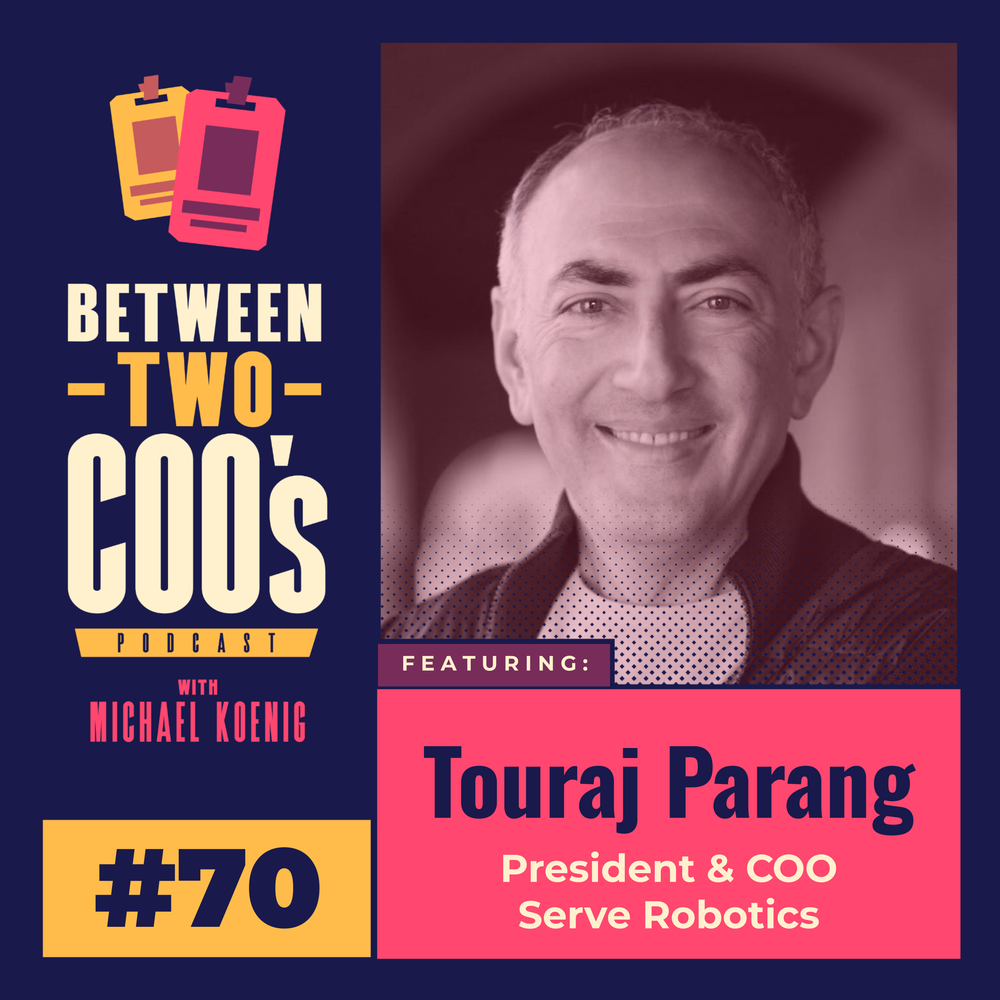
Serve Robotics ended one year with $6,000 in the bank. The next year it had over $100 million, because it had gone public and could raise money. In between, says Touraj Parang, the company's president and chief operating officer, there were many brushes with death, and the job was to figure out how to make one more round of paychecks.
Serve builds and operates sidewalk delivery robots, with about 2,000 deployed nationwide. It started as a project inside Postmates and spun out of Uber. Parang explains the question behind it (why move a two-pound burrito in a two-ton car?), why Serve plugged into the delivery platforms and gets paid per delivery instead of signing restaurants one at a time, and why traditional venture funds passed even with an Uber contract for 2,000 robots on the table.
The second half is the operating job. Parang trained as a lawyer, worked in venture capital, and founded a company that was sold in a fire sale while its rivals were acquired. At Serve he covered the general counsel, finance, and people roles until the company could afford to hire them. He talks about hiring on mission when there is no money, running the company on experiments, and why he thinks trust is the biggest constraint on robots in public spaces.
Topics Covered
- Cold open: $6,000 in the bank (0:00)
- Meet Touraj Parang of Serve Robotics (0:46)
- What Serve Robotics does (1:46)
- Robots leave the warehouse (2:55)
- Philosophy, economics, and Yale Law (4:19)
- Leaving law for venture capital (6:04)
- Why investors need operating experience (7:07)
- Starting Jaxtr before the iPhone (8:01)
- The fire sale (9:18)
- Exits, corp dev, and writing Exit Path (10:07)
- Spinning Serve out of Postmates and Uber (10:54)
- Jaxtr and the downside of focus (12:33)
- The rivals who got acquired (14:19)
- A two-pound burrito in a two-ton car (15:54)
- The economics of robotic delivery (17:14)
- Plugging into the delivery platforms (17:59)
- Starting with delivery data (19:57)
- Merchants, pedestrians, and cities (21:12)
- Why autonomy is table stakes (22:48)
- The bet on falling sensor costs (24:19)
- Hundreds of investor rejections (25:50)
- Strategic investors got it first (27:19)
- $6,000 to over $100 million (28:11)
- Never questioning the logic (29:17)
- What a president and COO owns (31:39)
- Filling the empty executive seats (32:22)
- Hiring on mission without money (34:23)
- Starting from zero as an immigrant (35:59)
- Permission to fail (39:51)
- Experiments, acquisitions, and building in public (41:42)
- What a world model does (44:42)
- Robots are embodied AI (48:33)
- Robots scale at the speed of trust (48:56)
- Safety and human-piloted crossings (50:02)
- Going to regulators first (51:21)
- Principles over perception (52:30)
- The next chapter of Exit Path (55:06)
- I never thought I'd see that: a Waymo ride (57:30)
- Where to find Touraj (59:26)
- Wrap (1:00:17)
About Touraj Parang
Touraj Parang is president and chief operating officer of Serve Robotics, which builds and operates sidewalk delivery robots and, through Diligent Robotics, the Moxi hospital robot. The company began as a robotics project inside Postmates. After Uber acquired Postmates, Parang helped spin it out as an independent company and joined as chief operating officer. Along the way he has filled in as its general counsel, finance lead, and head of people, and covered business and corporate development.
He studied philosophy and economics at Stanford, earned a law degree at Yale, and practiced corporate law at Wilson Sonsini before opening the US office of a European venture capital firm. In 2005 he founded Jaxtr, a social communications company that reached 10 million users in its first year and was sold in a fire sale after the financial crisis. He later led strategy and corporate development at Webs through its sale, and worked in corporate development at GoDaddy. He is the author of Exit Path, a book that argues a startup's exit can accelerate its mission instead of ending the story.
Frequently Asked Questions
How do Serve Robotics food delivery robots get their orders?
Serve Robotics plugs into delivery platforms such as Uber the same way a human courier does. Touraj Parang, the company's president and COO, says signing up restaurants one at a time would cost too much, because a single restaurant does not have much delivery volume. The platforms had already built those connections, so Serve works as an alternative to their couriers and is paid per delivery, a model the platforms already understand.
Why use robots for food delivery?
Parang says the idea that started Serve Robotics is a question: why move a two-pound burrito in a two-ton car? Sending a person in a car across town with a $10 burrito can cost more than the food. He says robotic delivery can bring a $10 delivery cost down to one or two dollars, and at massive scale could remove the cost altogether.
How many delivery robots does Serve Robotics have?
Parang says Serve Robotics has more or less 2,000 robots deployed nationwide doing sidewalk deliveries. Through its acquisition of Diligent Robotics it also operates Moxi, an indoor hospital robot that carries supplies and lab samples between nurse stations.
How did Serve Robotics survive with $6,000 in the bank?
Parang says Serve Robotics ended one year with $6,000 and had over $100 million the next, because the company had gone public and was able to raise money. He says there were many brushes with death along the way. His summary of that period is that the key is to survive and figure out how to do one more round of paychecks.
Why did venture capital firms pass on Serve Robotics?
Parang says that three to five years ago investors saw robotics as capital intensive with an unproven use case. Meetings ended with more questions than answers: is the market big enough, will the tech work, what if people steal or kick the robot. Strategic investors such as Uber, 7-Eleven, Delivery Hero, and Nvidia invested early, but he says no traditional venture fund would underwrite the fleet, even with an Uber contract for 2,000 robots.
Do delivery robots drive themselves?
Mostly, with people supervising. Parang says autonomy is table stakes, because one remote person driving one robot does not fix the economics. With autonomy, one remote supervisor can monitor several robots. Serve Robotics still has a human pilot the robot across street intersections, which it treats as the highest-risk moment, and it deliberately keeps its robots under certain speeds.
What limits how fast robots can scale in public spaces?
Trust, according to Parang. He says robots move at the speed of trust and scale at the speed of trust, and that no matter how good the technology is, it will not go far if people do not trust it. Trust is earned through repeated, reliable, safe interactions with the people around the robot, which is why Serve Robotics treats safety as its number one priority.
How does Serve Robotics work with cities and regulators?
Proactively. Parang says that even where no regulation stops a robot from using the sidewalk, Serve Robotics goes to the municipality first. It explains the benefits, shares its safety profile, its delivery count, and its incident history, and brings a plan for how law enforcement should interact with the robots. He calls the value behind it principles over perception.
What does the president and COO of Serve Robotics do?
Parang says a COO fills in wherever the company has a need. For a long time Serve Robotics had no general counsel, CFO, chief people officer, or chief data officer, so he covered those roles, along with business development, sales, and corporate development. As the company scaled, it built those functions out.
How do you hire good people when a startup has no money?
Parang says a mission people believe in does part of the work that money cannot. Serve Robotics was transparent with employees about what the company was going through, and he says it lost very few of them. He credits the team's belief with giving the leadership the energy to keep going through the setbacks.
What happened to Jaxtr, Touraj Parang's first startup?
Jaxtr was a voice over IP company Parang started in 2005. It grew from zero to 10 million users in its first year, then was sold in a fire sale after the iPhone changed the market and the financial crisis hit. He says the mistake was staying heads down while competitors built relationships with potential acquirers. One rival was bought by Google and became Google Voice, and others were bought by Telefonica and British Telecom.
What does a world model do for a robot?
Parang, who says he is not a technical person, describes the older approach as a long list of if-then rules: if you see a cat, go this way. Nobody can anticipate every case. With foundation models, the system is fed a lot of data on what proper navigation looks like and learns the right behavior, including in situations that are not exact copies of what it has seen.
Can a startup go public before it has much revenue?
Parang says yes, and that he did not know it was possible before Serve Robotics did it. He thought going public was for an elite group with hundreds of millions in revenue. There is a path for startups that are pre-revenue or early revenue, have validated technology, and need capital to grow. He says it is the chapter he would add to his book, Exit Path.
Mentioned in This Episode
- Serve Robotics
- Exit Path, by Touraj Parang (book and exit readiness scorecard)
- Diligent Robotics (Moxi hospital robot)
- Voysys
- Uber
- Postmates
- Waymo
Listen & Subscribe
Apple Podcasts · Spotify · YouTube · Amazon Music · RSS
About Between Two COO's
Hosted by Michael Koenig · betweentwocoos.com · b2coos.com
For more on OKRs and operational excellence, visit Helm.
Full Transcript
Show full transcript
Touraj Parang: We ended the year with $6,000, and then we had over $100 million the next year. Is the market big enough? Will the tech work? Will people accept it? What if people steal your robot? What if people kick your robot? We even had a contract from Uber saying we can deploy 2,000 robots on their platform, but no traditional venture fund was willing to underwrite that. We never questioned the logic for what we were doing, because we knew that the delivery economics were broken. We knew people wanted to have food delivery. We knew there was a massive number of deliveries that are under two and a half miles. The key is to survive and figure out how you can just do one more round of paychecks. We lost very few employees, and we were pretty transparent with them as to what the company was going through.
Michael Koenig: Hello, and welcome to Between Two COOs. My guest today is Touraj Parang, president and COO of Serve Robotics. Serve builds and operates the robots that you might have seen delivering food on city sidewalks. And through Diligent Robotics, it also operates Moxi, a hospital robot that transports supplies and medications for clinical teams. Now, Touraj came to robotics through an unusual route: philosophy, then law, entrepreneurship, buying companies at GoDaddy, and then he got there. He's been on both sides of the acquisitions, and even wrote a book about what he learned called Exit Path. Now, what interests me about Serve, and Touraj in general, many different things, but specifically how many different things Serve has to have to work together. The robot has to navigate, the restaurant has to load it, the customer has to meet it, and everyone sharing the sidewalk has to be comfortable with it being there. So making that work every day is an operating challenge that we're gonna learn about. Touraj, welcome to Between Two COOs. Happy to have you here.
Touraj Parang: It's my pleasure, Michael, and it's... You made it sound easy. So my job is done. You pretty much explained it all. Yes, so what we do at Serve Robotics is operate a fleet of robots. More or less we have 2,000 robots deployed nationwide right now that do deliveries, sidewalk deliveries. You also mentioned our acquisitions of Diligent Robotics, among other robotic companies that we have done over the past couple of years. And we are also in indoor robots as well. So Moxi, the hospital robot, is one of those. Primarily we're just basically finding that robots can be extremely helpful to humans and we wanna be the company that helps robots do that, and do that everywhere, outside, indoors. And you know, what you had if I may, to kind of give you a kind of brief overview of the robotics industry, is that for the longest time, robots were confined to warehouses and industrial spaces, very structured environments. And you know, time was ripe to kind of bring those robots into more unstructured environments where they can kind of commingle with humans around them. Humans don't have to change their behavior and get out of the way of the robots. Robots would do that instead. And so it started with food delivery for us, but our big vision is to kind of build that physical AI layer where robots can be in public spaces, unstructured, complex, chaotic environments, and you know, do their work
Michael Koenig: And that real world operating is sort of the crown jewels, it seems like, for where AI is gonna go next. We're gonna get there. First I wanna talk about you. You've been a lawyer and a founder and an investor and an operator. When we talked previously, and this has been, as you said to me earlier, this has been a long time coming. We've been talking about doing this episode for a couple years, and I'm really excited. But previously you said that you can't be a good investor unless you've been an operator or an entrepreneur. And so I'm wondering, can you just kinda take me through this path and take me through you know, what made you want the responsibility? How... Like, you've had a fascinating career.
Touraj Parang: Well, thank you so much. You know, I've definitely kept it interesting for myself. So yeah, maybe I'll kind of go back a little bit and kind of give you the context of how I arrived where I am today. So basically I was a Stanford undergrad in the '90s. I studied philosophy and economics. I chose those two because I didn't know which one is more practical and which one is more useful for my future, so I kind of wanted to hedge between practical and theoretical. It turned out philosophy was actually the more practical one. And then I went to law school because I kind of wanted to help entrepreneurs. I mean, I already got the sense that Silicon Valley Bay Area community was where I wanted to be, and I tried my hand at coding, but I was terrible at it. So I realized... I wanted to come back and help entrepreneurs somehow. I knew I couldn't do it as a computer scientist. I really tried, but I went to the other code of law. And having come from an immigrant background also, I felt that this is a nation built on laws, and if I wanted to kind of make it in this world, I better understand what's the legal infrastructure of this society. So I went to law school, went to Yale Law, and with the full intent to come back to Silicon Valley, and came back and started practicing corporate law. I went to Wilson Sonsini, which is one of the prominent law firms representing startups from formation all the way to their exits, and sort of learned a lot in a very short span of time. And one of the learnings was that I didn't think I could... I wanted to be a lawyer either. Legal profession is a great profession, but it requires a specific mindset, a mindset that's very much focused on risk minimization rather than opportunity maximization. And I felt that I really wanted to be at the forefront of where opportunities were created rather than kind of worrying about risks too much. I do worry about risks, that's why I'm a lawyer. I am a trained lawyer and you know, I'm a risk-averse person by nature. But at the same time, I felt like, you know, there's so much potential in technology, I wanna be able to make some decisions that kind of strikes the right balance there. So I left law, went into venture capital, and I actually opened a US office of a European venture capital firm that wanted to come to the US in the early 2000s, and that was a great run. I kind of got my MBA on the job as a VC. So started as an associate, kind of rose through the ranks to a principal which is a junior partner at a VC firm. And one thing I realized was that I was sitting at these board meetings, I was sitting around the table with entrepreneurs who've had many years of experience, and I really didn't have much to add because I didn't have that operating experience. I've never had to fire people. I never had to grow from zero to 100 employees or take a company public or sell a company myself. I was just on the sidelines and sort of Monday night quarterbacking in many ways. And it just felt very uncomfortable, and felt that... I wouldn't be the right investor if I didn't myself have also the operating experience. Now, I know there are some great VCs out there that are fantastic pattern recognizers, if they go straight from business school to being great VCs. But for me I just didn't feel like I could do that. And so tried my hand at starting a company in 2005. It was at the kind of beginning stages of communications coming online. You had Skype on the desktop computers, but you didn't have mobile phones connected to voice over IP and kind of IP telephony. It still cost an arm and a leg to call long distance, and long distance could be from one side of California to the other. You'd pay by minute, and you'd pay per text message. So we wanted to kind of disrupt that. So that was my first company called Jaxtr, and we had a great run. We grew actually from zero to 10 million users in the first year. So it was like a precursor to Telegram or WhatsApp but we were before iPhone. So iPhone came about, phones with apps came around, and we had to completely rethink our strategy. And that was right at the time when the financial crisis hit, 2008, 2009, and the Great Recession. And we just got wiped out. We had to quickly sell the company because we couldn't raise any more money. Hadn't even thought about an exit or creating those relationships with potential strategic acquirers, and basically we had to do a fire sale. Pretty devastating personally because I had high hopes for where the company was going, and it was for a while doing well. But I learned a lot from that experience and tried not to repeat that mistake in my next ventures. The next startup I joined, I was the actually head of strategy and corp dev there. And we kinda took the company from like a $10, $20 million valuation to an exit, a $120 million exit within two years using some of those learnings hard learnings I had from the last one. And I kinda rinsed and repeated that same process a few times. Also, when I angel invest, I kinda give the same advice to entrepreneurs. And what happened was that I fell in love with sort of being in an operating role, being also on the transactional side of things, either buying companies or selling companies. So I did that for a while. I also put those learnings into a book called "Exit Path." Thank you for mentioning it. And I published that a couple of years ago. And you know, that's sort of how I became an operator. And then with Serve Robotics a good friend of mine had started a company inside Postmates a project of doing automation, robotic automation, robotic delivery within Postmates. And when Postmates got Postmates is a food delivery company for those of your audience that may not be familiar with it. Postmates got acquired by Uber about six years ago, and then the team went to the Uber leadership and said, "Look, this robotic potential is huge. It's not just for food delivery, but also for other types of delivery, and it would be best if it's an independent entity so that it could use the economies of scale, hire the best talent, and In retrospect, also Uber would benefit from it because if you can bring down the cost of delivery for anything any partner, any food delivery partner would also benefit from that. So the industrial logic made sense to Uber, so I helped kind of with that spinoff. That was five and a half years ago, and that's when I joined Serve Robotics as its chief operating officer. And I've been in that role since. So it's been a crazy wild ride.
Michael Koenig: Yeah. I wanna go into Jaxtr and what you took away from that, and how it changed, how that experience changed the way that you operated at your subsequent company, Webs.
Touraj Parang: Yeah. So yeah, at Jaxtr, basically, as I mentioned, it was a voice over IP kind of telephony, we called it a social communications company. And What we had the benefit of was that because communication is inherently viral, it kind of grew very fast. Now, zero to 10 million users may not sound a lot today, but at in those days, 2005, it was a lot. And so we kinda got a little arrogant, to be honest, and we said, "Okay, we've figured this out. We've found a viral engine that and what all we need to do is now pour fuel on fire and also not distract ourselves with external partnerships or acquisition conversations, because we are on a rocket ship. It's gonna go places. It's gonna be a billion, multi-billion dollar company soon, and all we need to do is just focus on this, tune it tune the viral, virality." And yeah, and that was kinda like the mistake. So kind of we found the downside of focus. If you're too heads down focusing on what you're doing, you kind of may miss the forest for the trees. And the forest was we were operating within an ecosystem of a lot of other players for whom what we were building probably was a great addition. In fact, our competition, there were like five other companies at the same time with the similar ideas around voice over IP and internet telephony. All of those guys got acquired. One of them got acquired by Google, became Google Voice that was called GrandCentral. Another company got acquired by Telefonica for like $200 million just months after we went under. And I would say we had the better technology and a much larger user base. And there was another company that got bought by British Telecom called Ribbit, and they got acquired before they had even launched the product or had any users for over 100 million pounds. So that was a year before we went under. So everybody around us was like winning in a way, in the startup sense of the word, but we were not. And the real... And this was in hindsight obvious to me. The big difference between us and them was that we weren't out there building those bridges to the ecosystem, and we were so insular and focused on what we were doing, and those guys were just building those partnerships. I mean, that's really the end of the day what made them successful and us not. And so That was the biggest learning, I would say, from Jaxtr for me.
Michael Koenig: That gives us a useful way into Serve, because this company has lived, as you mentioned, inside a larger business, Postmates and then Uber, become independent, and then you built the relationships with several large businesses. Take me through the through line there.
Touraj Parang: So, you know, with food delivery one of the biggest I would say, advantages of robotic delivery is that it just makes the process a lot more efficient. You know, our tagline, sort of the idea that started the whole thing is why move a two-pound burrito in a two-ton car? It just... It's absurd to have a person driving a $10 burrito with a car with this expensive equipment across town. And just the cost of doing this is, in many situation, more than the cost of the item that it's being carried, right? In fact, I personally don't deliver anything or order anything for delivery that's below $20 because $10 delivery fees, when you kinda add up the tip and all the other fees and expenses to it just doesn't make And regardless of how wealthy, quote unquote, you may be, it just doesn't make sense to spend that much money on delivering something when it's you could just go out and get it yourself. Or cook something at home open a box of cereal, whatever. So... The promise of robotic delivery is that it can radically change those economics, bring the $10 cost as low as one to two dollar costs, or even eliminate the costs altogether at massive scale. So that's the promise of robotic delivery. But then the plight of it and the problem with it is that if you have to go and convince every single restaurant one at a time, well, the cost of that customer acquisition and the integration with each restaurant is prohibitive for... Because each restaurant doesn't have that much of a volume of delivery. The good thing is you have all these other companies that have already built those pipes to the restaurants. They have built an ecosystem around... These are the marketplace, the platforms, DoorDashes and Ubers and Grubhubs of the world. And so our initial thesis was that, look, it's best to work with them, be an alternative to the human couriers that are on their platform. In fact, plug into their platform just like any other courier to sort of eliminate that individual business customer acquisition and accelerate your go-to-market that way. Also, make it a lot less painful for them, rather than them buying a robot or leasing a robot, a business model that they're not familiar with. They are familiar with paying per delivery. Well, pay the robot per delivery. Just sort of make it as brainless as possible. Of course the integration itself takes effort And they have to basically create this new form factor on their platform that's called a robot, and now there are multiple different form factors. There's, like, a drone, there is a autonomous vehicle there are sidewalk robots, which we are an instance of it. And so it takes time to get that integration right. But that was sort of the thinking of how do we go to market, how do we accelerate go to market, and also minimize the friction points along the way.
Michael Koenig: As you're thinking about proving this out, there's so many... A as I mentioned during the open, there's so many different parts that have to go right to this. Which assumptions needed proving first? Was it that a robot could make the trip, or that people would use it, or that the economics could work?
Touraj Parang: Really good point. So we started with data. Having been born inside of a food delivery company gave us a distinct advantage to actually look at delivery data, look at what radius they are when do they occur, and kinda create simulations of if a robot were to go at certain speed how would it take over some of... Or replace some of these human deliveries with robotic delivery? And kind of run those simulation and understand, okay, what would the characteristics that this robot would have to have in terms of speed, in terms of charging capacity, things like that, or carrying capacity based on the size of the order. What would the robot need to look like and for it to do in order for it to take us make a dent in the business? And so we ran those simulations, and then we started experimenting with very early versions of our sidewalk robot to see, hey, could this be validated? Could we build conviction that a robot not only can do this, but that there's enough volume and that the user experience is right? Now, the user here are multiple stakeholders. One is, of course, the platform that we plug into But then there is the merchants that have to load the robot and that have to interact with the robot. The robotic user experience is very different from a courier coming into the restaurant, picking up a package, and going. They need to actually... The staff's... Restaurant staff today need to come out of the restaurant and load the robot. So that's a friction point. Then there's pedestrians. Like, what if people stop the robot or they wanna interact with it? And how about other stakeholder? How about the municipalities? And what about cars and bikes and scooters? So there's a lot of folks that we come in contact with, and also the end customer, where when the robot arrives, they need to come and basically pick the food from the robot. It the current versions of the robot don't drop off the package the way a human would drop it off at your door. So there are all these different parts of the journey of a food delivery that we needed to consider and test and see, okay could this work? And all this is regardless of the tech. Of course, the tech needs to work, and for the tech working, you have hardware, you have software, you have autonomy. And the reason you need autonomy is because that's how you reduce the cost. If you have one person basically driving a robot from a remote location, you sort of haven't really solved the economic problem, no matter how inexpensive that person is, because now you have the cost of the robot and all the other things that go with it. So in order for this to really work, you need to have a level of autonomy on the robot that one person, for instance, a remote supervisor, can monitor multiple robots, and so you get the benefit of scale that way. Also autonomy is a key attribute for safety because no matter how good the humans are they may not be able to react as fast as onboard autonomy at a split second when they need to make a decision right away. Humans get distracted. Humans can lose their attention span. The network connectivity could be bad. So you... It's like table stakes to have autonomy on these robots if you wanna scale them. So and then we haven't even talked about the cost of all these components, right? Which six years ago were pretty high. Now, a bet we made was that this is gonna run kind of the same Moore's law and reduction in expenses that come along with every piece of equipment that we use today, that it would be a lot cheaper down the road, and it turned out to be true. Like the sensors we use dramatically fell in cost the processors, everything. So like even the LiDAR sensor which you know, was is 90% cheaper now than when we started. So the economics wouldn't make sense if that wasn't the case, and the cost of also compute and everything else coming down. Ubiquitous broadband is another kind of table stake, something that you have to have in order for these robots to work. Again, because someone... If someone needs to remotely connect to them and move them around, you need that broadband connectivity. So a lot has to come together for this to work. It's not just one thing, that tech from user experience all the way to all these other things. And it's a process. It's... I wouldn't say we have solved it all, but we are constantly tweaking and optimizing and figuring it out. In new environments you encounter new things, and you have to constantly iterate and get better.
Michael Koenig: Thank you for that. I read an account while you're building Serve where, you described going to hundreds of investors and just getting rejected, and at a point when cash was really tight, having, you know, $6,000 in the bank. Like, what is that... First off, does that account capture it accurately? And then just, like, what is that like for you personally?
Touraj Parang: There are very few startups that haven't gone through that. Perhaps some of the latest AI cohorts foundation models, they never had to deal with that. But as a robotics startup, especially three, four, five years ago, there was very little appetite in the investor community to invest behind what they considered to be capital intensive in a use case that was not proven. A lot of people... I felt like we came out of every meeting with more questions than they had than answers that we gave them. And so you know, is the market big enough? Will the tech work? Will people accept it? What if people steal your robot? What if people kick your robot? Like, the questions were just... Every time we went into a meeting, it was just like there'd be so much skepticism that made it very hard for traditional venture investors to get over the hump. Surprisingly enough, we had actually great success with strategic investors. Like Uber got it right away 7-Eleven got it, Delivery Hero got it. They were all early investors. We had Nvidia as a strategic investor as well. So it's... It was funny. We did have venture investors, so Neo was our lead seed investor. But among the bigger kind of VC funds that we needed to raise hundreds of millions of dollars from in order to build this fleet of 2,000... We even had a contract from Uber saying we can deploy 2,000 robots on their platform, but no traditional venture fund was willing to underwrite that So we yeah, I mean, we had many brushes with death. We came so close so many times. And yes, you're right. I believe it was on our 2023 or it's I think it was a 2023 statement that we ended the year with $6,000, and then we had over $100 million the next year because we had gone public and we were able to raise money. Yeah. Yeah, that's... It when I said it was a wild ride, that's part of the rollercoaster that you go through with a start. But many startups go through that, so we are not unique in that sense, but the key is to survive and figure out how you can just do one more round of paychecks.
Michael Koenig: Previous guests had said to me, you know, the really visionary and successful entrepreneurs are the ones who will look at 300 noes and say, "Well, there's, you know, another seven billion and change people out there. Someone's gonna say yes to it." once you hit that 300, though, i it doesn't make you question things?
Touraj Parang: You know, we never... Again, this is perhaps the benefit of having been born outside of a food delivery company. We never questioned the logic for what we were doing, because we knew that the delivery economics were broken. We knew people wanted to have food delivery. We knew there was a massive number of deliveries that are under two and a half miles. In fact, the median distance in the US is two and a half miles. In urban areas, it's even less than that, the delivery distance. So there's a lot of deliveries. We have, you know, in the US, there are millions of deliveries per day, and half of that is our, like, target market. So we could... We didn't doubt that. And we... Also, the economics and the feedback we got from merchants, from customers. Merchants loved it because they felt they're more in charge and control of what how the food gets delivered to their customers with the robots. Robots don't pester the merchants. They don't come in sort of and take the wrong food order, et cetera. On the flip side, customers don't have to pay a tip to the robot. Also, our robots are 10 times more reliable than humans in getting the order from the merchant to the customer. So the much less failure than actually human delivery. So there was a lot of goodness in what we were doing. Right. And also it helps by eliminating cars from the cities or reducing the number of cars. And it's a bring... Makes cities a lot greener and safer because cars are responsible for so many pedestrian deaths. So we never wavered in our conviction in what we were doing. But we did, us always kinda chuckle as to the mindset of the investor community and how much of it is really hype-driven and FOMO-driven rather than first principles, really look at something to understand Does this make sense? And would this be something that's, that I wanna be a part of to bring into the society because it's helping everybody?
Michael Koenig: Let's go into your role as president and COO. What areas of responsibility do you have within the company? What are you responsible directly for?
Touraj Parang: I jokingly say that a COO's role is to wear many hats, and that's why I've lost all my hair.
Michael Koenig: That's probably why I'm receding so much.
Touraj Parang: Be careful with those hats. So you know, the way I see a COO, and you've spoken to so many, so please correct me if I'm wrong, a COO is supposed to kind of fill in the needs wherever the needs may be. Now, perhaps some COOs are more technical, so they could actually fill in technical needs as well. As I mentioned, I'm a philosophy undergrad, so I couldn't do anything on the technical side. But on the non-technical business side of things, from an operational perspective, from the back office, all the way to sort of how the whole thing hangs together, I feel like I could play a role. And you know for the longest time, for instance, at Serve, we didn't have a general counsel. Since I used to play lawyer, even though I'm not a practicing lawyer, I could still kinda look over contracts and interact with our law firms. So I kind of filled in the quasi general counsel role. And we didn't have a CFO so I kind of filled in that role as well. And we didn't have a chief people officer, so I kinda filled in that role as well. And no chief data officer. And so any kind of executive role that was kinda blank because we couldn't either afford to hire one or we weren't at a scale that needed, required a full-time person in that role, kinda felt like I kinda could pitch in and help. Also for BD, sales corp dev you kinda, as a COO, go where you feel like you have expertise and experience, and you can add something to the organization. Now, slowly you kind of build in those competencies as you scale. But for the longest time, I kinda... Many of those functions, it was either me alone or myself and one more or two more people more junior people that could fit fill in those roles, yeah.
Michael Koenig: And then eventually, once you can, you hire people who are better than you to take on those roles. Hopefully.
Touraj Parang: That's... You know, what you wanna do is basically be able to afford to hire those people because they're not cheap. And you know, when you're a scrappy startup with very little, $6,000 in your bank account it's very hard to convince amazing talent to come on board. But the benefit of a good mission is actually if you're working at a company that has a great mission that people believe in, you can actually do that. So you don't always have to have all the money to be able to convince great people to join your team. You just have to work at finding the right people and convincing them that you know this is a mission worthwhile undertaking. And you know, through those, all those ups and downs, in fact, we lost very few employees, and we were pretty transparent with them as to what the company was going through. But they were all sort of missionaries and believing in what we're doing, and they kind of stuck with the ship. So really proud of the team that we have at Serve because without them, we would not be here. And also their belief also gave me and others in the leadership team the energy to kind of go that extra mile and not let the setbacks kind of dissuade us from Really believing in what we're doing.
Michael Koenig: You know, you touched on, gosh, so many things that I wanna follow up on, and one that I would usually avoid, but I'm gonna ask. And you spoke about, your being an immigrant as one of the things that, has played into your success, and I think we see that a lot in the United States, where some of the most successful CEOs, founders, entrepreneurs are immigrants. What do you think it is about the immigrant experience that has led to this incredible success that you see?
Touraj Parang: Yes you're right. There are a lot of amazingly successful immigrants and I'm sure there are much better statistics around this, but I think half of all startups have, like, either a co-founder or a founding employee, et cetera, that's from an immigrant background. And I think, for me at least, I don't wanna generalize too much, for me at least, it's kind of like I had to start from zero. When my family came to the US in the '80s, we had nothing. I had to work multiple jobs while in high school, while applying for college, and while trying to learn a new language and new society. We came here when I was in ninth grade, and right... From the first month, I was actually working at Denny's because we couldn't pay for our rent. And you kinda see that, you know, it's okay to start from the bottom of the society and to just not have any means, financial means. And what you kinda... The only thing that you can rely on is your own work ethic and how hard you can work. Now the amazing thing about this country is that hard work is actually rewarded, and you can... If you put in the work the opportunities sort of are there. I don't think that's... I know that's not the case in every country in around the world. There are many countries where you work hard, but the jobs just aren't there. And I was speaking with a friend actually who was talking about, I believe, Sweden or some Scandinavian country, where the majority of their PhDs and doctors don't really have a job. So it's amazing that we are in this land of opportunities to use a cliché and to be able to work hard and to know that you can overcome challenges. It's possible. It's not like the whole world is against you or that the society is built so that it's meant to keep you down. I think that's the immigrant mentality, the ethos that kind of then transfers into startup culture, where you feel like, "Okay-" What's distinguishes my startup ultimately from the competition or even the bigger players is how hard I can work and how savvy I can be about approaching a problem.
Michael Koenig: Is that something that has played into how you lead?
Touraj Parang: Huh, that's a great question. I mean, I do expect a lot from myself, and I wanna lead by example. I don't necessarily kind of preach that to people, but I try to be someone that at least in the way I show up at work, I can set a right example. One of the core values at Serve is that we believe in experimentation, and that to have freedom to experiment is a permission to fail, and that is another sort of one of those things that it's okay. It's okay to fail as long as you're learning from it, as long as you are intentional about running an experiment. And that I think is also bound in this immigrant ethos because we do know that, hey, it's okay to start over again and to go to a new country and... You know, country in a metaphoric sense to even if you can... You wanna pivot from one idea to another, it's okay. It happens. It's not the end of the world. But the learning is the most important part. So that's I would say yes, probably it informs in the background how I show up at work and the values that we create for that we wanna live by.
Michael Koenig: Speaking of starting over from just a company perspective, because we have this preponderance of no-code software using natural language, to your point hardware is getting cheaper, LiDAR, all of this is dropping It is cheaper than ever to start over, so you can keep iterating until you get it right. But what does that mean for a company like Serve that has been around?
Touraj Parang: We run a lot of experiments. We try to experiment with both, like, how we go to a new market, the playbook of opening up a new market, to how we route the robots, how we go to a merchant what notifications we send to users, et cetera. We're constantly experimenting. Now, there could be very minor experiments, there could be big experiments, different form factors, different partners. So I would say experimentation and kind of a curiosity about what's possible. Are we optimizing things in the right way? Are we kind of getting stuck in a local maximum versus a kind of having to have a more bigger view of things? What are all the different things we can deliver, for instance? We're not stuck to food delivery alone. We've actually experimented with different things including laundry delivery. And so this kind of experimental mindset also goes beyond just pure delivery. As you mentioned in the beginning, we do have indoor hospital delivery robots that do kind of go between nurse stations and take supplies and lab samples from one part of the hospital to another. We acquired a kitchen robotics company that built robots not for delivery in kitchens, but actually doing things, work in kitchens. As well as we have a teleoperation stack. Like, we tried different teleoperation software. This is the connectivity layer between the robot and the remote supervisors. And we realized that there was one company out there that had the best set of those tools, and we made a run for acquiring that company, and we did. It's called Voysys, and they're out of Sweden. So we are experimenting all the time. The experimentation can take different shapes. It's not just product innovation within your four walls, but it's also which partners you work with and which companies you potentially acquire. So it's constantly iterating in that sense. And yeah, you could pivot from one idea to another Many ideas people don't see. Now, the those are companies that are more software-oriented, products that are software. With hardware, with robots especially, we're kind of building in public. So it's very hard to have a sandbox environment when you're in public spaces. So that's another fun aspect about what we do.
Michael Koenig: With so much development in AI right now, with, you actually having robots on the physical streets for someone who understands language models but hasn't necessarily worked in robotics, what does a world model actually do? Where does it start to tie into this? How are you all thinking about that?
Touraj Parang: Yeah. I mean, robots, in many ways need to understand the world and be able to interact in it. So and I'm not a technical person, but this is the way I understand it, you know? For the longest time you know, AI, artificial intelligence, was done in sort of a if-then statement kind of a thing approach where, you know, you would say, "Hey, if you see a cat go this way. And if you see a statue, don't worry about going that way. You can go straight. And if you see a person, do this." so a lot of if-then statements, right? But then it becomes really hard to anticipate all the ifs in the world and have rules based on those potential eventualities. So you... Kinda that was sort of the old approach to world-building. The new approach with foundation models, with the latest way that neural networks and AI works, this is my layman understanding, is that you kind of feed it a lot of data and then let the model really start figuring out what's the right behavior based on seeing use cases and ways that robots navigate in the world and how navigation is done. So this can be of course, this depends on a lot of data of what proper navigation looks like, so that the AI can learn from that and can kind of project also into the situations it hasn't seen for that's not exact replicas of those situations. So permutations of what's in the data. That's the state of the world today, and that's kinda has unleashed a lot more possibilities. Like the way, like a Waymo, for instance autonomous car works is I don't think you would have autonomous vehicles on streets if we didn't have these latest advances in AI. And also in sensors and what... How the robot, the vehicle can see the world around it is also very important because that data then feeds into what the reaction should be to that perception.
Michael Koenig: The reason I asked was I get excited whenever software crosses into the plane of the physical world. It just becomes more real when you can actually interact with something that is powered by software. For me, I've... I don't recall if it was a Serve or not, but, going down the street, I saw a little robot, and I was like, "This is blowing my mind." It happened to be, two weeks before I went and tried full self-driving in a Tesla, which also blew my mind. And so anytime you can see technology actually interacting with the real world like that becomes very exciting for me. So that's why I was asking about it.
Touraj Parang: So robots are embodied AI. It's it is true manifestation of software in the physical world. So it excites me as well.
Michael Koenig: Let's assume that AI keeps improving, which I think is a safe assumption. Robots understand more and more situations, and they need less help. What do you think becomes the next constraint on the business?
Touraj Parang: Well, I think trust is the biggest constraint on robots in public spaces. I say that robots kind of move at the speed of trust and scale at the speed of trust. No matter how great your technology is, if people don't trust it, you're not gonna be able to go too far with it. And how trust is earned, how is it earned? It's through repeated, reliable, safe interactions with humans around it. So I think what you will see is robotics companies that have the best safety profile and are most trusted will be the ones that ultimately will be able to scale and do more things for people. And otherwise I think it's a nice lab experiment, but if... It won't see the light of day, so to speak. We really emphasize safety as our number one priority in the company. It has always been. It's not an afterthought, it has always been from the beginning, understanding that our safety is a non-negotiable. And we deliberately don't go over certain speed levels that we think could be great for business if we go faster but would increase our risk profile until we develop enough conviction in our systems and processes that it doesn't impose a safety risk to people around the robot. One of the areas, for instance, that we think is the highest risk for a robot is when it's crossing a street an intersection. So in those cases, we actually have a human remote supervisor pilot the robot and drive it rather than let the autonomy do it by itself. Even though our autonomy is fantastic... We still have that additional direct human touch. And so I think it's also from a regulatory perspective, in order for... Even if there are no regulations on the book today that prevent a robot to be on the sidewalk, we take a proactive approach. We go to the municipalities, we go to the regulators, and we tell them, "Hey, we intend to come to your neighborhood. This is the benefits that the robots bring. This is our safety profile. This is how many deliveries we have done in the past, and these are how many incidents that have happened and all that." So, and also we have a law enforcement response plan, like how would law enforcements interact with these robots. So kinda like going that extra step And making sure that the community can trust these robots and interact with these robots in the proper way is what will ultimately, for this industry, be the unlock.
Michael Koenig: It has to be, especially with the legal training that you've had, when there is no written regulation on something, it does introduce... There is opportunity, but it also does introduce risk because you don't necessarily know what the regulation is gonna be and how the business is gonna have to adapt. Is it something that you think about, or it's like, " "You know what? We'll get there when we get there"?
Touraj Parang: It's a proactive step we take all the time. And we don't say we get there when we get there. We say, "Do the right thing first." another value is that we have is kinda just do the right thing, right? And it's you know principles over perception is what we call it. Go based on your principles, do the right thing, and then don't worry about trying to message or trying to make sure that people don't think this or that of you. I mean, when you follow the right principles, perception will eventually catch up with that. There is a lot of fear-mongering. There is a lot of articles that come out when a mishap happens, when a robot, like, crashes into a bus stop a glass that it couldn't see. It becomes quite sensationalized. Media loves to pick on things that are negative. But that, you know, what can you do? What we do is focus on what we do right, focus on the core metrics that matter to us and the communities we serve. And we know eventually public sentiment will catch up, and it has always done that. In fact, in LA, where we have operated the longest people love these robots, and people barely even notice them anymore. You know? Yeah. When you first go to a neighborhood, it's like all sorts of discussions about it. But then after a while, it becomes pretty normal and pretty welcome part of daily life. A lot of kids take delight in seeing a robot around and you know, we still it just warms my heart every time, like, I see these positive videos about interactions with robots and people actually helping out robot. Like, I saw once there was a robot flipped on its side or it was caught in a tree well somewhere, and then this gentlemen like parked their car and came and rescued the robot.
Michael Koenig: How about that?
Touraj Parang: It's awesome. It's nice. Yeah. It's heartwarming to see that.
Michael Koenig: Yeah. It's too bad that media doesn't cover all of the successes, but to your point, does need to sensationalize the failures.
Touraj Parang: That's a clickbait, right?
Michael Koenig: It is. I'm curious Now, if you were to add a chapter to Exit Path today Based on what you've learned, what would it be about? I've been... I always love asking authors this.
Touraj Parang: One thing I didn't realize was even a possibility for startups was to go public. And I sort of thought that going public was just for that select elite group of startups that have broken hundreds of millions in revenue and reached profitability, et cetera. But there is actually a path to go public for many startups who may be pre-revenue or early revenue and may have the right validation, the technology works, et cetera, but just they need capital in order to grow that business. I was very pleasantly surprised to see that path exists, and of course, we benefited from that as at Serve Robotics. But I see more and more startups now exploring that path, because for some industries, venture capital again, may not be the solution to financing. And I know... I think biotech companies, for instance, had taken that path before, but it was less in the non-biotech life sciences world. So that's one area that potentially I would explore further in my book. And really Exit Path, the core thesis behind it is that an exit doesn't need to be... An exit, like a strategic sale to an acquirer, doesn't have to be the end of the story. It can actually be a mission accelerant for a startup. And so that's really another chapter would be could going public be another mission accelerant? And is, are there alternative ways to do that than the traditional going public route with a Goldman Sachs or a top-tier bank?
Michael Koenig: It's time for my final and favorite question. We've all had those moments in the seat where we've seen something just completely nuts and thought to ourselves, "I never thought I'd see that." Do you have one that you can share with us?
Touraj Parang: Being in a self-driving car, being in a Waymo I never thought that would be possible 10 years ago, and it blew me away when I first sat in a Waymo. And I actually, when I have out-of-town guests, that's the favorite activity. I take them in a Waymo if they haven't been in one before, because it is kinda magical defining moment to be in this car that kinda turns its own wheel, and it's like, it's, it truly is magic, and the, how seamless and how smooth the experience is so delightful. Yeah, that to me not just as an insider in the world of robotics and autonomy, but I think as a human being experiencing something so magical is it's truly unique.
Michael Koenig: It's unbelievable. I'm not a car person. I'm just not. And I've always looked at a car as just a utility to get me from place to place, but whenever I put the car into full self-driving, I like... For me, it's like, confetti should be launching. [Segment omitted.] For us at least, it's still magical.
Touraj Parang: Yes. Yeah. Magical, and then it becomes infrastructure that everybody accepts. Yeah.
Michael Koenig: Yeah. Pretty much. Pretty much. We didn't even talk about infrastructure, but I've used up so much of your time, and thank you for going over. Touraj where can people go to keep up with you?
Touraj Parang: Oh you know, I'm very active on LinkedIn, so please connect with me on LinkedIn. I post there pretty regularly, at least once a week. So I kinda share my thoughts about, you know, operating a business and kinda learnings along the way there. Also please do check out my book, Exit Path. It's sold on wherever you get your books. Also, exitpath.net is my website. I've just recently created a exit readiness scorecard so if people wanna find out how exit ready they are, they can kinda answer a couple of questions and it gives you a score.
Michael Koenig: I love it. Well, thank you again for joining me, and thank you to you all for listening. Tune in next time, and until then, so long.
More on AI
The COO's Execution Playbook
Frameworks, templates, and hard-won lessons from operators who've been in the chair. Every Tuesday.
No spam. Unsubscribe anytime.