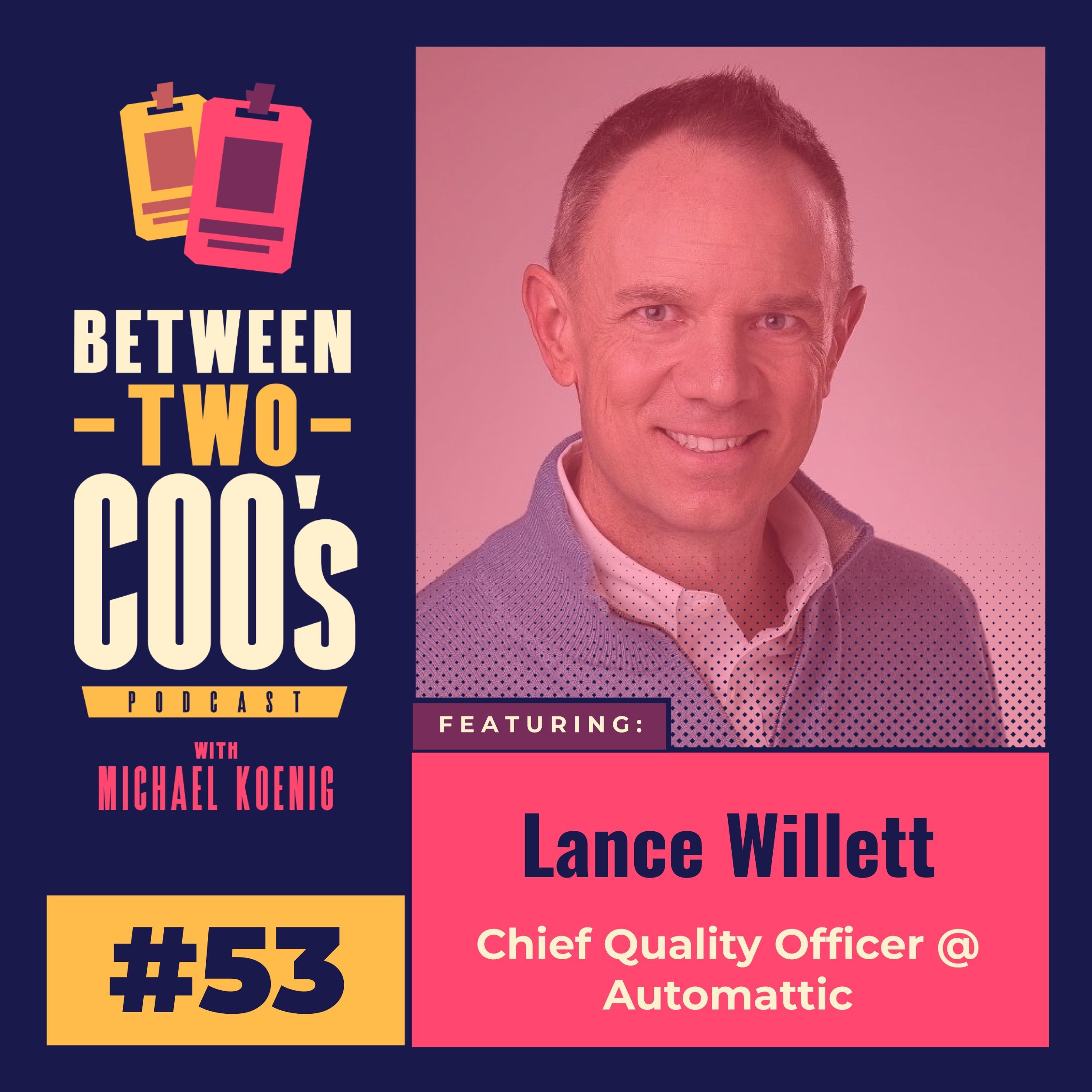
Lance Willett, Automattic CQO on Powering 45% of the Web
Watch on YouTube
In this episode, Michael Koenig speaks with Lance Willett, Chief Quality Officer at Automattic, about what it takes to maintain quality at the company behind WordPress and WooCommerce, software that powers 45 percent of the web. Lance breaks down quality as a feedback loop between craft and context, then walks through how Automattic standardizes tools, governs AI experimentation, and ships AI products like support bots and a site builder.
Lance gets specific about the operations behind that scale: an audit spanning more than 2,000 GitHub repos, WooCommerce stores that run 45 to 50 plugins each, quality benchmarks built on the DX Core 4, and a 20 dollar threshold for AI experiments. He also revisits stabilizing Tumblr through heavy turnover, Matt Mullenweg's insistence that details matter, and the 250,000 dollar revenue split error that still shapes how he leads.
Guest: Lance Willett, Chief Quality Officer at Automattic
Topics Covered:
- How Automattic’s open source culture evolved over 20 years
- What a Chief Quality Officer actually does—and why it matters
- Quality = Craft × Context, and how that feedback loop scales
- Automattic’s AI strategy: support bots, contextual UI, and site generation
- The importance of tools like Linear and Storybook in enforcing quality
- How Automattic balances speed, risk, and governance with AI experimentation
- Lessons from stabilizing Tumblr during its post-acquisition reboot
- Prioritization and the dangers of unbounded optimism
- Leadership takeaways from working closely with Matt Mullenweg
🕰️ Time Map
Topics Covered
- Intro, Lance's journey, and Automattic's open source ethos (0:00)
- What a Chief Quality Officer does, craft times context (5:00)
- Powering 45 percent of the web (8:00)
- Auditing 2,000 GitHub repos, signal versus noise (10:00)
- WooCommerce complexity and DX Core 4 benchmarks (12:00)
- QA rituals, bug triage, and Linear SLAs (17:00)
- Standardizing tools to drive culture change (21:00)
- AI guardrails and 20 dollar experiments (24:00)
- Support bots, conversational UI, and AI site builder (29:00)
- Competing with Webflow, Wix, and Squarespace (33:00)
- Free ecosystem work versus revenue pressure (36:00)
- Stabilizing Tumblr after the acquisition (39:00)
- Bounded optimism as the long term challenge (42:00)
- Matt Mullenweg's lessons and the 250K mistake (44:00)
https://fullstackleader.blog/ (work topics: WordPress, tech, productivity, quality, & more)
https://lance.blog/ (fun stuff: poems, stories, links; photos “on the go”)
https://clay.earth/ via https://automattic.com/2025/06/12/automattic-welcomes-clay/
Companies with dedicated quality efforts:
- > While fixing small bugs might not 10x your growth overnight
- > Not fixing them will make 10x growth impossible over time
Credit: Casey Winters – someone you should have on this show if you haven’t already
Mentioned in This Episode
- Lance Willett on LinkedIn
- WooCommerce: Automattic's commerce platform and a core quality challenge
- Tumblr: The acquisition Lance helped stabilize as CTO
- Linear: Issue tracker with opinionated triage flows and SLAs
- Storybook: Tool for automated testing of UI components
- DX Core 4: Framework measuring efficiency, speed, quality, and impact
Listen & Subscribe
Apple Podcasts · Spotify · YouTube · Amazon Music · RSS
About Between Two COO's
Hosted by Michael Koenig · betweentwocoos.com · b2coos.com
For more on OKRs and operational excellence, visit Helm.
Full Transcript
Show full transcript (auto-generated from audio)
Michael Koenig: Hello and welcome back to Between Two COOs. I'm your host, Michael Koenig, and today I've got a really special guest who also happens to be a dear friend of mine, Lance Willett, chief Quality Officer at Automatic, the company behind WordPress and WooCommerce.
Michael Koenig: Lance and I go way back. We're talking nearly two decades of friendship from the early days at Automatic, when it was just a small, scrappy team to today's global powerhouse. We'll be diving into how automatic's open source culture has evolved, what it means to maintain quality at scale, and how AI is reshaping the future of work.
Michael Koenig: Lance is just one of those people who's not only brilliant at what he does, but also has this methodical mind that shaped the way he leads. I'm so excited for this conversation, so let's just get going. Lance, so good to have you here. Welcome.
Lance Willett: Thank you for having.
Michael Koenig: Well, first gimme the story How, who is Lance Willett? How did you become who you are and how did you land? Automatic.
Lance Willett: Everything started [00:01:00] with an independent web developer. I was building websites as a hobby. I know you're a climber, so you'll appreciate, I worked in an outdoor store, so it was a mountaineering climbing store here in Tucson and I kept trying to get on the web team, you know, but I was a, I was working in the mail order, you know, shipping people carabiners when they were about to go up, you know, half Dome or something.
Lance Willett: But from there I left and started my own company and one of my first clients was the outdoor store. So I got to redesign their commerce site, uh, you know, as a freelancer. Really ran my own agency for five years. It was really fun, the pain of being a small business owner, you know, building that empathy.
Lance Willett: That's how I found WordPress. I was using WordPress as one of the tools that I would deploy. It wasn't only WordPress, but I liked it and I was paying attention to the companies around it. Automatic was on my radar. I always thought about the flexibility. This is years before Van Life and at this time I was living in an RV full time and I thought about companies that would allow that.
Lance Willett: Like there's Mozilla, maybe Sun Microsystems within MySQL team, [00:02:00] there weren't that many, and Automatic was a standout there. And so because they made WordPress, it really, I started kind of fanboying the people that worked there on Twitter, meeting them at conferences, and uh, one day they posted a job that was perfect for me.
Lance Willett: So part of my background is I'm a hybrid designer developer, so I don't really fit into any quite one like pure design, pure code. And they posted the theme role, which really interested me, and I applied and it led to a 10 year, you know, decade long role there.
Michael Koenig: And like so many people that end up. At automatic, they have a history with WordPress, whether it be in the open source community like yourself, building themes different plugins. I was building a plugin and somehow we all landed at Automatic, which was really special in those days because it's built on this open source ethos of, we are making web publishing better for everyone and democratizing it so people [00:03:00] in countries with oppressive regimes can have their free freedom of press.
Michael Koenig: There's that real ethos. Is that still there today? 17, 20 years later?
Lance Willett: In fact, it's more expansive. So our mission is beyond democratizing publishing, but now we talk about democratizing publishing, commerce and messaging. We have this three pillar business model. So yeah, it's expanded and that global scale is what really attracted me to. Beyond just the, obviously the, the obvious things around the tools that we love to use and the flexibility.
Lance Willett: It was also the scale. It's a pretty massive learning curve going from, you know, building one client site to building a theme that can be downloaded by billions or millions of people. But you mentioned the, the different cultures around the world. One of the biggest lessons for me early on was right to left.
Lance Willett: I had never encountered that. So Farsi, Arabic, uh, Hebrew . So people would send in bugs and were like, ah, I don't even know how to test this. Can I? There'd be hopefully someone, there's an automatic who knew that language and can help us, but that meant that mindset shift, right, where you're just [00:04:00] producing something just for your own utility or maybe for a client going then going 10 XA hundred x to the whole world.
Lance Willett: So yes, that ethos is still there. Working in the open is still there. A lot of the things that we've talked about over the years, we don't have to broadcast as much. The distributed, you know, versus remote, uh, conversation. That's the pandemic kind of blew that up. But we do still talk about the economics of open source, right?
Lance Willett: So I, I just had a conference with Linux Foundation and this came up over and over and over. The economic value of open source software is in the trillions now because it saves so much time that we can compute the value of the replacement cost of that. And automatic's been a big part of that.
Michael Koenig: I am building something right now, and whenever we can we go, well, let's see if there's an open source library for this that we can just pull. I've always been fascinated with open source and passionate about it. Now let's talk about, chief Quality Officer. What is that? Is it just a cooler name for COO or is this [00:05:00] something like fundamentally different?
Lance Willett: It's absolutely technical operations, so I won't hide that fact. But it is special in the sense that it has a gravity to it. And one of the things I've been noticing is there are other companies that have this, they don't always call it the same thing. Sonos has a quality ombudsman, for example, which I had even, I had to look up that word.
Lance Willett: I didn't know what it meant. Like a, like a guide
Michael Koenig: I don't know what it means. What does that mean?
Lance Willett: like a steward. Someone who pays attention to what ships, right? Quality control, but fancier.
Lance Willett: So you can, if you look at it from the technical quality, think of it like two Cs. So one Cs the craft, right? Design code, product management, all the things that go into making software.
Lance Willett: That's super important. So it's quality as we see it. The other C is context from those. We're making it for oxygen and from the outside it could be customers, users. With us, we have internal user, so it doesn't have to be an an external customer, it could be an internal employee using it. But if you put those two Cs together, now you get a feedback loop.
Lance Willett: And so quality is really looking to make sure that loop is connected, first of all. And then second of all, how it move faster. [00:06:00] So I would say it's not just code, though. One of the misperception about my job, I pay attention to everything. Copywriting, correct typography, how fast things load speed, page speed.
Lance Willett: Think about, um, I was working with my dentist, you know, help fix his site when I was in the chair WordPress site. And what it was, was he had a video on desktop, beautiful wifi on, you know, everything loaded. As soon as he went on the go with a phone and not on wifi, it, it, it took 20, 30 seconds to load and it was just one video that needed to be optimized.
Lance Willett: So that's also quality speed, security, accessibility, how forms work. And it sounds boring, but think about, um, go to market lead gen and you have a intake form, maybe even for like booking between two COOs. If you have too many fields and there's too much friction, that's part of quality, you're gonna have your businesses in grow slower.
Lance Willett: So, and one last misconception or sort of clar clarifying thing that's new to me in this, in this go round is the integration piece. So think of the ecosystem. WordPress is a platform, WooCommerce [00:07:00] is a platform. Quality to me means integrating really well with all the layers in the tech stack as well as the players in the ecosystem.
Michael Koenig: I am just, imagining that dental appointment, right? Whenever the hygienist is, cleaning your teeth and asking you questions like you can't really answer, right? Because, you, they have these tools in your mouth. So how are you troubleshooting a, a WordPress site? And, you know, I, I, I kid of course.
Michael Koenig: How was the you talked about forms. How was the between two COOs intake form, was that okay?
Lance Willett: Yep. Everything worked great. I didn't test a keyboard, uh, tab index, but No, you're good. This is, but imagine the scale of things though, right? Imagine like a HubSpot scale, or, I'm trying to think of another example, but maybe university would be a good example, really any business that wants to book, a counselor, a psychologist, someone taking appointments, the more forms you add, and this has been studied, with white papers and technical details and data.
Lance Willett: Obviously it's, it seems logical. [00:08:00] The more steps in your way, the less likely you would complete it. But it's just like a funnel. The more there is for the more steps in the funnel, the less likely you'll get to the end, just through sheer, stuff happens or you get distracted. So, yeah, yours was fine, but I get, I, I didn't test it deeply, so if you want me to, I would have to go
Michael Koenig: No, no, no. Don't, please don't, please don't, and don't try writing in Farsi, um, uh, RTL. I remember that being so difficult and digging into PO and mo files and I'm just thankful that I didn't, that I don't have to do that. So technical operating well first. I just wanna highlight for listeners who may not be familiar with it, WordPress powers, what is the latest 45% of website, the, of the top 100 million websites on the internet?
Lance Willett: almost half.
Michael Koenig: is a massive, massive scale. And WooCommerce the the E-commerce, plugin or version product rather of automatic powers. What, like a third of e-commerce sites out there, like we [00:09:00] are talking about really massive scale where simple things like forms working like languages that are right to left instead of left to right.
Michael Koenig: Where all of this is really, really important just in terms of the usability of the internet. So Lance's role as chief quality officer has very broad and significant impact across how people use the web over the entire world. Now, technical operations is really interesting because most of the time when we think COO we think go to market, we think general administrative.
Michael Koenig: I've led technical operations on more than one occasion. It is very undervalued. Normally, you may find this in the CTOs. Office, but having someone who's really focused on that quality, how has that changed things at WordPress at,
Lance Willett: This is a [00:10:00] fascinating question because so much of it is cultural. And when I was thinking about the challenges, you know, I'm forming a new team around this as well. So we're forming and have a charter and a three year plan, all that. So I already mentioned the scale and the scope. That's just even just the automatic products.
Lance Willett: Forget the ecosystem, but just our own things. Working with each other is a big challenge. I don't, you remember back in the day, you know, the homepage of automatic.com had the kinda the product list on it. It's hard for us to fit things on there now. Uh, I, I, I recently did, as part of technical operations, we had to do a bit like inventory management, which GitHub repo is where, you know, things like security updates, all that, who's owning it?
Lance Willett: Testing. And I was surprised there were over 2000 individual GitHub repos. Number one, that's hard to fit in your head. That's a lot of code to track. But there's also this notion of signal versus noise. So when you're looking at that many things at once, if they're all in the red, it would be impossible.
Lance Willett: To pay attention to. So going back to what I said earlier about the [00:11:00] craft versus the context, the inner loop of that, right? The, the development, let's include design and product and other folks as well. Data. But let's just say we're building an interface, a, a software product. We can get a lot of alerting and it's in our IDE or maybe it's in an cursor now, right?
Lance Willett: You get some immediate feedback, you're opening it up in a browser. But think about that at scale when you've already launched something, it's already out in the, in the public. How do you track all that? So there's a lot of noise, right? In these, in these, it could be a dashboard, it could be metrics, it could be simple like a, a Slack alert.
Lance Willett: And so what I'm finding is I have a lot of audit to do and a lot of cleanup to do, just to even figure out where's the signal? What is important? Let alone giving that to a team to look at, right? I want to evaluate it first. So there's something here around sense making or map making a bit like taxonomy of the whole thing to even figure out where to then put pressure on and change the culture.
Lance Willett: But what you were saying about. Um, from like a COO's perspective, it's always about growing the [00:12:00] business, right? Cutting costs, improving revenue, more efficient. I think about that as well. But in this case, we're also trying to just keep up with things, but we wanna drive things. You mentioned automatic's mission, and it's in, it kind of, it's in an inception that I would say what's so interesting about working here, that ambition has grown.
Lance Willett: And so when I would mention 10, you know, my boss would say a hundred, and that's still true. And so that goes with technical quality also, and I'll give you an example from Woo, the typical Woo store. Think that one of the that comes to mind is Brodo. It's a popular broth subscription service that you can have it shipped to you.
Lance Willett: Check it out. Y'all runs on Woo.
Michael Koenig: D two C broth, huh? Wow. That's a new
Lance Willett: I love that Brodo. So the typical Woo store would have something like 45 to 50 plugins. Which to me is a lot. My typical blog probably has like three or four, right? Like maybe an SEO thing or a site map thing. But it's very complicated 'cause you have things like tax, you [00:13:00] have shipping, you have lots and lots more. Well, back to the interoperability. Some of those are built by automatic. Some are built by like a third party partner, like 10 up, you know, WordPress agency. Some are built by the company themselves. Maybe they have an in an in-house developer. And so what ends up happening is with the breadth and the depth of that, it's very hard to know when you release a new version of the software Woo Core or one of the extensions that automatic built, how's it gonna work with all those other things, including the host, the PHP version, like I said, all the tech stack. And so if you think about it like two, like a quadrant, like you know, X and Y on one, you have the whole stack, right? Like how is this gonna work? You know, anywhere it's put out into the wild. And then on the horizontal is sort of the end to end customer experience. The person who visits that site to buy the broth.
Lance Willett: Checkout needs to be fast, mobile friendly, translated like so it gets complicated quickly. So to me, one of my responsibilities is once I map and audit all that, then there's a set of benchmarks. [00:14:00] So targets, just like you would do with financial, whether it's a forecast or a plan, yearly, quarterly, you do the exact same thing for a whole bunch of product quality metrics or technical efficiency metrics.
Lance Willett: And something for listeners, if they haven't checked this out, this is pretty common in engineering circles, but I think it's starting to come out further. It's called Core four. from a company called dx, and they have four. The the four are efficiency, speed, quality, and impact. And so what you can do is you can start to categorize what those signals are and then have target like an industry wide P 75, P 90, what other tech companies measure in that.
Lance Willett: And you can start to see, okay, where we wanna shoot for. So that's part of my job as well, is. Instrumenting everything. Checking in on it, reporting to the board on it.
Michael Koenig: And this is so interesting because automatic is the vast majority of people who work there are engineers. And so having smooth engineering operations focused on this Core four is focused [00:15:00] on having quality in check reducing human error. Creating an environment where engineers can do their best work is so critical to a company like Automatic.
Michael Koenig: That depends on this for its success. That's why I love this because we overlook the operations that go into powering 45% of websites on the internet and. With that said, I would like to thank our new sponsor, Brodo. If you like broth, but don't like having to go to the store and want a subscription, check out Brodo, what's their website?
Michael Koenig: brodo.com. Is it brodo.com. And Brodo uh, to whoever works there, you can send your check to. No, I'm just kidding. But we will be in contact over that anyways. Sorry for the broth. Divergence, any way we can
Lance Willett: Have you tried that by the way, the, there's this, there's this principle from nutrition where if you take the [00:16:00] protein first, it kind of evens out your blood sugar for the rest of the meal.
Michael Koenig: No.
Lance Willett: It really works. I haven't been doing brodo. I, I should start, but I've been just doing from the grocery store, you know what, you can get in a caner and you just heat up a little mug of it and then start your meal with that.
Lance Willett: A little bit like a, you would have in like a French restaurant. And then the idea is because your body starts to metabolize that protein first before any other sugars or complex intake, it just evens you out so you don't get a crash after the meal.
Michael Koenig: And that's brodo.com. Go start your subscription today.
Lance Willett: Unpaid
Michael Koenig: Uh, that's, that's fabulous. Perfect. Um, well, look, we, we think about quality and part of quality is accountability. In order to have accountability, you have to have expectations that are aligned in a company like automatic 3000 people or so. How do you do that at such a scale and ensure that quality.
Lance Willett: I love this question. Basically, the presentation I'm [00:17:00] doing ev almost every day to my business partners, whether they're in a business unit or they're, you know, engineering leader or design leaders. It all starts with the rituals. So again, the craft of how we build things, how do we get to fail fast experiment type loops.
Lance Willett: And part of that involves, you know, getting things to early beta testers or. How do you get immediate feedback before the ink is dry? That's one of the principles, and so part of my role is making sure that they know how to do qa. I'm putting that in quotes because quality assurance means so many different things to different people.
Lance Willett: But rather than have a separate step, like a separate QA team, how are you doing that yourself? Open up the browser, refresh, that type of thing. And there's so many modern tools here that we don't have time to cover all of them, but there's one called Storybook, which has all your visual components from your ui.
Lance Willett: Imagine like a design system with buttons and links and things. You can do automated testing on that to say, every time we change something in our code, does it change our interface, do our buttons, and do our [00:18:00] links, and do all our fonts and everything work well. So that's an example from the early, early days.
Lance Willett: But there's also cultural things, right? There could be tools and processes, but there's also things like when's the last time you talked to a customer? And it sounds dumb, right? It sounds like, of course, right? But it's, we have these yearly, we have a habit of yearly customer support rotation. So when you first get hired, you do two weeks of customer support.
Lance Willett: Used to be three when you and I joined, and then we do another year, sorry, every year you do another week. But beyond that, what's the pressure, right? So I think another part of my role is not, again, not just the craft of how we build things, but who's gonna use it and what's their feedback. And so an example here is from bug triage. That falls under me as well. Building the systems for that. So the principle is the cost to repair goes up significantly as time goes on. And when you're in those early days, you have the whole con your, all your files are open, your browser's open, your IDE is open. It's really cheap and simple to fix something.
Lance Willett: If you're talking to people using it later, maybe you've moved on to something else, you've closed that down. But there's also security [00:19:00] li, you know, legal liability. made commitments to partners. It's out in the wild. It's a lot more expensive. So in early, you know, computer science textbooks, there's this really famous graph that shows this kind of decay of a lot of bugs in the beginning, cheap to fix.
Lance Willett: And then the, the cost goes way up post-release. So when I'm talking to teams, when they're asking me about quality or testing, I say, do as much as possible before the ink is dry. And then get really strict on, you know, what you accept and how you're doing that triage to look really quickly for the high impact bug.
Lance Willett: So if we have time to talk about it today, one of my new favorite tools is linear. It's a project and issue tracker. And Linear has very specific built in opinionated flows on triage, if something comes in and it automates the priority, it pings the team lead and they ha have to fix it With an SLA that you can set up, like if, if it's a high priority within a day, if it's a, if it's a normal priority, maybe within a week. there's ways you can shift the culture using the tool. And that hits both the operations, right? How are we're gonna get this done and how are we gonna measure it? It also [00:20:00] goes to, I don't even have to think about it at scale, because if we have one central tool, then different teams don't have to adopt different principles.
Michael Koenig: Hmm, well you brought it up. Let's talk about culture shifts, culture change. These things are really difficult. Um, early days at automatic, everyone was from open source essentially, and it was very much a, Hey, wouldn't it be cool if, and then we go off and do it. And as we grew and grew, that doesn't necessarily scale.
Michael Koenig: And so there was culture change and with all culture change, some people embrace it, some people resist it. You get folks who opt out and leave and go on to bigger and better things. How do you do it at scale like this, especially when. There's so much technology change. We're talking about using a tool like Linear using ai.
Michael Koenig: We'll, we will definitely talk about ai, but before we get there how do you think about that now?
Lance Willett: Hmm. It's, it's exactly the role of the operations leader. In my [00:21:00] opinion. One of our jobs is to come up with a standard consistent set of tools across all of automatic case in point, GitHub for code Figma for design and linear for project and issue tracking. just decided we're picking that master that maximize that.
Lance Willett: So that's one thing is you can have a top down approach where you say, this is the best in class. Think of when Slack took over IRC. There was a team at Automatic, I think it was the design team using Hip chat at the time.
Michael Koenig: Mm-hmm.
Lance Willett: It was a lot more visual, a lot more interactive. They were really enjoying it. Eventually we ended up using Slack and that's the defacto now. So it's not just 'cause we like the tool, it's because it improves execution, right? One place to learn. So going to AI real quick, if we're gonna build an MCP integration or we're gonna build some ai, I don't wanna do that in three different places.
Lance Willett: Trello, Asana, GitHub, I wanna just do that in linear. And by the way, they're one of, we're a close partner to them. Maybe they can even build it and we don't have to. So one place to add AI assistance, that's one principle. It also increases visibility. So single source of truth. We, I say this every day so many times [00:22:00] that, uh, my dictation app, I use this app Whisper flow for dictating AI power tool.
Lance Willett: And it has started adding that to my dictionary to kinda like text expander of your, where you would type the, the same thing a lot and it would suggest a snippet to you for support agents and stuff. So single source of truth, what does that do? Now if I'm a team new teammate and I need to onboard, I just go there.
Lance Willett: If I'm a manager, I need to check in on things. I go to those insights one place to, to look at the data next. We have corralling costs. I don't have to negotiate three different vendors. So one thing that happened in automatics history, we used to really lean on the autonomy, do your own thing. It's okay.
Lance Willett: You know. Well, I've noticed in the shift, as I, as I've, I've matured, but also the company has matured, is we do less of that. We do some of that in terms of flexibility of time, how you build things. But in terms of tools, we've really tried to be more consistent. So at scale, across that many employees, that negotiation with that vendor.
Lance Willett: If we go to one vendor, we'll have more negotiating power. Another one is for very, very, very important to me is how [00:23:00] do I set and teach a higher standard? So how do I speed up if I'm trying to build a culture and maximize the use of this tool? I want that to be front and center for everyone. So if I go into an all hands or a town hall, I want that just to be one kind of easy memorable thing, like this one shortcut or this one tool, or watch this one video.
Lance Willett: So it speeds up how we spread knowledge and skills. And lastly, I think that something with the tool and the way it, it supports an opinionated workflow, it actually speeds up shipping. And I don't know how to exactly how to explain this, but one of our principles has always been learn in public ship faster.
Lance Willett: And rather than wrangling a tool and becoming like an expert in that thing, let's become an expert in shipping code. So if the, if we can maximize and learn the tool really well, then that all goes away. And now we're operating the way we wanna operate.
Michael Koenig: Well this is interesting now we're talking about shipping code faster, but effectively. And here's where we get into ai, right? There's this paradox. Essentially, AI lets you ship faster and scale, but it also introduces [00:24:00] tons of noise and unpredictability. How do you balance that?
Lance Willett: The most important thing to me with all these AI use cases is what problem are you solving? It's back to basic product management or even entrepreneurship, right? The most basic business principle. Who's your customer? What's their pain point, and how does your solution do it well enough for them that they're willing to pay you?
Lance Willett: Exact same principle for all these things, and I've been thinking about this a lot because with testing and QA and, and quality, there's a lot of opportunity. Speaking of the scope and the scale and all these things to just deploy an agent, right? Or unleash some, some intelligence on it. What if we don't even know the workflow?
Lance Willett: What if we're not even sure what the pain points are? Right? So it all goes back to you need to know your customer. You need to know those loops, whether it's an inner loop, an outer loop. What's the feedback? How are you gonna know if it's going well? Is it checking in? Are there places, are there metrics?
Lance Willett: Are there dashboards? Are there po? Can you pause it? Right? So I feel like the design and the judgment and the [00:25:00] foresight is so critical before even thinking about is it automation? Is it ai, gen, ai versus off the shelf tool that has that or maybe not. And beyond, I think the design. Then you get into probably some of the governance and things like data.
Lance Willett: How do I know where this is gonna be shared? What model? You know, that kind of thing, that that's just diligence, basic stuff you would do with any vendor. But it's moving so fast that I think it's easy to get fast and loose with that. And so one principle I've picked up, and I think our team, we have a internal AI team, has really been.
Lance Willett: Pushing this, doing a good job pushing this internally. If it's under a certain threshold, like you're doing a quick experiment, just go ahead, right? 20 bucks, show us what you did. Kind of execute out loud a little bit. Show, you know, show and tell. If you're gonna do something that's a bit like you, then you got to customer, you're gonna start working on data that's, uh, you know, maybe has some personal information.
Lance Willett: That's where you want to then lean on the team. That's where you wanna have a little bit more of a decision making conversation.
Michael Koenig: And that's so critical, um, is setting up those [00:26:00] guardrails and the guidelines on here's how you can use AI in a safe way and make sure you follow this. We're all about experimentation. Have, you know, like, go ahead, expense that 20 bucks. Show us what you can do. But there has to be a very firm understanding of what is and is not permissible to include in that.
Michael Koenig: How has that scaled? Because to me that is so difficult.
Lance Willett: It's still early days, but I'll share an example of what I've been putting in my workflow. I can't speak for other folks at Automatic, but I have seen a lot of experimentation. We were doing a bit like a hack week here and there, you know, build something today and share. It's really exciting and really fun.
Lance Willett: But one thing I'm doing, let's say I have a spreadsheet, so I've got my Google sheets open. I've got a bunch of columns and maybe one of them is, maybe it's recruiting. Let's just pick that. So I've got some names, some LinkedIn, so it's personal. Got the person's email maybe, or something like that. Some of it's public, some of it's not. I'm not just gonna paste that into chat, GPT or Gemini necessarily, but one thing I learned recently was because we're a paid Google workspace account, [00:27:00] there's a different data agreement that it will not be used to train the model. I have to research that, verify it, check with legal, et cetera, with chat GPT.
Lance Willett: If I just open up or perplexity or some other vendor, which is great user experience, but I have not done the diligence to see what their data agreements are and it's not paid part of our paid workspace, that's where I get like a mental step to say, let's, let me check that first. So what I've been doing is I've just been using Gemini more often within my automatic workspace as that my default first stop, because I know it has that data production behind it where they aren't gonna share that data out.
Michael Koenig: We're talking about risk management here, but how do you disseminate those practices for risk management?
Lance Willett: One of our principles, you might remember the open communication. We have this blogging tool called P two. We have Slack. We don't use email too much. And one of the things about that open communication is if you share it with one party, everyone else sees it. So you can disseminate a bit by osmosis or a bi rubbing shoulders.
Lance Willett: But there's also this idea [00:28:00] of repetition. And this is probably a typical executive leadership thing, right? Say it 10 different times. For me, what has come up for me is I make a slide deck, I make a P two post. I make a Slack update. You know, I mention in every meeting, then we write it down. So we have a field guide, which is like our wiki in that field guide has a one-stop shop.
Lance Willett: So ai, you know, tool use for everyone. And you kind of bookmark that, pin that to the top of the field guide. So when someone lands there, they see that. And then beyond that, you know, all the typical things like an like a team lead or a manager would, Hey, help us spread the word on this new employees. Tell them immediately. What I've noticed also with tools, I'm trying to think of a good example here. Maybe linear has this, but maybe you have a good example when you have something that is sort of a preamble, like you're typing into it and has that little help text or the tool tip, you could also program it in there a bit like a heads up display of like, Hmm, are you sure?
Lance Willett: And before you click enter and it can kind of have like a little help section. That's something I've done a bit in my coding for internal tools. I'll have like a little, you know, reminder with hopefully not to, [00:29:00] not blocking them, but just kind of like before you post this, are you sure you wanna post this?
Lance Willett: And that's another way you can link out to documentation and things, but.
Michael Koenig: And there's a business idea here, by the way, folks, anyone wants to go and solve this challenge. You can probably use AI to prevent people from putting bad things in ai. So there you go. If someone wants to go out and start that business, you can send the check to, no, I'm kidding again. Uh, man. Well, AI is so cool these days.
Michael Koenig: Obviously, it's going to be with us for a long time. It's changing how we do work. It's changing how we think about the scope of the world. What's the best real world use case of AI at automatic right now?
Lance Willett: Ooh, probably our chat support experience. We have a home built, uh, bot that is deflecting support and really shifting. There's two parts to it. There's the conversational ui, right? When you're trying to get to support, there's also surfacing the right context at the right time. That's been a big push for us across all our products, [00:30:00] and I've experienced it as a consumer myself before I return to automatic.
Lance Willett: I was building websites again, and I had to contact wordpress.com support, and it was a bit in the rough stage. And you know, six months ago, it's really improved since then. We've put a lot into it. And the idea here is well-trained happiness engineers, that's what we call our support line reps, our frontline support.
Lance Willett: They can then spend time on upselling, getting engaged with customers on a zoom call rather than here's the docs for the DNS for your domain, right? Which would be obviously the interface if the app is built, right. So some of the trends I'm seeing are we can then categorize some of those interactions and start to improve everything, product support, documentation, tooling, just from the data, right?
Lance Willett: Even without humans in the loop. That's been a beautiful feedback loop. And then another thing I think is what are some ways we can introduce new ui, so new interactions that don't exist right now. One of our recent acquisitions is WP ai, James LaPage and [00:31:00] team. He spoke at WordCamp US last year and I was really excited by his talk.
Lance Willett: Then he joined the company and one of the, the things he showed in that WordCamp talk was, than trying to figure out where the menu is for that one plugin for that one thing you need to do, which you can never remember, you just talk to it. Conversational natural language. I need to update my tagline, right?
Lance Willett: It takes you to that page. So that's another thing. And then the third thing I would share, super proud of this for the team that's been working on it is our AI website builder, perennial pain point with WordPress is themes and customization. How do I get it to look like the demo? How do I get that font that I saw the other day and how do I get it, the sidebar?
Lance Willett: You know, it's just so complicated. And if you don't know CSS or HTML or even WordPress. So we've built a AI site builder that's really, I would say it leaps ahead of what has been seen before and we really hope we can bring this to the rest of the ecosystem eventually.
Michael Koenig: And pretty soon you won't have to uh, navigate away from that chat to update your [00:32:00] site's tagline and it'll just do it for you. Yeah. That's coming tomorrow?
Lance Willett: I think that's a good idea in the sense of things that are deterministic, but the assistant would also be there for the kind of the creative stuff. And that's what I was going on, going toward with the happiness engineer conversation. At our, at our best, if we're in support, we're enabling the person to grow their business or get their gold, grow an audience.
Lance Willett: You know, we have bloggers too who build, you know, newsletter subscriptions and things. Well, I'd rather spend time, uh, with them talking about how do you grow an audience and what, what, what should your headline testing strategy be versus where's the headline again? And do I need to do an H three versus an H four with my theme?
Lance Willett: You know, it gets kind of ticky tacky. And so I think with a conversational ai, whether it's, whether it's the tactical stuff like this one time chore, I never have to do ever again. I'm not gonna memorize this. Just do it for me. Like SSL certificates or something super tactical. Those, by the way, those are still really annoying and really painful for a lot of consumers.[00:33:00]
Lance Willett: On the other side of that is sort of the more generative, right? And that's where you can get into, I've got an idea, but I don't know how to do this with this tool. And I think that's where the opportunity is for growth
Michael Koenig: So early days of WordPress. A lot, a ton of excitement. There are people probably don't even remember these, some of the incumbents were movable type and typepad both from six apart which I don't even think exists anymore. There was what? Microsoft Live journal,
Lance Willett: text pattern
Michael Koenig: type. Yeah. Yeah. And WordPress came along and just put 'em all outta business.
Michael Koenig: WordPress has been around now how many years? 20. 25. Long time. Yeah. And when we're talking about 45% of the internet, the slightest little change is quite consequential. And there's that same, big ships are hard to turn. There are all of these upstarts, Webflow. I recently had Linda Tong, the CEO of Webflow on there's what?
Michael Koenig: Wix and Squarespace, how do you. Keep pace, how do you keep pace with the innovation that they're putting out while still maintaining the internet that people can still go to 45% of those websites?
Lance Willett: I love this challenge and it's why a lot of people are still sticking with this thing. 'cause
Michael Koenig: Hmm.
Lance Willett: you get to a certain, like an S-curve where you've kind of solved the first challenge and then there's another one right behind it. You know, you're hiking and there's another mountain range right behind it.
Lance Willett: So it's really endless ambition, endless challenge.
Lance Willett: I dunno if you've used either of those tools, but Canva particularly, really democratizes design. I mean, it's just, you can almost speak into it and it has templates in it.
Michael Koenig: My 11-year-old is a Canva Power user, along with a, well, it was Dolly and then what? SOA and yeah. Image gen. And like I have a pro account for Canva for myself, but if I go in and I look, it's just, I have to scroll very [00:35:00] hard to find my projects because it is dominated with the incredible creativity of my 11-year-old, which I think speaks to the beauty of the software and the product.
Lance Willett: But how do we harness that same power? And I love the idea of a younger person because they're not bound by the same constraints you and I would think of like, oh, the sidebar should be on the left. They don't care about that. It's like, I didn't want it this way. Minecraft, another example is, right, build whatever you want. So I think the future and how we push goes back to the how. What problem are we solving, which is, I want it to look like my vision that's in my inside my head. Without getting in my way, that's any creative task.
Michael Koenig: While maintaining that, that innovative edge which, it's true, the upstarts will be able to move faster, there's no question about it, but it really comes down to the businesses and how do we react? How do we respond? How do we ensure quality is there? Taking off the engineer hat, putting the business hat on.
Michael Koenig: Back in [00:36:00] my day at auto, oh man, gosh, I sound like an old guy in my day. We used to type full blog posts ourselves. Anyways uh, back in my day at Automatic, it was very supportive of building products that were completely free. And would always be free, right? Because it enhanced the WordPress ecosystem.
Michael Koenig: But now there's hundreds of millions of dollars of venture capital investment that has gone into automatic. The last was at a $7.5 billion valuation, and I imagine more pressure to generate revenue. Is that the case? And like how do you balance that beautiful thing of putting out things that just contribute to the overall ecosystem versus the very real need to generate revenue and show a return to those investors who have put so much money in.
Lance Willett: Some of it happens organically. I think that one of our many, many, many years now, motto or sort of part of our creed is we're helping build a sustainable livelihood for folks, whether [00:37:00] they're in the ecosystem or outside of it, right? They can get a job in a WordPress related ecosystem company, or they're building a business on this thing.
Lance Willett: So that, just like any other, you know, for-profit company. That's a flywheel of if you help other people grow, they will. It's a high willingness to pay, right? So they'll renew at a good pace. So I think some of the, some of it's organic. You already mentioned innovation and pushing. That's another piece where you gotta really cross innovator's dilemma, how do we disrupt ourselves?
Lance Willett: And that goes to like the, the page building that I mentioned and kinda the new, how people are interacting with digital apps in general. How is WordPress in that space? But my brain starts to go a little bit toward, uh, on the quality side. There's a gravity that attracts customers organically when you have high quality such that the loyalty and the expansion happen without a lot of marketing and sales dollars.
Lance Willett: That's a unique kind of quirk of automatic is we haven't always been a marketing powerhouse. In fact, you could argue that's not our strength. We were an engineering led shop. What comes to mind for me is this [00:38:00] quote from Casey Winters. A skilled operator that might be a good candidate for this podcast.
Lance Willett: He talks about, while fixing small bugs might not 10 x your growth overnight, not fixing them make 10 x growth impossible over time. So the system thinking around that, right? The first principles of what's the long term compounding effect? What do we do today, which will then bring us to that dollar valuation or the next, next phase of that.
Lance Willett: So we have to continually think about the, the quality of our, of our product, how that lends itself to renewals and expansion, the innovation, making sure that we're meeting people's needs. And then the other side is the team. The culture.
Lance Willett: So those, those two things are essential to that long term growth.
Michael Koenig: there's another interesting thing to talk about here. Automatic acquired Tumblr for next to nothing, especially when compared to the $1 billion price tag that Yahoo paid for it. You became the CTO of Tumblr, and as I understand it, you along with the rest of the team largely [00:39:00] stabilized a company that I imagine was bleeding cash, probably bleeding talent, and users.
Michael Koenig: Take me through that.
Lance Willett: It's quite a journey. It's still going, Tumblr is still alive and kicking. I would say. You mentioned this already, but the cost cutting effort, that's anytime you bring something in. That's not special to this case. But Tumblr was a really popular web originally and it kind of morphed into Android and iOS, like a heavy duty mobile.
Lance Willett: And it also shifted from text and maybe some images to much more video. So the cost to host it was a lot more than I think a lot of folks knew about just the sheer cost of the servers. You know, video is more expensive than image, but how you, uh, compress that, how you serve that. To me, the other piece of it was.
Lance Willett: It just brought a lot of things we didn't have at robust scale within automatic, which was all built around community and topics and tags.
Lance Willett: So really kind of shifted our culture for a positive there. But for me personally, it was definitely a masterclass in change management and operations. I mean, probably my first tab every morning [00:40:00] was, what are the server costs with AWS, you know, what's the staffing? You mentioned, you know, the best folks.
Lance Willett: That was a big lesson actually on a base of like 200 or 300 people. We turned, we turned over probably a hundred seventy five, two a hundred, like quite a few in the first year, 18 months. So how do you find ways to engage the best people, bring them into key roles in the parent company? Make them all stars and make them rock stars and what they're good at, their strengths.
Lance Willett: And how do you get to a fast no, with those that you know aren't gonna stick around very long. That was difficult for me because I think there's so much work to do. You don't necessarily want people to leave to somewhere else, but you kind of knew that they weren't gonna stay. So it was a tough conversation, but I would say it really boosted us in some ways and then in other ways, um, it, it stretched us.
Lance Willett: So it stretched us on infrastructure, it stretched us on, I mentioned recommendations and data. Uh, and then the piece that's harder to talk about, uh, because it's just not my expertise, but there's the safety aspect as well. This is a, this is an app that's really popular with younger folks, 15 to 25, [00:41:00] typically Gen Z or, or younger.
Lance Willett: And there's laws around things there, like how, like what age people can join the platform. You have kids that age, so I'm sure you know all this. And then there's. It's the web, it's the internet, right? So there's people posting stuff that you don't want those kids to see.
Lance Willett: And so that aspect is just very challenging.
Lance Willett: You know, meta Instagram, Facebook, TikTok, you know, do this at scale. But for us as a smaller company, that was very, it continues to be a challenge. And I think that was something that I underestimated personally, and it's still something we're learning how to do. Well.
Michael Koenig: You said it was a masterclass in in change management. What's the biggest lesson? What would you do differently?
Lance Willett: This is outta my control, but I would've met in personally, this was the pandemic. Uh, the team was in Manhattan, mostly in New York City. I was in Arizona. I never got to meet anyone. Zero. So it was all mediated by video. No tr it was typically one of our strengths is we do meetups, so we travel in between and see each other frequently. I had zero time with the Tumblr team, so if I could do it all over again, I would, you know, make my way and shake people's hand, give them a [00:42:00] hug, boost them up with the more human side of things. That's one of my strengths. I just didn't get to do that and I, I regret that.
Michael Koenig: Well, not something you can really regret, right? The world shuts down. You don't necessarily get to hop on a plane and to Manhattan and shake hands and give hugs. So give yourself a little bit of a break there. Looking at automatic, looking at the pace of iteration, looking at just how the tech world is changing.
Michael Koenig: What do you think the biggest business challenge that automatic faces over the next 10 years is?
Lance Willett: Probably our long term challenge and is our optimism, I would call it bounded optimism, but it's our ambition to be really stretch and grow. And so one of the maturity cycles that we're in now is not taking on too much. And I'm seeing this from the quality side. 'cause I have to track everything. There's a lot of stuff, right?
Lance Willett: And so what's our appetite and how do we do sort of a portfolio review of that from a business ownership standpoint to say, maybe think of like a high performing quadrant and a [00:43:00] lower performing quadrant,
Michael Koenig: Mm.
Lance Willett: and not have it be an emotional or gut decision. And I think a lot of this is my, uh, personal, uh, tendency.
Lance Willett: I think why I, I really thrive in this culture. A lot of what we do is in that vein, like we see a new opportunity and we go for it. We're fast, but you have to wait against everything else, all the other opportunities. So I think that's one of our biggest challenges is what are we doing? How does it fit in with what we're doing now?
Lance Willett: How does it integrate? How does it create a, a sum that's better of its parts? Good example is our latest acquisition. Clay. Clay, earth personal CRM. It's part of that messaging pillar that I mentioned. How do you, when you're speaking to someone, have all the information about them that you need? If you're booking a meeting or things like that, really great, great tool, but that could be a distraction from something else, right?
Lance Willett: So how do we put it in its place? How do we make sure that we give it the right amount of investment, but not too much or too little? I think that's one of the biggest things.
Michael Koenig: Lance, you've worked with Matt Mullenweg, the founder of Automatic and WordPress for such a long time, so very closely. He is such a brilliant [00:44:00] founder and such a a, a brilliant businessman and investor.
Michael Koenig: What's the most impactful thing that you've learned from him?
Lance Willett: It is hard to pick. You had asked me this a couple years ago and I had 10, so I gotta pick one. Let me pick the one around, I'll pick the one that's harder for me at times. Other times it's, it's simple. But the principle is details matter. So look, your best, look an interface. And the way this comes up is, let's say you're gonna put out a press release or you're gonna put out a public blog post about something double and triple check it.
Lance Willett: Is the screenshot to the right screen? Is it, you know, on a Mac, is it gonna be blurry? And Matt has a reputation for being very picky about those things. But I love the principle behind it, which is first impressions matter. Think about onboarding to an app, right? So the first run experience, this comes to play how the logo looks, how the patient, the field, the form fields, which we talked about today, the usability.
Lance Willett: So this isn't just aesthetics or visuals, it's also how the thing works. So Matt has drilled into us, and I've taken this to heart of. [00:45:00] a little bit extra attention to how the human interface works and not just the technical details. It needs to load fast as well. But if you look your best and the details are in place, then you have a chance to have that conversation.
Lance Willett: Now you have a chance to, uh, open up the conversation for someone to become a customer, take their money rather than something that's a bit more sloppy or a bit not your best work. And there's been so many times where, in my role, it's been a bit of like a Matt Whispering role where folks that are around me, it could be a third party coming into a negotiation.
Lance Willett: It could be a teammate within the company. I'll mention this and they'll say, oh, I, it's okay, right? It's good enough. And I don't know that that's true, right? I think that it is something that we need to pay attention to. And so it's really impacted me even what we're doing right now, right? The setup, the lighting, the technology like fast computer.
Lance Willett: Investing in my home network. All these things come to play and there's so many aspects to this, but the principle remains, [00:46:00] which is you want an opportunity to be in the market, if you wanna be an opportunity to be a leader, if you want the opportunity to be an operator, put your best foot forward, make it your best shot.
Lance Willett: And I think that's really stuck with me to this day.
Michael Koenig: Love it. Okay. It's time for my last and favorite question. We've all had those moments where we've been in the seat and something completely off the wall happens and we thought, I never thought I'd see that. Do you have one you can share with us?
Lance Willett: Everything I learned about failure started with my quarter million dollar mistake. Everything was going great. We launched the themes marketplace. We got together in San Francisco, so it was the, the third party partners, the internal team at automatic. fives, handshakes, hugs, and we were flying high.
Lance Willett: So partners were happy 'cause they had a new revenue stream. We were happy the platform. And then the customers were really happy because now they had new options for their, we talked about this today. Customization, new themes, new colors, new [00:47:00] fonts. And then we got home. And the glitch, it was a shock. So we had a simple arithmetic error that meant for the first six months of this marketplace, instead of the even split, sending out 50% of revenue to the partners, we'd been sending a hundred percent out.
Michael Koenig: Wow.
Lance Willett: My heart sunk. I was digging in with the team. I didn't know how I was gonna come back from this. My Skype lit up, and this is in the days when the CEO, it was the CEO calling. And he typically did text only, no video, no phone calls. So I knew it was serious. I didn't wanna hit that button. How was I gonna pay for this?
Lance Willett: I mean, it was multiple times my yearly salary. So I click the button. Matt gets on, he's calm, he says, Lance, I'm glad we found it. I'm glad we understand it. I'm glad we're gonna fix it. Now I need you to do, to go do the hard work of talking to the providers to break the news to them. So I was relieved. You know, we, we learned, we understood it, we're gonna move on.
Lance Willett: But what I took away from this crisis was two leadership lessons that have stuck with me. One is, money [00:48:00] isn't everything. Number two, our mistakes don't define us. I've taken that appreciation to the teams I've led to have this space to make mistakes while working together in an atmosphere built on trust.
Michael Koenig: And what's one mistake you will never make again? Just that fantastic. Lance thanks so much for joining me. This has been, it's been a really special treat for me. Where can people go to, to keep up with you?
Lance Willett: Full Stack Leader blog. That's my work blog. So I have productivity, WordPress stuff, you know, work quality. If people are interested in more on that. I also have Lance do blog that's more on my personal side. Photos, poems, a few stories, and that's a bit more like my on the go. If I'm traveling, I'll try to put something up there.
Michael Koenig: Fantastic. Well, there you have it. And thank you very much, Lance. Thank you so much for joining me. Thank you all for listening to Between Two COOs. I'm your host, Michael Koenig, and a very special thank you to Lance Willett for joining us. [00:49:00] Tune in next time for our next co o Chad. I'm between two COOs, and be sure to subscribe on Apple Podcast, Spotify, or wherever you listen to podcasts.
Michael Koenig: So you never miss an episode. Just visit between two coos.com for more. And if you have a minute, please leave us a review so other folks can get great advice from phenomenal COOs, or in this case, chief Quality Officers C QoS. I'm not sure there's any others out there. Thanks for listening to this week's episode.
Michael Koenig: Tune in next time, and until then, so long.
More on AI in Operations
The COO's Execution Playbook
Frameworks, templates, and hard-won lessons from operators who've been in the chair. Every Tuesday.
No spam. Unsubscribe anytime.