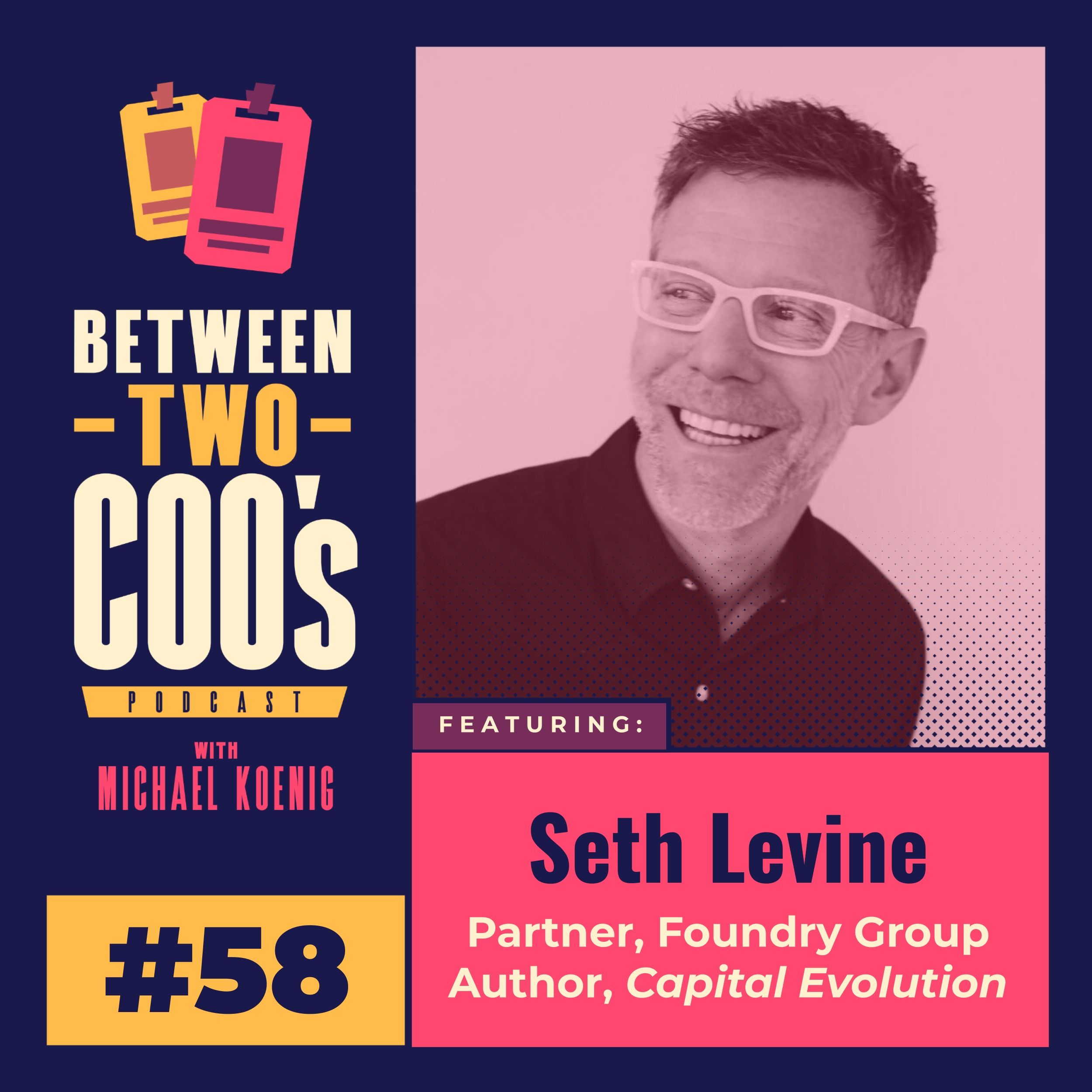
Seth Levine of Foundry Group on Capital Evolution and AI
Watch on YouTube
In this episode, Michael Koenig speaks with Seth Levine, Managing Director at Foundry Group and co-author of Capital Evolution, about how American capitalism is changing and what that shift means for the people running companies. Seth traces the book to a board dinner after the Dobbs decision, where a portfolio CEO asked whether he would accept a lower return for the company living its values, and explains why businesses are pulled into roles once held by government and media.
Seth contrasts Milton Friedman's shareholder doctrine with the dynamic capitalism the book proposes, built on long term thinking, a limited but real role for government, broader employee ownership, and respect for the rule of law. He cites executive pay up roughly 900 percent since Friedman's 1970 essay while average worker pay rose 12 percent, urges quarter by quarter planning for 2026, and recounts the AdMeld board crisis that preceded its half billion dollar sale to Google.
Get 90 Days of Fellow's incredible AI notetaker for free at fellow.ai/coo
Guest: Seth Levine
Book: Capital Evolution
Podcast: Between Two COO's
Host: Michael Koenig
What we cover
- Why Seth wrote Capital Evolution and why now
- Why today’s economic shift is structural, not cyclical
- How power has moved from public institutions to businesses
- What companies are being asked to carry that they weren’t built for
- How AI fits into this broader realignment
- Early signals that companies are adapting well to AI
- What strong executive teams do differently during uncertainty
- Common leadership traps when change happens too fast
- A real crisis from a portfolio company and what the executive team did well
- The new leadership muscle operators need for the next decade
Topics Covered
- Introduction and sponsor message (0:00)
- The 30 second pitch for Capital Evolution (1:57)
- The board dinner question that sparked the book (2:22)
- Coinbase, Jamie Dimon, and values versus politics (5:38)
- The Business Roundtable redefines corporate purpose (10:00)
- Where Friedman style capitalism went wrong (11:09)
- The four tenets of dynamic capitalism (16:09)
- AI and the future of work (19:47)
- New graduates and the entry level sugar high (24:22)
- The instability CEOs are quietly worried about (30:39)
- AI in every boardroom and 2026 planning (34:50)
- AdMeld's working capital crisis and turnaround (40:30)
- The vodka luge story from 2001 (44:24)
- Where to find Seth and the book (46:30)
Mentioned in This Episode
- Seth Levine on LinkedIn
- Capital Evolution: Seth's new book at the center of the conversation
- Foundry Group: The venture firm where Seth is managing director
- The New Builders: Seth's earlier book with co-author Elizabeth MacBride
- Business Roundtable: Its 2019 statement redefining the purpose of a corporation
- Friedman Doctrine: Friedman's 1970 shareholder primacy essay the book pushes against
- Strong Floor, No Ceiling: A recent book Seth cites on opportunity and inequality
- AdMeld: Foundry portfolio company in the crisis story, later acquired by Google
Listen & Subscribe
Apple Podcasts · Spotify · YouTube · Amazon Music · RSS
About Between Two COO's
Hosted by Michael Koenig · betweentwocoos.com · b2coos.com
For more on OKRs and operational excellence, visit Helm.
Full Transcript
Show full transcript (auto-generated from audio)
Michael Koenig: Hey, it's Michael. If you've been on a Zoom with me lately, you'll notice that you have my full attention. It's because I'm not taking notes. Instead, I rely on fellow and AI meeting assistant to take notes for me, along with tracking action items and decisions, handling recordings, transcripts, and summaries, all in one secure platform.
Michael Koenig: It's kind of like magic built with security and privacy At its core, fellow is the only AI meeting assistant that thousands of leaders in organizations trust. To capture meeting notes and recordings while keeping your data safe. They're so confident that you'll love it. They're offering an insane deal to you all between two COO's listeners, 90 days of unlimited AI powered note taking and recording completely free.
Michael Koenig: Visit fellow AI slash COO to sign up today and experience the AI meeting assistant trusted by leaders everywhere. [00:00:55] [00:01:00] Introduction
Michael Koenig: Hello and welcome to Between two COOs. I'm your host, Michael Koenig. Today I'm joined by someone who has shaped how founders and operators think about building companies. Seth Levine is a managing director of the venture capital firm, Foundry Group, and the co-author of a new book, capital Evolution Up. Book about how the American economy is shifting and what it means for the people running companies.
Michael Koenig: Seth has spent years inside boardrooms and alongside founders watching AI automation, remote work, political fragmentation, and declining institutional trust reshape how companies operate. These aren't just. Abstract forces. They show up in hiring, decision making, operating rhythms and leadership models.
Michael Koenig: The center of gravity has shifted. Businesses hold more power and more responsibility than ever, and operators sit directly in that tension. Seth, welcome. Thanks for being here.
Seth Levine: Awesome. Fantastic introduction too. Thank you, Michael.
Michael Koenig: Oh, thank you very much. Well, I wanna ground the conversation that we're about to have in your new book, capital Evolution.
Michael Koenig: Gimme the 30 second elevator pitch. What's your book about?
Seth Levine: Yeah, so thanks for that. Capital Evolution talks about the changing landscape of capitalism. It is. In one part, a defensive capitalism wasn't exactly what we thought we needed to write three years ago. Seems pretty relevant today, but it also is a discussion of the ways in which capitalism both is changing and needs to change. [00:02:22] Why This Book Now?
Michael Koenig: Three. You started this three years ago and you spent two years researching. I mean, to your point, it's incredibly timely, but going back three years, why this book? Why now? What did you start noticing that made you think that something big was actually changing in the way our economy works?
Seth Levine: Yeah, the, the genesis of the book, Michael actually came from something that I think your listeners will very much relate to. I was at a board meeting. Um, and it was after the board meeting. We had a board dinner and, uh, all the other board members are local, so, um, everyone was, got to be, we were in New York, it got relatively late and everyone had gone, [00:03:00] everyone had gone home.
Seth Levine: So it was me and the management team and, um, we were just. Sort of chatting about things that were going on in the business at that point. It was shortly after the Dobbs decision had come down and we were talking about another CEO in the Foundry portfolio that had posted something to LinkedIn about Dobbs and what they were doing about it, and, and that CEO had heard from people who works, works for him both, who thought he did not go far enough.
Seth Levine: Who felt like he went too far. And we ended up having this discussion around what, what's a, what is a company? What's a CEO to do? And the CEO of this business asked me a very specific question. He said, would you accept a lower return for us living our our values? Um, I thought it was an incredibly thought provoking question.
Seth Levine: I gave him the most VC unsatisfying answer, which I will repeat, which is some version of I don't, I believe that's a false choice. I don't think you have to make that choice. I actually believe that to be true, but I also recognize there's a lot of nuance behind that. But it got me really thinking about, and he said, listen, our [00:04:00] customers are Fortune 100 companies, right?
Seth Levine: They have different, different people, different sets of values. And he said, look, we just had. Pride month, we changed our logo to the, you know, sort of multicolored, uh, flag. I hadn't I, the meeting, the CEO had not even thought about that. Like, yeah, we just did it. But now in the context of like companies being asked to speak out about Dobbs, about George Floyd, about anti-Asian hate, all the things that had been sort of popping up.
Seth Levine: Um, it, it, he said, it, it, it occurred to him that actually he needed to put some thought into that and he wanted my advice on that. And so, and I realized that that was a really intriguing question. I think it, it is an example of a shifting landscape. You mentioned it in the intro, but media becoming less trusted.
Seth Levine: Government sort of always hasn't been particularly, I shouldn't even say always, right? Back in the seventies, trust in government was actually pretty high. Um, but. In our, our lifetimes, it's not been particularly trusted. Um, and so companies are stepping into the void, but when they've done that, they [00:05:00] are being asked to be social arbiters in ways that they never had been before.
Seth Levine: And so that got me thinking about it. And, and, you know, I took it to Elizabeth who she and I wrote a book, uh, a handful of years ago about future of entrepreneurship. And, and she and I like to bat around interesting ideas like this. And I, I called her up, you know, a day or two later when I got back to, to Colorado and I was like.
Seth Levine: This is an interesting concept. Like, what do you think? And we started talking about it and um, and as we do, then we said, well, we should talk to some other smart people about it. And we got some interesting people on the phone and, and they gave us their perspectives and, and we pretty quickly realized, Hey, there's a, there's this, there's something here that we need to write up and talk about.
Michael Koenig: Well, it's interesting too, just in the last three years from when you first started seeing the shift and, and the social. Things that were happening, and you saw companies coming out and taking stands, and it was the expectation that companies were going to weigh in on these social issues that were happening until I, [00:06:00] I think it was Brian Armstrong, CEO of Coinbase came in and said, you know what?
Michael Koenig: This is just work. We're not going to be talking about politics, talking about these social issues. And he got a lot of backlash for it.
Seth Levine: A lot of flack for that. Right?
Michael Koenig: yeah, now in hindsight, it's, it's like. Well, yeah, that should be kind of how it is. I don't know if you have an opinion on that.
Seth Levine: Well, so here's an interesting sort of sort of anecdote about our journey or statement, I guess, about our journey, which is when we started writing the book or really researching the book. I was more on the side of, yeah, no, I think if government snuck around, media sort of doesn't exist and is fragmented, like I, I think CEOs actually should live up to their values and, and make proclamations about, you know, sort of things that are going on day to day. When we finished researching the book, after having talked to people really on both sides of that, I, we didn't actually talk to Brian and that that is a, that was probably an oversight 'cause that was right in the [00:07:00] middle of all of this. Brian comes out and, and says, Hey, I, I'm just, we're just gonna run our business.
Seth Levine: I'm not gonna talk about this stuff. And to your point, took a lot of flack for it. I think now he's seen as being more prescient because I think, uh, we've realized as a society that it's actually kind of, it's really fraught to have CEOs jumping in on everything. Um, and I, you know, one of the more interesting conversations we had about this was with Jamie Diamond, the CEO of JP Morgan Chase.
Seth Levine: Really fortunate to get to spend some time with not just him, a whole bunch of really interesting people. Dan Schulman, who's now the CEO of Verizon at the time was CEO of, of, uh, PayPal, uh, Lisa Green Hall, who basically invented the idea of impact investing. Uh, Dick Parsons, who ran well, ran the LA Clippers for a while, but before that was the chairman of Time Warner City Bank.
Seth Levine: Or Citigroup. Um, and, um, all had different ideas on this, but I thought what Jamie said. At first, I kind of didn't believe him. He was trying to draw this distinction between values and politics, and we really pushed him hard on, well, what do you mean by that? And by the end of it, I think I, I, I sort of was a, [00:08:00] by the end, I mean, having not just interviewed him, but then written it up in a, in the course of, you know, a number of months, not just his interview, but others, I, I really was a convert and a believer that there is actually a distinction between having a set of values at a business.
Seth Levine: And expressing them in terms of politics and, and I mean, to use Jamie's term, like he felt, he felt like too many CEOs were becoming weaponized. That was his exact word, weaponized by essentially special interests or interests on one side of an issue or another. And, and his, his advice, and it carries a lot of weight, what is not to be weaponized, right?
Seth Levine: And, and don't allow yourself to be used by that. I Jamie's a really interesting figure in this whole discussion because he was. So we talk about, you know, our, our economy, our form of capitalism has been governed, if you will, by the ideas that Milton Friedman in particular espoused really in the late sixties in, in a, in a book he wrote.
Seth Levine: Ultimately, he wrote a article in the New [00:09:00] York Times, which was 3000 words. So a lot easier to digest. So many more people have read that than the book. Um, but uh, that was 1970. And that was what we now call neoliberal capitalism. Right. And I mean, there was a time when, I mean, it was, uh, Mary Summers, uh, said, uh, when, when, uh, Freedman died in 2006, uh, said, Hey, we're all Freedman Knights now.
Seth Levine: Right? I mean, so that's a, you know, a Democrat saying it. I mean, really everyone was a Freeman Knight for a while, sort of in our political sphere. Um, and, but our, our belief is, and we, we can talk about this in, in more depth, but like that, that actually has not been working. It's actually failed, failed us quite a bit.
Seth Levine: And, and for a very specific reason, it's sort of like, it's like the Jeff Bezos joke, reason like Jeff Bezos walks into a bar and the average person's a billionaire. It tells you absolutely nothing about the people in the bar. And neoliberalism has been incredibly successful at building our economy as a whole, but at the expense of this unbelievable stratification in terms of wealth and opportunity.
Seth Levine: Um, [00:10:00] and so Jamie in 2019 is, is the chair of the Business Roundtable, which is not a group people hear about a lot, but it's actually a very influential business group. It's 200 or so CEOs of the biggest companies in the United States. Um, and they weigh in on various, mostly economic related issues. Not a lot, and not a lot.
Seth Levine: Recently, by the way. But in 2019 they came out with this statement of a purpose of a corporation. And Friedman had had very famously said, the only purpose of a company is to make money for shareholders. Um, and in the 2019 statement, the Business Roundtable said, actually, there are other stakeholders that matter.
Seth Levine: It is not the only purpose of a corporation to make money for shareholders. There are employees, obviously, um, but suppliers, the environment, community. Um, and that's exactly what they listed. Um, and it was interesting. I mean, unfortunately we didn't really get to have a debate about that because they, they issued the proclamation in November of 2019.
Seth Levine: There [00:11:00] was like a hot flash of like, people either saying it was lip service or, or saying it was overstepping and then COVID hit and then we weren't, we were talking about it anymore. [00:11:09] Friedman & Neoliberal Capitalism
Michael Koenig: Many things there. So for, just because you touched on it, uh, Friedman posited that the best way, um, to drive value is to drive shareholder value. And can you talk about, just for listeners who may not be familiar with this, some of the downsides and, and some of the things that we've seen, and this goes more towards, uh, the book in general.
Michael Koenig: What sort of shift are you seeing?
Seth Levine: Yeah. I think that was, I think a couple things. One is that I think Friedman is a little bit misunderstood. I think people took his idea and they took the, like Twitter version of his idea, X version of his idea, the like, what would you say in a couple hundred characters version. And, and they, they sort of made it into an extreme, almost like a Frankenstein version of what he really meant.
Seth Levine: 'cause even in the, even in the 3000 word [00:12:00] essay, let alone the full book, he, he actually describes a decent amount of nuance. Now I think Friedman was wrong. I think he, he's a frustrating figure on many respects. But I think it's important to, and we do in the book, we have an entire chapter. Um, and in fact, I wrote the first draft draft of that chapter.
Seth Levine: 'cause I was so interested in this like. I wanna understand people from history, but in the context of their time and, and so we really try to understand Friedman and why he thought some of the things that he thought. Not the black and white version, but in the more nuanced version. Um, but the reason that it doesn't work is because it, what it does is it ends up creating this like, massive stratification that we've seen in our society, right?
Seth Levine: Uh, the average CEO pay or really executive compensation, has gone up by 900% essentially since Friedman, uh, you know, wrote that. Uh, and the average worker pay has gone up by 12%. And, and what's happened is we basically treat everything below revenue. On an income statement as [00:13:00] something to be extracted from, you know, minimized essentially.
Seth Levine: Right? And, and so that's included really everything you can imagine, but in particular workers and, and, and wages. And it's not to say that companies shouldn't be. Efficient in, in reasonable ways, but we took it to too much, uh, of an extreme. And a good example is what happened to the supply chain over COVID, right?
Seth Levine: We extracted so much from our supply chain that we. Like it became too brittle, right? Which again, it's not to say that some amount of supply chain optimization, even a lot of supply chain optimization makes sense, but we forgot that there are other reasons why we wanna have some production near shore.
Seth Levine: Some of those might be national security. Government has more recently been been talking about that and making investments in that. Um, but there are other reasons that are just pure business reasons, right? When there is a global disruption. If you are unable to move [00:14:00] things from primarily China at the time, but China, Vietnam, Taiwan, et cetera, the major producing, uh, uh, sort of suppliers of the world, if you're unable to move things from there, that's not good for your business.
Seth Levine: Right. And so, you know, I think that, that we took Freedman style economics a little bit too far, sort of to our peril. And, and by the way, I think this has created a bit of the fractious politics that we have. It's, the book is not political in, in, or particularly political. Um. But it, it, we at least acknowledge that, um, the way in which we've treated labor resource to be extracted, kind of like we treat the environment resource to be extracted from, um, that's led to the rise of not just Trump, but people like Mandani in New York.
Seth Levine: Right. And there's a reason that double digit percentage of people that voted for Mandani, voted for Trump is as sort of maybe counterintuitive to some people, as that might sound the, the. The reasons that though, that they, you know, state, the voter state for wanting to vote for, for both of these [00:15:00] guys are pretty similar.
Seth Levine: It's been probably why they got along so well in the Oval Office, right? They have different prescriptions, but they at least agree on what the problems are. It's really fascinating and I, you know, look, I think what I would say to the people listening to this podcast, and most of whom just given the demographic I assume are.
Seth Levine: Capitalist in nature. I like to say that I'm, I'm a capitalist by job title, so I'm, I'm, I'm all the way there. Um, but I, you know, I care a lot about the success of our capital system. It's been incredibly powerful for me, fortunate for me, I've lived in an incredible life that, that, um, I, I attribute very much to having, you know, opportunity and, and unbounded upside, right?
Seth Levine: Which I think is one of the great features of capitalism. With 50% of people under 40 not believing in capitalism, those of us that care about it should probably pay attention.
Michael Koenig: Yeah, absolutely. And excuse me, [00:16:00] that capital system, what you're outlining is a rebalancing. What are we, what do we need to rebalance towards? [00:16:09] Dynamic Capitalism
Seth Levine: So there's, in the book we describe something we call dynamic capitalism. So it's. And by the way, capitalism has always sort of ebbed and flowed. I think people, when I say that to some people, they're like, oh, wow, we're talking about a radical change in capitalism. No, I mean, capitalism existed like that. I mean, the golden age of capitalism, there's a natural term, the golden age of capitalism.
Seth Levine: If you're listening, I'm doing air quotes. Um, but, uh, that was from roughly the end of World War II until, you know, early seventies, right? I mean, essentially until neoliberalism, the economy was growing faster overall. And it, the, uh, uh, the results of that were, uh, that, that growth were spread more equally across the economy.
Seth Levine: Um, so it can be done. And what we're kind of describing is, you know, learning from the past, but creating something new. Right. So, I don't wanna say we should just go back to the golden ages. There were plenty of [00:17:00] challenges during that time period that we don't wanna replicate. Um, and there are a lot of things about our economy that are very different, right, in terms of the, the types of people that are in the workforce.
Seth Levine: And, and we just open up the workforce quite a bit. Um, but dynamic capitalism is marked by four things. Um, one is a longer term view versus a short term view. Neoliberalism really made us. To an extreme focus on the short term. I think to companies detriment, the average halflife of a Fortune 500 company is 20 years.
Seth Levine: So it's not like they're doing a great job of perpetuating themselves, but long-term view versus short-term view, um, a, a real role for government, but a limited role. Right. I think that that's something that was important for us to outline. We, we don't think the government is the solution to many or most problems, almost any problem.
Seth Levine: Uh, there are a few things in there that make sense and, and, uh, but we, we have a, a whole. Sort of chapter, chapter plus of description of where we think the right role for government is. Um, an empowerment of workers in the form of sharing more [00:18:00] ownership, right? We want to create more capitalists. Um, we want more people with a stake in society.
Seth Levine: I think when people don't have a stake in society, they do things like we saw in New York, which is they. Hey, what free stuff can I get? And I, you know, I sort of don't care what that means for the rest of, of the economy, or even if the economy won't work in five or 10 years because of all of that. I just, you know, I don't feel like I've got a stake here.
Seth Levine: Um, and then lastly is, which is almost crazy to have to say this, but I'm gonna say it out loud anyway, which is a respect for the rule of law. Um, and we. We are at a moment in time in the United States where actually it probably is worth saying that you can't have a functioning, a highly functioning capitalist economy, almost any economy without respect of the rule of law and, and, and, and, and it's application equally across people.
Seth Levine: And so that, those are the four underlying tenets of dynamic capitalists. So it's not like a radical shift, right? I mean, one of our observations was most of the books about. future of capitalism or whatever [00:19:00] fell into two categories, neither of which were particularly interesting for us. One, one was sort of like an academic treatise from, you know, some whatever, someone at Harvard or wherever, and talking about the sort of ethereal, high-minded notions of how it should change.
Seth Levine: And the other was sort of the personal history, CEO who had run a business and they ran it in a certain way and they treated their employees this way or that, and, and those are interesting, but they're, they're not necessarily extensible to the economy. And we were like, no. Maybe we should write this and we can pull from some of, and we talked to some academics, we talked to some of the people who wrote those books that we didn't, that we liked, but didn't think did a, a very good job of outlying anything realistic.
Seth Levine: We talked to plenty of the CEOs that, you know, had written books and, and others, and tried to pull it into something that was much more sort of readable, tangible, actionable. [00:19:47] AI & The Future of Work
Michael Koenig: No, it is incredibly reason, excuse me, readable. Uh, it, it is a heady topic, but is very consumable, and so I commend you on that. Um, I actually [00:20:00] enjoyed it. It wasn't, I, I have it on my bookshelf here. Um, guns, germs, and steel. To this day, I've never made a pest. Uh, page 36, because I read two sentences and fall, fall asleep.
Michael Koenig: So this is the opposite of
Seth Levine: Diamond is a little dense.
Michael Koenig: But, uh, no, it's a, it's a fantastic book. Now, excuse me, AI runs throughout the book and, and you mentioned something here that. The, it just, the workforce has just opened up. I wonder if you can expand on that. I have a feeling this is related, uh, in some capacity.
Seth Levine: Yeah. Well it certainly, there are lessons to be learned from history. Particularly the out outsourcing manufacturing to, to sort of where we are with ai. We had to be careful with AI in the book. I mean, it's, you know, we, when you write a book where we had a publisher and editor, you know, like all of the things like it.
Seth Levine: So it was a traditional process. We turned the first draft of the book in more than a year ago, right? So [00:21:00] we had some opportunities up until sort of May, June of 2025 to do some revisions. But AI was moving so fast. We wanted to be careful about how we treated it because we were worried that, you know, we'd say something in May, and you know, here we are in December when it's finally out and it'd be totally different.
Seth Levine: But, um, I think that, so it was a perversion of. Of capitalism that so many people were left outta the workforce. Right. And continues to some extent to be right. I mean, meritocracy is an incredibly capitalist concept because it enables us to, um, fulfill the promise of every, of every person, or ideally fulfill the promise of every person in the way that is most productive.
Seth Levine: Right. And I think one of the things that I think is important to acknowledge is like inequality is normal. People have different aspirations. They have different value sets and, and I think this notion that. Um, somehow we should all like revert back to the mean is incredibly dangerous. I don't, I don't think that works [00:22:00] for an economy, period.
Seth Levine: I certainly don't think that's the American way. And, and so I think there could be a discussion about how much inequality or, or not even, how much inequality is probably, that's probably the wrong way. 'cause I, I don't think there should be any bound on sort of the upper bound, right? I think people should be free to pursue to, to any extent possible.
Seth Levine: Sort of their, their absolute purpose and they should get paid for that, right? I have no problem that people make a billion dollars doing whatever, or multiple billions of dollars. So really maybe the, the question is sort of like, what's the floor? A friend of mine recently wrote a book called Strong Floor, no Ceiling.
Seth Levine: And I think that phrase kind of captures how I think about it. Um, but there's a, if you actually look and some, some academics have studied this, the inclusion of women in the, in the workforce. Um, has been a massive driver to not just productivity growth, but overall economic growth. Right. Because we have, I mean, if you go back to the, you know, forties and fifties, right?
Seth Levine: So the beginning of the last golden age, there were a huge portion of the workforce just simply wasn't working right? I mean, they were at home, [00:23:00] um, not getting paid, right? And still women's shoulder of disproportionate, uh, amount of that sort of work. But, but there's a huge, been a huge unlock to that. I think AI can help us unlock, I mean, I'm.
Seth Levine: I'll be curious to get your views on this. Michael. I, I mean, I'm a techno optimist, right? So I, I believe that AI ultimately will be incredibly bountiful for the United States, for the world, for our economy. Um. That's not to say that I don't think that there'll be some short-term disruptions, and when I mentioned sort of what happened to manufacturing in the nineties, maybe that's a, a place we could look to, to understand sort of how not to do that.
Seth Levine: There were a lot of job disruptions in the nineties and, and sort of the retraining programs that we offered were super basic and, and didn't really get at sort of the core problems. I don't have the solutions yet. I, I, I, it's not, I, I, I'm still thinking about like, what does that look like? And I think we're still trying to understand what, uh, the repercussions of AI will be.
Seth Levine: But I ultimately believe, and I believe it pretty firmly, [00:24:00] um, that AI will be a benefit to our economy, not the least of which is, you know, we have ridiculously high debt and, and we're rather gonna pro. Be more productive and get our, you know, grow our way out of it, or we're gonna inflate our way out of it.
Seth Levine: And inflating our way out of it is gonna be extremely painful to people that aren't asset holders. So it's gonna exacerbate the problem we have now.
Michael Koenig: Yeah, it's really interesting and I, I, I, to be frank, don't have a diagnosis. What I do see, and I'm in a university town, university of Michigan, uh, Ann Arbor. What I do see is AI really straining a lot of newly grads trying to get into the workforce. And these are folks who are graduating with mountains of debt and now you're [00:25:00] getting even some hard degrees, not just, uh, interpretive dance, but degrees that are, that are true science degrees.
Michael Koenig: People just can't, these, these new folks in the, the economy can't, in the workforce rather, can't get jobs. So. It. There is definitely disruption that's going to happen, not just to the people who are in the workspace right now. There's that quote that everyone's saying, which is AI's not gonna take your job.
Michael Koenig: Someone using AI will take your job.
Seth Levine: Right.
Michael Koenig: Also with the people who would be entering the workforce. So I, I don't have any sort of, uh, prescription here for what this is going to be, but I do see the challenges firsthand as I just interact with people throughout Ann Arbor. So I, I can't even wrap my head around.
Michael Koenig: There's a reason why I am an operator. We get to focus on the micro versus the macro.
Seth Levine: yeah, yeah. No, it's, I mean, I would say two things. One is [00:26:00] I'm very sympathetic to this, right? I, I actually have two college seniors right now. So, uh, they're going through this sort of question about, well, okay, what are they gonna do? Um, and the second thing I'd say is that I do worry a little bit that companies are thinking a bit short term, right?
Seth Levine: And, and I've said this to a couple groups and, and, uh, we've had some interesting discussions about it. And so you, there's like a sugar high, you know, you drink a Coke and you go out for a quick run. And you know, if you're running a marathon, that's terrible. If you're running, you know, a whatever, 5K, it's probably fine.
Seth Levine: Um, and so there's this like little bit of a sugar high that's happening where companies are like, oh my God, we're gonna be so much more productive because, you know, and, and more, uh, profitable. 'cause we don't have to hire these entry level, uh, employees. But, but eventually people are gonna age outta being mid-level employees or senior employees.
Seth Levine: And then who are they, who's gonna be there to train, uh, or to have been trained and, and, and enter those jobs. And I, so I think that there's gonna be a realization of that now. I think companies will get more efficient and ultimately I think that's probably good for our overall economy. But we [00:27:00] need to, or, and we need to figure out how to expand and expand some of the, uh, the numbers of jobs.
Seth Levine: But I, you know, I'd remind people that new technologies are scary. Right? And, and if you, and so right now AI is new and we don't quite know what to do with it, and it, it feels very scary. But, you know, look, the car was that back in the day, right? And, and you know, this is, uh, Reid Hoffman talks about this in his, his new book.
Seth Levine: Um, but, uh, you know, people, when the car first came out, you had to hire like a flagger, I think is what they called them. And they someone who would walk in front of the car waving a, like a, a yellow flag to warn people. 'cause it was like so crazy that there was this like. Thing that was a horseless carriage.
Seth Levine: Right. And even just, you know, think about walking down the street today. You see someone walking down the street, they're talking, you know, into thin air and you know, they're on the phone. Right. Or mostly maybe if you're in New York, they're not. But, um, but you know, like, like that. And, but when that first started happening, it was really, really weird.
Seth Levine: And they, you know, we had to like, I think it's the reason I, you know, AirPods are white is just to make it kind of obvious that there's something there. And you know, you [00:28:00] don't want to just like. Embedded in your, you know, in your cranium or whatever. And, and so, you know, look, technology takes a moment to become normalized.
Seth Levine: And I think that that AI will take a little bit to do that. And, you know, look, people were talking about how disruptive the internet would be, and it would be the end of brick and mortar and the end, like, and that didn't happen, right? It, it, it was. There was sort of an ebb and flow and ultimately kind of figured out what, what role it would play in our economy and, and actually I think the role it ended up playing was kind of bigger than we all imagined, right?
Seth Levine: I mean, it's, it is the, the amount of tran, the dollar value transactions that run on the Internet's rails, things like that. I mean, it's just way orders of magnitude. More than people were thinking about. And even cell phones. I remember I worked in, uh, telecom investment banking when cell phones came out and we would run these reports and, and, and we'd model out what we thought the cell phone penetration was.
Seth Levine: This was back when penetration was single, single digits. Right. So, you know, less than fewer than 10% of people had a cell phone. And we were sort of like, well, where is it gonna max out? And they, and at the time the [00:29:00] thought was like, yeah, 60, 70% like that is like. We will ne there will, and now it's way over.
Seth Levine: A hundred percent. 'cause so many people have two phones for various reasons. Right. So we just like, you know, we're wrong about these things.
Michael Koenig: Oh, absolutely. And the truth is, is we don't know what kind of jobs will be created by ai. Certain jobs will certainly go away. I, I think one of the more interesting jobs to, to keep an eye on, um, about how it changes will be that of attorneys. Ais are great with structured language. Well, what, what are contracts, right?
Michael Koenig: Incredibly structured language. So how, what happens to the legal profession in and of itself? How does it change, especially when you look at work output, if you're charging billable hours, you know, even, even the, the actual pricing structure of it. I think it's gonna be fascinating to watch the legal industry, um, even though I don't know that much about it, aside from having paid way too much money to attorneys and always been really upset about it.
Seth Levine: And that, and it's a good example of [00:30:00] where AI has the potential to expose flaws in business models, right? And there's an absolute flaw in the business model of legal, which is, it's just based on time, right? So the more time someone spends on something, the more it costs you. It's, it's dissociated with value and that that really makes no sense.
Michael Koenig: Well, I think, uh, in terms of the internet economy, it's gonna be really interesting to see how AI disrupts the per seat licensing model. And we're already seeing some of that disruption, but what is it actually going to turn into? Um, but. One Kind of to to, to put a bow on our discussion about the book, because I do wanna kind of continue this.
Michael Koenig: You spoke with leaders, you, you mentioned dam, uh, Jamie Diamond, you mentioned Dan Schulman. Um, what did you get the sense that they were worried about that? Most of us still don't even see coming.
Seth Levine: Yeah, I think I actually. The undercurrent to most of our discussions, at least with sort of active CEOs, [00:31:00] was this concern, I I, I'm trying to think about the right word, the right way to say it, because no one expressed it in exact, like in a sentence, but there was this undercurrent of like instability, political instability, sort of rule of law instability.
Seth Levine: Like it was very clear that everyone we talked to was worried about sort of cultural norms, meaning across the United States. And this moment of, of incredible fractiousness. Right. And, and I think people, they, no one we talked to was in the business of division and wanting to sow division. Right. These were, these were all people that were in the business.
Seth Levine: Jamie in particular, just 'cause they've got such a big platform at JPM. But they serve all sorts of people. They bank, and we talked about this, they bank alternative energy. They bank oil and gas. Right. And he's like, I get it from everyone. Right? I get sued by attorneys general of, you know, red states because we're banking alternative energies.
Seth Levine: And I get it from California and Massachusetts and a bunch of [00:32:00] blue states. 'cause you know, we also do some banking with, uh, oil and gas extractors, right? And it's just like you can't win, right? One of the most environmentally, I think, interesting companies on the planet is Occidental P Petroleum. My sort of liberal friends hate it when I, when they hear me say that, but I really believe it's true.
Seth Levine: Maybe that's why, in part why, uh, Warren Buffet made an investment, a huge investment in them like five or 10 years ago. But, you know, yeah, it's an oil and gas company, but they are really thinking of like very forward around, uh, climate and I feel like what we should be looking to the experts. To help us with some of these challenges.
Seth Levine: Um, ask, I think we need to, we talk, we talk about climate in the book very explicitly and like the need to be pragmatic about climate policy specifically. 'cause energy won the 20th century for the United States. We produce more energy than anyone else. And it will win the 21st century as well. We don't know if it will be China or the us.
Seth Levine: I will say China is investing a lot, not just in coal, but in nuclear. They've got like 35 nuclear [00:33:00] power plants that they're in the, in the frosted building. All sorts of alternative energy as well. Obviously solar panels are quite good at, like, we are falling behind in that and I, I do worry about stuff like that.
Seth Levine: And so again, I think those were sort of the undercurrents of the conversations that we had with, with essentially every active CEO was like. It feels like things are a little unstable and they would like to know what the rules are and to have a bit more stability.
Michael Koenig: And we do have a shortage of electrons, which, uh, is becoming clearer and clearer. They're, uh, building a data center about 15 minutes away. Everyone's freaking out because it's go, there's the fear that it'll drive up energy prices and. Uh, to your point, yes, China is investing massively in what this future infrastructure is and we kinda, not so much
Seth Levine: Our solution is to go fire up Three Mile Island. I mean, I have no problem with that, but Three Mile Island was like, is older than I am. Right. I'm actually, I grew up sort of in that general area, like I am in, at least in Northeast like that. [00:34:00] Again, no problem with that, but like gen four. Is where we should be spending our, our time and money on nuclear.
Seth Levine: And I don't know why. I mean, I, you know, I will say the Trump administration has made some noises around fast tracking nuclear, which I, I think is great. So I'm hopeful that maybe there'll be some more there. But, but you know, I also worry about the whiplash, right? And this is something that, that, again, not in so many words, but many of the CEOs we talked to mentioned because they were, and some of these, a lot of these interviews were before.
Seth Levine: Trump too. So these were sort of predictive of Trump too. But even just the Trump to Biden, you know, Obama to Trump to Biden was like back and forth we're ping ponging back and forth on policy. And it's really hard to make a decision when you are a multinational C corporation about where to invest when you're worried that every four years there's gonna be some new framework.
Michael Koenig: Yeah. Yeah. [00:34:50] Shifts in Operations
Michael Koenig: Well. Uh, this is the shift into operations now, uh, and you kind of teed it up perfectly there. Uh, when you look across your portfolio today, where do you see your teams feeling this shift most in, in their day to day? In, in how they're thinking about planning as well?
Seth Levine: Yeah, it's, I mean, AI of course, right? And I really, every boardroom should be having some version of the conversation that is as ai, like AI will never be worse than it is today. Yeah, right. So it's only getting better in terms, in terms of functionality. Um, and so ev every, we are talking actively at every company about, as AI gets better, does that help us or hurt us?
Seth Levine: And we have some companies where it was clearly not going to help us and potentially hurt us. We like the companies that will win will be out in front of that, recognizing that maybe even willing to disrupt some of their business model, uh, to uh, sort of invest in longer term. But every company should be thinking about it, not, and, and I think not just like how do we install co-pilots and get our engineers to be 30% more productive or whatever, whatever, but, but like really, how do we embed AI more deeply in what we are doing as a business [00:36:00] and.
Seth Levine: Meaning on our business operations side and how does this affect our product and how can we integrate AI so that it makes our product even more useful, effective, valuable for our customers? So that, I mean, that's sort of the obvious answer, but I think that all companies need to be talking about that.
Seth Levine: And then the other thing I think companies need to be talking about here in the end of 2025 is we are on the cusp of some sort of pullback in our economy, right? We saw it with the Dollar General, uh, figures the other day. Uh, they, their earnings announcement. Um, and, and, and I think that it's important for not because every company is selling to consumer, but consumerists two thirds of our economy here in the United States.
Seth Levine: And so people should be aware and thoughtful about that in the planning process. And I think for this year. So people who are listening to this right now, I think it, to me, it shortens the planning horizon. So every company, of course, has a. Depending on how, how, uh, sort of late stage they are at least a 12 month budgeting process.
Seth Levine: Oftentimes it's a rolling 18 month budgeting process, [00:37:00] but I'm encouraging a lot of the companies that we work with to think in terms of sort of quarter to quarter, right? So let's, let's have a annual budget for 26, but let's focus on Q1 and then we're reevaluating partway through Q1 and we're having a Q2 budget discussion, right?
Seth Levine: Because I think this is one of those years where you wanna be really careful not to get too far out and that. Does mean that longer term projects need to have more scrutiny because money that you are spending today that you don't think you're gonna get back for, let's say 18, 24 months. Not that you shouldn't spend it, but we, you, like every company should be very careful and thoughtful about how much they're spending and what the return assumptions really are.
Seth Levine: To be careful that they don't get too far over their skis. 'cause those, those projects can be harder to pull back, especially
Michael Koenig: Right, and what you just described is, is such a fine balance between, uh, investing, making those bets about, you know, we need to redo, remake our product in some sort of [00:38:00] way that we don't get wiped out by the latest and greatest in AI and yet still kind of protect themselves so that they, to your point, don't get.
Michael Koenig: Over their skis too far. It's such a, a art at this point. What are you gonna say? What, what sort of advice do you give to those CEOs, the COOs and your portfolio companies on, on how, what they should be focusing on?
Seth Levine: I think this is why we, I mean, the answer is different for each company, and this is why. This is why we like it's fun. Like, this is what, this is what I like about it, and I know it's hard and obviously we've got a lot at stake here and there's real dollars and all of that, but like really sitting down and having meaningful, and I think what it does is it exposes sort of the, I I, I have a, I get on my high horse about like BS board meetings where it's just a bunch of reporting and there's no real discussion.
Seth Levine: Like we, like it really exposes that because the, the, the Q4 board meetings this year, and I think every board meeting that next year should be very, very leaning towards [00:39:00] tactical. Robust. Right. Which is to say interactive. It's, it's learning from people. Ideally, you constructed a board that has people that have different perspectives.
Seth Levine: They see different things. 'cause they're, they are in different companies, either as investors or operators. There are different parts of the country. They've got d like all these different perspectives need to come together to help inform these decisions. There's no not, not one right answer for every company.
Seth Levine: I think that there are many companies that will thrive in the economy of 2026, but I think that that's gonna take both precision, thoughtfulness and investing in the right things and being willing to realize when you, and this is why you do the check-in quarterly now, and not just, Hey, we'll set the budget this year and we'll, we'll report back in a couple months, you know how it's going, and then we'll keep going.
Seth Levine: Like you set the check in and you've gotta be willing to say, Hey, we thought A and B and that, and B was wrong. And we're, we are not gonna keep spending money in that. I even though we invested X dollars in it already. We're gonna hit pause on that, but we're gonna go a slightly different direction 'cause we now know that that's.[00:40:00]
Seth Levine: That was wrong. And I think one of the things the companies struggled the most with is once they've made an investment in something, it's the bad money after good. Like, it's just so hard. You, you're just like, oh, but we only need two more months and another million dollars, then we'll, we'll have this thing, even though we don't think it's exactly what the market needs, but then we have it right.
Seth Levine: And then maybe, maybe we'll sell a little bit of it. And I think it's really hard for, for managers and boards to say, actually, we're gonna stop that. We're gonna do something else. We need those resources elsewhere.
Michael Koenig: No. When to, uh, hold them. No. When to fold them.
Seth Levine: Exactly. [00:40:30] Crisis Management Story
Michael Koenig: Crisis, uh, this is, this is where the real lessons show up sometimes. Um, can you take me through a crisis inside one of your portfolio companies and, and what stood out about how the team handled it? And the reason I ask this is because we talk about the success.
Michael Koenig: And we diagnose, uh, and we're able to reprint playbooks. But so much of what doesn't get discussed are the actual crises and how teams show up is so critical in [00:41:00] that. So I love hearing about these
Seth Levine: So I'll tell, I'll give you an example from a while ago, just so I'm not, you
Michael Koenig: Yeah, of course.
Seth Levine: treading on anything. Um, but we had a company that was in the ad tech space, uh, ad meld. I'll just tell you who it was. Um, and this was relatively early on in ad Mel's history. They invented real-time bidding. Um, sorry, but the mo, the world was moving that way.
Seth Levine: Um, and um, but the cash flows of that business, the working capital, were really off and they had this sort of. Way that they were operating. And they came to the board and they presented a plan. And it just was like, the better we did, the worse we did. Right? Like it just, I mean, it made no sense. And we kind of debated it back and forth for a little bit.
Seth Levine: And then one of the other board members took it was we, they had printed out the plan for some reason for us, I guess this was like 2000 and, you know, eight or oh nine. Um, and he picked it up, he threw it. He's like, this is bullshit. He threw it in the trash and he left. [00:42:00] Not left dramatically and then came back in like, okay, let's solve it.
Seth Levine: Left the room. And we had relatively recently hired a new CEO Michael Barrett, uh, who's the CEO, uh, currently the CEO of Mite. And um, and we all sort of looked around and they're all looking at me. I'm the only other, this is the other venture board member. I'm the only other venture board member in the room.
Seth Levine: And uh, and I was like, okay, I think we know how he feels. Um, and I said, listen guys. Yeah, that was a dramatic way of saying it. This plan doesn't work at all, right. The better we do, the worse we do. And I, I, it sounded like they thought that there was gonna be some way to finance our way out of this. And I'm like, that's not what you've presented us.
Seth Levine: Like there is that you, you build a bigger hole, the better you do. We need to come up with a better plan, um, which is not to say a better financial plan. We actually need to change the way that we price and collect for our product. Um, and to their credit, it took a little bit, but to their credit, a month later or so, they came back and said, we've ex, we've talked to a bunch of our customers about this.
Seth Levine: We figured out this sort [00:43:00] of new way of doing this was pretty innovative and here's what we're gonna do. And I actually, I, I give them a lot of credit. I give my co-investor a lot of credit for calling the ball so dramatically. I think we were all gonna come to that conclusion. But I think it, it put a finer point of like, we need to fix this and fix it now.
Seth Levine: I give a lot of credit to the company because I think most companies would've just been like, look, we're just gonna grow. We'll figure out the working capital financing stuff later. Um, but it was really, and by the way, I mean, that company became a big company. Uh, Google bought them a couple years later for half a billion dollars.
Seth Levine: Right? So like it was, and this was this, this investor and I did the, the, the seed round back when it was, we split a million dollar seed at a three post. That was like back when, that was a normal seed. So, so, and it was maybe five or six years from that round to $500 million AC acquisition. Um, and we never would've gotten there if, if the company hadn't like, taken that step back and said, no, no, no, we gotta, this is actually an existential problem.
Seth Levine: Um, that's sort of masking [00:44:00] itself as a, as a current problem or a temporary problem. And they really fixed it
Michael Koenig: That's fantastic. Classic. Good cop, bad cop right there. I mean,
Seth Levine: kind of worked. Yeah. Not by design, but by it. Just, that was how it is.
Michael Koenig: I love it. This is shit. You guys figure it out. Um,
Seth Levine: successful VC as well. I mean, he's, he's a good friend of mine and, and, uh, you know, we laugh about, we're still on a couple boards together. We laugh about it. [00:44:24] Never Thought I'd See That
Michael Koenig: Great. You guys are a great balance. It should be, uh, you know, two for the price of water. Um, Seth, time for my, uh, my last and favorite question, and I know we're running short on time, but, uh, we've all had those moments where we've seen something just completely off the wall and just thought like, I never thought I would ever see this.
Michael Koenig: Do you have one you can share with us?
Seth Levine: I'll share why I was thinking about this a little bit. You were kind enough to give me the, the heads up on this question. So I was thinking about this a little bit. So when I, I started in venture in 2001. And so it was a weird time in denture because there was still the like party [00:45:00] atmosphere of the 2000 bubble, but everyone knew it.
Seth Levine: It sort of ended, right? And so we were just sort of like, let's have a couple of good times. And I was at a annual meeting of a very large venture fund. It got, you know, late at night. And, um, the associates at that fund were like, there was a vodka luge, which is like this ice sculpture that has a little path through it.
Seth Levine: And you put the vodka in at the top, and then there's a thing at the bottom. In theory, you put a cup at the bottom and it, and the vodka is like ice cold, and you can drink the vodka. Um, and it was, you know, one or two in the morning at this point. And, and, uh, some of the partners, some of whom were very well known, had to hung, were still there hanging out, and the associates were picking up the partners and like holding the underneath the vodka luge with their mouths open, uh, underneath it.
Seth Levine: And IW you know, it was. I mean, we had phones back then, but I didn't, we didn't have like camera phones. I wish I had had a camera phone. It would've would've been, it probably wouldn't have happened if that that
Michael Koenig: Probably
Seth Levine: it was pretty funny. It was amazing to think back on some of these, again, very well known VCs, like household name kind of VCs, you know, vodka collusion with their associates who were probably, I I not thinking about who the associates were, but many of them are probably now partners at, I mean, I was an associate at the time too, partners at venture firms holding them under the vodka deluge.
Michael Koenig: It's wild. Yeah. I never thought I'd see that. That's fantastic. Oh man. Woo. That's great. Sort of the Atari days right there.
Seth Levine: Yeah, a hundred percent. [00:46:30] Wrap Up & Where to Find Seth
Michael Koenig: well Seth, hey, thanks so much for joining me. This has been great. Um. Congrats on the book. Congrats, uh, that this is launch day. So I, I appreciate your time. I, I hope you have a big celebration and, uh, where can everyone keep up with you and, and pick up capital evolution.
Seth Levine: Yeah, so you can find the book@thecapitalevolution.com. Uh, there's a bunch of ways to buy at Amazon, Barnes and Noble Books a million, et cetera. Uh, and you can find me@sethlevine.com or foundry.vc.
Michael Koenig: And Seth, I didn't tell you this. I've been reading your blog [00:47:00] for like 20 years. Right? Like, like longtime reader or, or longtime listener. First time caller type of thing. Yeah, that's it. Um, well look, thanks so much. I appreciate it. And thanks to you all for listening to Between Two COOs. Uh, subscribe on Apple Podcast, Spotify, wherever you listen.
Michael Koenig: Check us out on YouTube now. That's right. There's this thing called video streaming and I've. Finally got up on it. And, uh, if the show has helped you, leave us a review on Apple Podcast so others can find these conversations. Until next time, so long. And there we are.
More on AI in Operations



The COO's Execution Playbook
Frameworks, templates, and hard-won lessons from operators who've been in the chair. Every Tuesday.
No spam. Unsubscribe anytime.