AC vs DC power: the 1890s design decision that could become the next bottleneck in AI
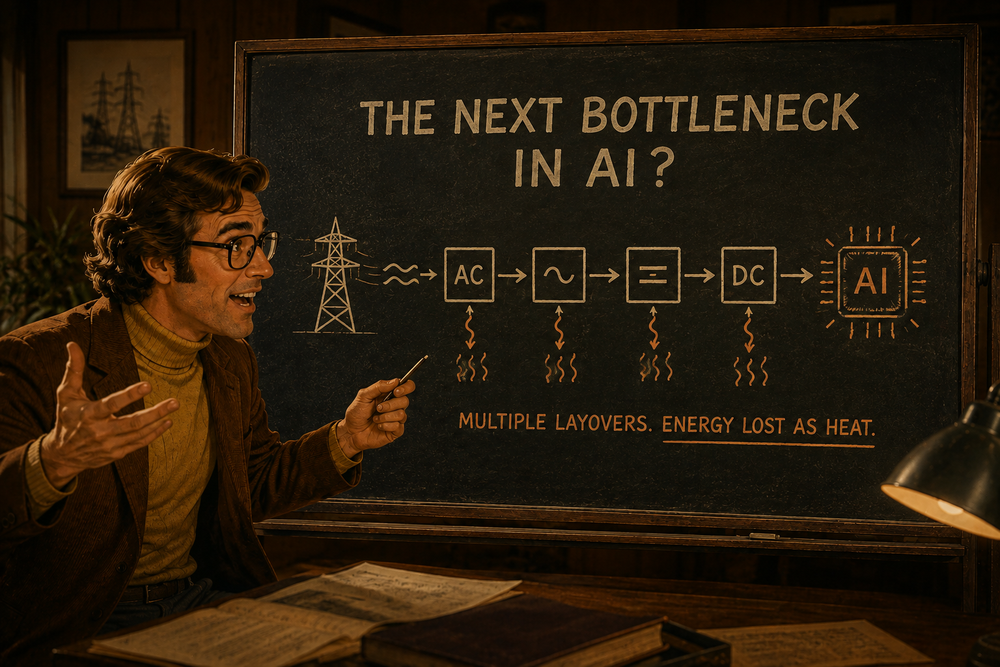
The next bottleneck in AI may not be chips. It may be a design decision from the 1890s.
I am talking about AC vs DC power. Alternating current and direct current. Not the band, though Angus Young can play.
Powering chips eats an enormous amount of energy, which everyone already knows. The part that gets less attention is that moving that energy from the edge of a data center to the chip also wastes it, and generates a lot of heat that then has to be cooled.
The layover problem
Think about it this way. You are traveling from New York to Tokyo. What is faster and more efficient: flying New York to Atlanta to Denver to Los Angeles to Tokyo, or flying direct?
Each layover burns fuel, takes time, adds delays, and increases the chances your bags end up in Miami.
Which raises the question: if layovers are so bad, why are there any?
There are a lot of reasons, but the one worth focusing on here is that airlines optimize for an entire hub and spoke network, not for your single trip. The layover is not a mistake. It is the cost of a system designed to serve every route at once.
Electricity works in a similar way.
Why the grid runs on AC
A century ago, engineers had to figure out how to move electricity across a country. That argument had a name, the War of the Currents, and it ran through the 1880s and 1890s with Thomas Edison on the DC side and George Westinghouse and Nikola Tesla on the AC side.
AC won, for reasons beyond this post but mostly about voltage. Alternating current could be stepped up and down with transformers, which made long distance transmission practical. Westinghouse lit the 1893 Chicago World's Fair and built the Niagara Falls project a couple of years later, and that settled it. The entire grid got built around AC and has stayed that way since.
What this has to do with AI chips
Chips do not run on AC. They run on DC, at low voltage.
So the electricity takes layovers on its way to the chip. Grid AC steps down through a transformer, passes through a UPS that converts AC to DC and back to AC again for battery backup, moves through distribution units, hits a power supply in the server that converts AC to DC one more time, and then gets converted again on the board down to the roughly one volt a processor actually wants.
Every one of those is a conversion, and every conversion wastes a little energy as heat. Then you pay a second time to remove the heat.
The numbers are not dramatic in isolation. A modern double conversion UPS runs somewhere around 94 to 96 percent efficient. A server power supply lands somewhere between 80 and 95 percent. None of those look alarming on their own. Stack seven of them in a row and the typical AC power path lands around 82 percent end to end, with most analyses putting the recoverable loss in an AC chain somewhere in the range of 7 to 20 percent.
For the last century nobody cared. The loss was small enough that rebuilding the grid made no sense, because the benefits of AC outweighed it by a wide margin.
AI changes that math.
Scale is what changes the answer
Modern AI data centers are not running a few thousand servers. They are running hundreds of thousands of GPUs, consuming hundreds of megawatts, with gigawatt scale campuses on the way.
At that scale a small efficiency gain saves an enormous amount of electricity, cooling, and cost. A few percentage points does not sound like much until your data center draws as much power as a small city, and until every watt you do not waste is a watt you can point at compute instead.
There is a physical version of this problem too, and it is more concrete than the efficiency argument. Nvidia has laid out the arithmetic for the racks it expects to ship: at the 54 volt DC distribution used inside racks today, a single one megawatt rack needs up to 200 kilograms of copper busbar. Across a gigawatt site, the rack busbars alone reach something like 200,000 kilograms of copper. That is not an efficiency rounding error. That is a supply chain and a loading dock.
What the industry is actually doing about it
This is no longer theoretical, which is the part I find most interesting.
Nvidia is moving to an 800 volt DC architecture for one megawatt racks, starting in 2027, with a long list of power component partners building toward it. The design converts grid AC to 800 volt DC once, distributes DC through the facility, and delivers it to the rack directly. Fewer layovers. Nvidia puts the end to end efficiency gain at up to 5 percent and the total cost of ownership improvement at up to 30 percent.
The idea itself is older than the current moment. The Open Compute Project has published on high voltage DC distribution for years, and Berkeley Lab has a body of work on DC power in data centers going back well before anyone was building a gigawatt AI campus. What changed is not the engineering. What changed is that the savings finally got big enough to be worth the disruption.
The other thing that changed is who owns the power.
Hyperscalers are building generation behind the meter, on site. When you are no longer just a customer of the grid at the property line, you have far more freedom to decide what happens to that electricity between the generator and the chip. The constraint that made AC the only sensible answer, moving power hundreds of miles, does not apply inside your own fence.
The bet underneath all of this
AI is now large enough to force engineers to reopen design decisions that have been settled for more than a century. That is a genuinely unusual thing to be able to say.
Chips get the attention because chips are the thing that is scarce and expensive and easy to count. But the chip is the last stop. Everything before it is plumbing, and the plumbing was designed for a world that no longer describes the largest customers.
One of the next real breakthroughs in AI may not be a model or a chip at all. It may be getting electricity to those chips with fewer layovers.
The 5 things I keep coming back to
1. The waste is in the path, not just the destination. Most of the conversation about AI energy is about how much the chips consume. A meaningful slice of the problem is what gets lost getting the power to them, and then what it costs to remove the heat that loss creates. Those are different problems with different fixes, and only one of them is solved by a better chip.
2. Nothing was wrong with the original decision. AC won because it was right for the problem in front of those engineers, which was moving power across a country. The design is not now being corrected. Its assumptions are being tested against a customer that did not exist when it was made. That distinction matters when you are looking at any inherited system in your own business.
3. Scale turns rounding errors into line items. A few percent is noise at one megawatt and a serious number at one gigawatt. Before dismissing an inefficiency as too small to chase, check what it looks like at the volume you are actually heading toward, not the volume you have today.
4. Owning the constraint is what unlocks the redesign. Behind the meter generation is not only about securing supply. It removes the grid's assumptions from your design space. Whenever you take ownership of something you used to rent, the interesting question is what you are now allowed to change that you were not before.
5. The unglamorous layer is where the room is. Everyone is looking at models and chips. The power path is copper, transformers and conversion stages, and it is where a well documented 7 to 20 percent is sitting. The boring layer is usually the one with slack in it, because nobody has been optimizing it.
FAQ
What is the difference between AC vs DC power? Alternating current reverses direction many times per second, which lets transformers step its voltage up and down easily and makes long distance transmission practical. Direct current flows in one direction at a constant voltage. The grid runs on AC. Batteries, solar panels and computer chips run on DC.
Why do AI data centers care about AC vs DC power? Because chips run on DC and the grid delivers AC, so every server sits at the end of a chain of conversions. Each conversion loses some energy as heat, and the heat then has to be cooled. A typical AC power path is around 82 percent efficient end to end, so the losses become a large absolute number once a site is drawing hundreds of megawatts.
How much energy is lost converting AC to DC in a data center? Estimates vary by design, but analyses of conventional AC chains generally put the recoverable loss in the range of 7 to 20 percent across all stages. Individual stages look benign in isolation. A double conversion UPS is roughly 94 to 96 percent efficient and a server power supply is roughly 80 to 95 percent, but they multiply rather than average.
What is an 800 VDC data center? It is a design that converts grid AC to 800 volt direct current once, then distributes DC through the facility to the racks instead of converting back and forth along the way. Nvidia is moving to it for one megawatt racks beginning in 2027 and estimates up to 5 percent better end to end efficiency and up to 30 percent lower total cost of ownership.
Why is this happening now instead of decades ago? The engineering has existed for years, and groups like the Open Compute Project and Berkeley Lab have published on high voltage DC distribution for a long time. What changed is the scale. At gigawatt campuses a few percentage points is worth the disruption, and hyperscalers building their own generation behind the meter no longer have to accept the grid's assumptions inside their own sites.
Also mentioned
- The War of the Currents, Edison against Westinghouse and Tesla, and why AC won
- Nvidia's 800 VDC architecture for one megawatt racks, and the technical case behind it
- The Open Compute Project, on high voltage DC distribution
- Berkeley Lab's Center of Expertise for Data Center Efficiency, on DC power
- Behind the meter generation, and what owning the supply does to the design space
- Jevons paradox and the AI infrastructure bet, on why the buildout is happening at this scale in the first place
Read the original
This piece is adapted from The 130 year old design decision that could shape AI's future, published on the 20 Minute COO newsletter on 6 August 2026.
Between Two COO's is hosted by Michael Koenig. Subscribe on Apple Podcasts, Spotify, or wherever you listen.
More on AI


The COO's Execution Playbook
Frameworks, templates, and hard-won lessons from operators who've been in the chair. Every Tuesday.
No spam. Unsubscribe anytime.