The physics is the easy part: Joe Yaffe of Cowboy Space on what it actually takes to put a data center in orbit
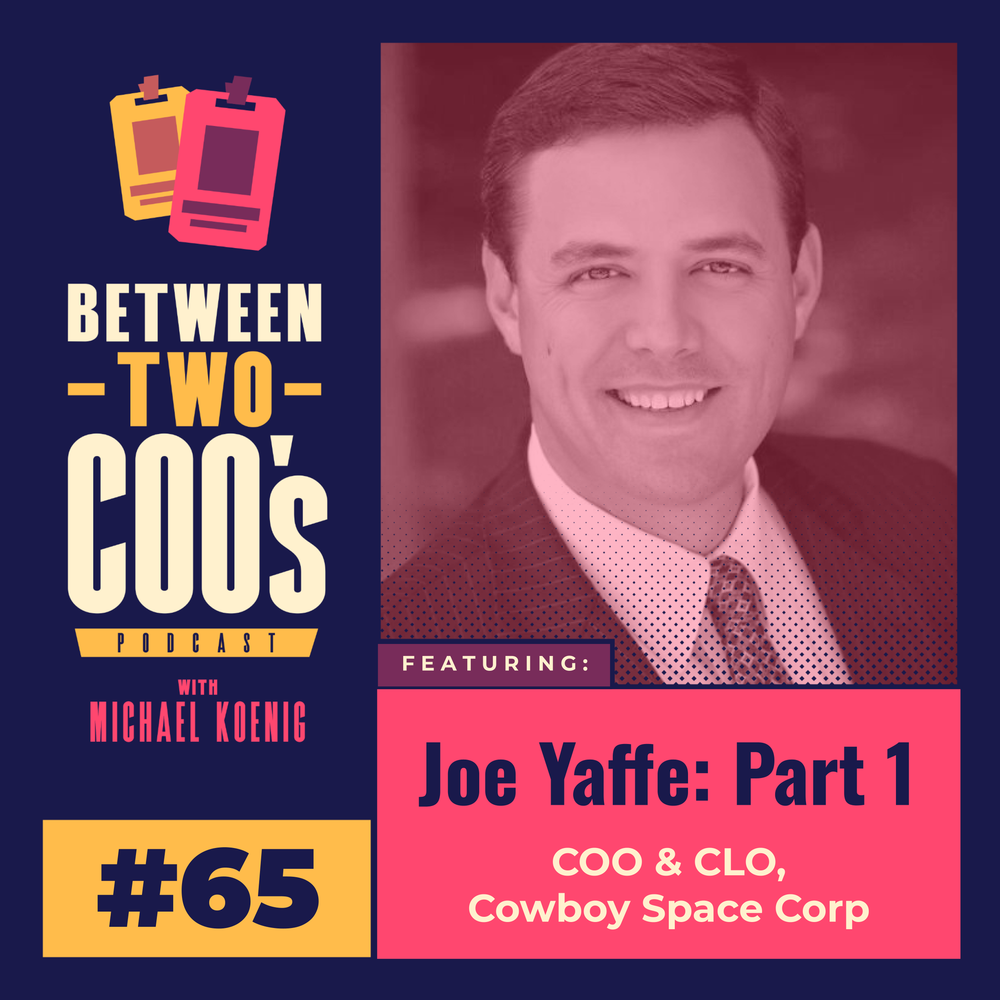
Most coverage of orbital data centers argues about whether the idea is serious. Joe Yaffe's answer is that the argument is settled and uninteresting, because nothing in the concept requires new science. What it requires is execution, and that is a very different kind of problem with a very different kind of person in charge of it.
Yaffe is COO and chief legal officer at Cowboy Space, which is building data centers that run in low Earth orbit. He is also the least likely person in the building. He spent 31 years practicing law in Silicon Valley, fifteen of them at Latham & Watkins and the rest at Skadden, where he was managing partner of the Palo Alto office. He studied ancient Greek in college. He describes himself, without embarrassment, as the liberal arts guy in a room full of engineers.
A midlife crisis with no risk in it
His own framing of his risk tolerance is the funniest line in the episode and the most revealing.
He thought his version of a midlife crisis was moving from one mega law firm to another mega law firm.
That is a man telling you exactly how far from the edge he had spent his career. He expected to finish it there. In his words, he thought he would die at his desk at Skadden. Kids out of the house, managing partner, the top of what he calls at least a small hill.
Then a client he had worked with for years stepped away from his day to day job, and Yaffe asked what was next.
The answer was space lasers.
The three things he learned watching founders
Before the leap, Yaffe spent two decades as personal counsel to founders and CEOs, which is a rare vantage point. He has tried to be methodical about what it taught him, and he is careful to say up front that they come in different shapes and that anyone claiming they all do one thing is not telling the truth.
Three common denominators survived that caveat.
They are relentless in a specific way. They will engage conflict, ignore a no or a maybe, and keep repositioning until they get a yes. When they hit adversity they treat it as a data point rather than an emotional event, which is what lets them respond efficiently instead of defensively. His illustration is the one operators will steal: when someone says the idea is stupid, the successful ones check whether there is anything in it, and otherwise conclude there are eight billion people on the planet and go find the other seven billion who think it is a great idea.
They are unusually empathetic. Not in the soft sense. In the sense of reading precisely who they are talking to and meeting them at that level while still landing the point.
And they run their own rulebook. Yaffe is direct that the reality distortion field is real, and his phrasing of what it is like to work inside one is the most honest thing in the conversation. It is his world, and Yaffe is lucky enough to traipse along beside him, because the founder is seeing it through a different lens with his own set of rules.
That last one has a practical consequence he learned the hard way as an advisor. When his judgment and the client's judgment pointed in opposite directions, the useful move was not to argue. It was to work out what set of facts the client was reasoning from, get to that vantage point, and only then fine tune the advice. Not because they were right and he was wrong, but because advice delivered from the wrong frame of reference does not land.
Second grade lawyering
The sharpest operator content in the episode is about his old job, and it generalizes well past law.
There is an easy button for a lawyer, and it is to say no. Not crudely. You take the idea, recite the law, list the ways the person could be fined or imprisoned, and consider the job done.
He calls that second grade lawyering.
The harder version is to give people complete visibility into the risk and then do the actual work, which is finding the practical path that takes the risk into account, and better than that, inventing a new path that removes most of the risk while still getting the business what it wanted.
What changed when he moved in house is the tempo. As outside counsel he handled discrete requests: a matter, a contract, a project. Now it is minute by minute with eighty engineers making purchasing, design and sales decisions. His metaphor is that he is constantly tapping the brakes and hitting the accelerator, and that you cannot expect perfection, only a middle ground that keeps the car moving.
Underneath the metaphor is the actual skill, which is triage. The world is full of risk. The job is to stack rank which risks are enterprise threatening and which are things everyone should know about while you proceed anyway.
One way doors, and the next 200 hires
He did not invent the one way door framing, and he sharpens it usefully.
In the real world, he says, very few doors are truly one way. What people mean is a decision that, once made, materially changes your timing, your cost of operating, or the company's strategic trajectory, such that being wrong sets the company back.
His live example is real estate, which is not where a space company story usually goes. Cowboy Space is expanding, expansion means long term leases, and leases commit you to cost, to a geographic footprint, and to the logistics that follow from it. Deciding whether to open a large factory in Southern California or somewhere else is a decision that will shape the next 200 hires the company makes.
That is the sentence to sit with. The factory question is not a facilities question. It is a hiring question wearing a facilities costume, and the hiring consequence outlives the lease.
The company has a value that governs this, and it is tied to the Western theme they adopted when they renamed. Be careful with the rations. Yaffe traces it further than most companies trace their values: the capital is venture money, and venture funds are themselves funded by teachers' pensions and nonprofit pensions. There is an obligation attached to that, and it is what turns cost decisions into one way doors.
How a liberal arts lawyer got to rocket science in a year
Yaffe went from no engineering background to what he describes as an undergraduate level understanding of the field in about a year. There is no trick in his answer, which is what makes it useful.
It starts with curiosity as a character trait, which he now screens for in hiring. Then roughly eighteen months of working a full legal job, billing in tenths of an hour, and reading optics, rocketry and space law textbooks at night.
The part that transfers to any operator is the third ingredient, which is a willingness to look uninformed in a technical room. He says plainly that he is the one person present who is not a hard engineer, and asks to have it explained. The rationale he gives the engineers, and that they accept, is that if they cannot explain it to him, he has some uncertainty about whether they understand it themselves.
Which lands on the line most worth repeating in your own company: if you want to show you have mastery of a subject, try teaching it to somebody else.
He is also unusually hostile to acronyms, and his reason is not style. Sometimes, he says, people reach for acronyms to blow a fastball by you, because it sounds like membership. He once demanded a running glossary in a government context, and the useful part was what it exposed. People occasionally could not say what their own acronym stood for. They had just always called it that.
Why the rocket becomes the radiator
The technical explanation is the best plain English account of orbital compute I have heard, and it is worth following because the operating logic is visible at every step.
Start with the resource. In the right orbit you can face the sun almost continuously, and solar power there is roughly ten times more powerful than at the surface. The original company, then called Aetherflux, was built to collect that power and beam it to Earth by laser. Yaffe is quick to say the idea is old rather than novel: the Department of Energy wrote about it in the 1970s, and Isaac Asimov wrote a short story about it, called Reason, in the 1940s. What changed is the cost of reaching orbit and the maturity of the pointing technology. Cowboy Space demonstrates the beam in October, hitting a ground station about fifteen meters across from several hundred kilometers up.
Then the pivot. Beaming power down to terrestrial data centers turns out to be the wrong tool, because too much efficiency is lost passing through the atmosphere. So the question inverts. Rather than sending the power down, send the computers up.
Here is where commercial space works against you. Space is fundamentally a delivery business. A rocket carries a second stage, the second stage is a container full of small flat satellites, the satellites are dispensed into orbit, and the second stage burns up on re-entry about two minutes later. You spend over a million dollars every launch on a container designed to be destroyed. That architecture is correct for telecom and Earth observation, where you want many small satellites covering as much ground as possible.
It is wrong for compute. For compute you want the opposite: a large number of tightly interconnected GPUs in one place. Yaffe's analogy is that a hundred GPUs split between the two coasts and joined by fiber is almost always worse than a hundred GPUs sitting together.
So stop dispensing satellites and keep the second stage. The second stage becomes the data center.
And then the part he describes as the epiphany, remembered as a flurry of texts and phone calls. Chips in space generate heat, there is no atmosphere to carry it away, so the only option is to radiate it, which requires a calculable mass of metal. They had already paid to lift a large metal object into orbit. So the second stage unfurls sheets of metal and becomes the radiator as well as the computer.
One piece of mass doing two jobs doubles the efficiency of everything they pay to launch. That is what closes the economics.
The line that separates this from a science project
The reason to pay attention to that efficiency argument is the standard he holds it to, and it is a standard more infrastructure companies should state out loud.
The business only makes sense if they can provide compute at or below what the same compute costs on Earth. Otherwise, in his words, it is a science project, and they are not interested in building a science project.
The metric follows from the standard. Much of the industry talks in dollars or cents per kilowatt hour. Yaffe's view is that the only question that matters is whether a customer will buy it, and whether it is indistinguishable from buying the same compute from a data center in Kansas or Northern Virginia at the same cost or less. So they measure themselves in cost per GPU hour.
The same logic pushed them into building their own launch vehicle, which sounds like empire building and is argued as arithmetic. The payload is about 22,000 kilograms. Buying launch means paying someone else's margin and depending on their capacity. And a rocket built for exactly one payload can skip everything a general purpose vehicle needs. What they are building, he says, looks more like a hypersonic missile with a data center on top than a conventional rocket. It works economically even if the rocket is not reusable, which he notes with some relish, given that catching a booster is the part everyone finds impressive.
At scale, each launch puts about a megawatt of compute into orbit, which he puts at roughly 792 GPUs depending on the chipset. Off the grid entirely. No water, no grid connection, no zoning fight.
And that is the operator's punchline. Standing up a terrestrial data center takes five to seven years of site selection, real estate, zoning and negotiation with regulators. Cowboy Space is trying to convert that into an industrial manufacturing process measured in weeks, so that frontier chips can reach orbit while they are still frontier chips.
Four companies at once
When I listed the challenges back to him, his response was that he wanted to get off the call and go back to work.
The honest scope is that they are building four companies simultaneously: a rocket company, a satellite company, a data center company, and eventually a software company, because they will likely operate a cloud. An optics and optical communications thread runs through all four.
His division of labour with the founder is clean. The founder's side of the house is vision, and Yaffe's argument for why that is credible is worth noting, because it reframes the risk. People hear rockets and assume that is the hard part. He would argue that disrupting a crusty, deeply embedded financial services industry, which is what Robinhood did, was an analogous challenge.
Yaffe's side of the house is ten thousand details that have to be choreographed, and a regulatory overlay that is entirely his wheelhouse. You do not put anything into orbit without clearing a long list of regulatory boxes.
Which brings the whole thing back around. A company whose defining constraint is execution rather than invention put a governance and transactions lawyer in the operating seat. That is not a quirky hire. It is the correct hire, and it is the strongest argument in the episode for taking non-traditional operating backgrounds seriously.
The 5 things I took away from this conversation
1. The physics is settled, which makes it an execution problem. Yaffe is emphatic that nothing here breaks any laws of physics, and that everything remaining is engineering and execution. Once you accept that, the interesting question stops being whether orbital compute is possible and starts being whether anyone can run the program. Most infrastructure debates would improve from the same separation.
2. A facilities decision is a hiring decision. Choosing where to put the factory determines the next 200 hires. Yaffe's one way door test is not about reversibility in the abstract, it is about which downstream commitments the decision quietly makes on your behalf.
3. Saying no is the easy button. Recite the rules, list the penalties, call it advice. He calls it second grade lawyering, and the same critique applies to any function that has been handed a veto. The hard version is inventing the path that removes the risk and still gets the business what it wanted.
4. If they cannot explain it to you, they may not understand it. Yaffe uses his own lack of an engineering background as an instrument rather than apologizing for it. The corollary is the better test: to prove you have mastered something, teach it to someone else.
5. Watch for acronyms used as a fastball. Sometimes jargon is compression and sometimes it is a membership signal. Demanding a glossary is cheap, and the revealing outcome is how often nobody can say what their own acronym stands for.
FAQ
What is an orbital data center? A data center that operates in orbit rather than on the ground. In Cowboy Space's design, described by COO Joe Yaffe, the second stage of the rocket is not discarded after launch. It remains in orbit and becomes the data center itself, carrying tightly interconnected GPUs and powered by solar arrays that face the sun almost continuously.
How do you cool a data center in space? By radiating heat away, because there is no atmosphere to carry it off and convection is unavailable. The required mass of metal is calculable, which led to the design decision Yaffe calls the epiphany: the second stage unfurls sheets of metal and serves as both the computer and the radiator, so one piece of launched mass does two jobs.
What was Cowboy Space called before? Aetherflux. The company was founded by Baiju Bhatt, co-founder of Robinhood, to collect solar power in low Earth orbit and beam it to Earth by laser. It was renamed Cowboy Space Corporation, and its values are tied to Western themes, including one Yaffe cites often: be careful with the rations.
Does an orbital data center require new technology? Not according to Yaffe, who describes it as a pure engineering and execution challenge and says they are not breaking any laws of physics. He notes the underlying idea is decades old, with the Department of Energy writing about space based solar power in the 1970s and Isaac Asimov publishing a short story on it in the 1940s. What changed is launch cost and pointing accuracy.
Why would a lawyer run a space company? Because the binding constraints are regulatory, contractual and organizational rather than scientific. Yaffe spent 31 years in Silicon Valley law, including as managing partner of Skadden's Palo Alto office, and describes his side of the company as ten thousand details that must be choreographed plus a substantial regulatory overlay. He taught himself an undergraduate level understanding of the engineering in about a year.
Also mentioned
- Cowboy Space, and the concept video showing launch through deployment
- Aetherflux, the company's original name and its space based solar power program
- Baiju Bhatt, co-founder of Robinhood and founder of Cowboy Space
- Skadden and Latham & Watkins, where Yaffe spent 31 years
- I, Robot by Isaac Asimov, which collects Reason, the 1940s short story on beaming power from orbit
- NVIDIA, whose radiation tolerant chip Cowboy Space is a technical collaborator on
- John McNeil, former COO of Tesla and Lyft, whose advice on working with a visionary founder Yaffe credits
Listen to the full episode
Joe Yaffe on Between Two COO's
Part two, on whether an orbital data center works as a business, follows later this week.
Between Two COO's is hosted by Michael Koenig. Subscribe on Apple Podcasts, Spotify, or wherever you listen.
More on AI

The COO's Execution Playbook
Frameworks, templates, and hard-won lessons from operators who've been in the chair. Every Tuesday.
No spam. Unsubscribe anytime.