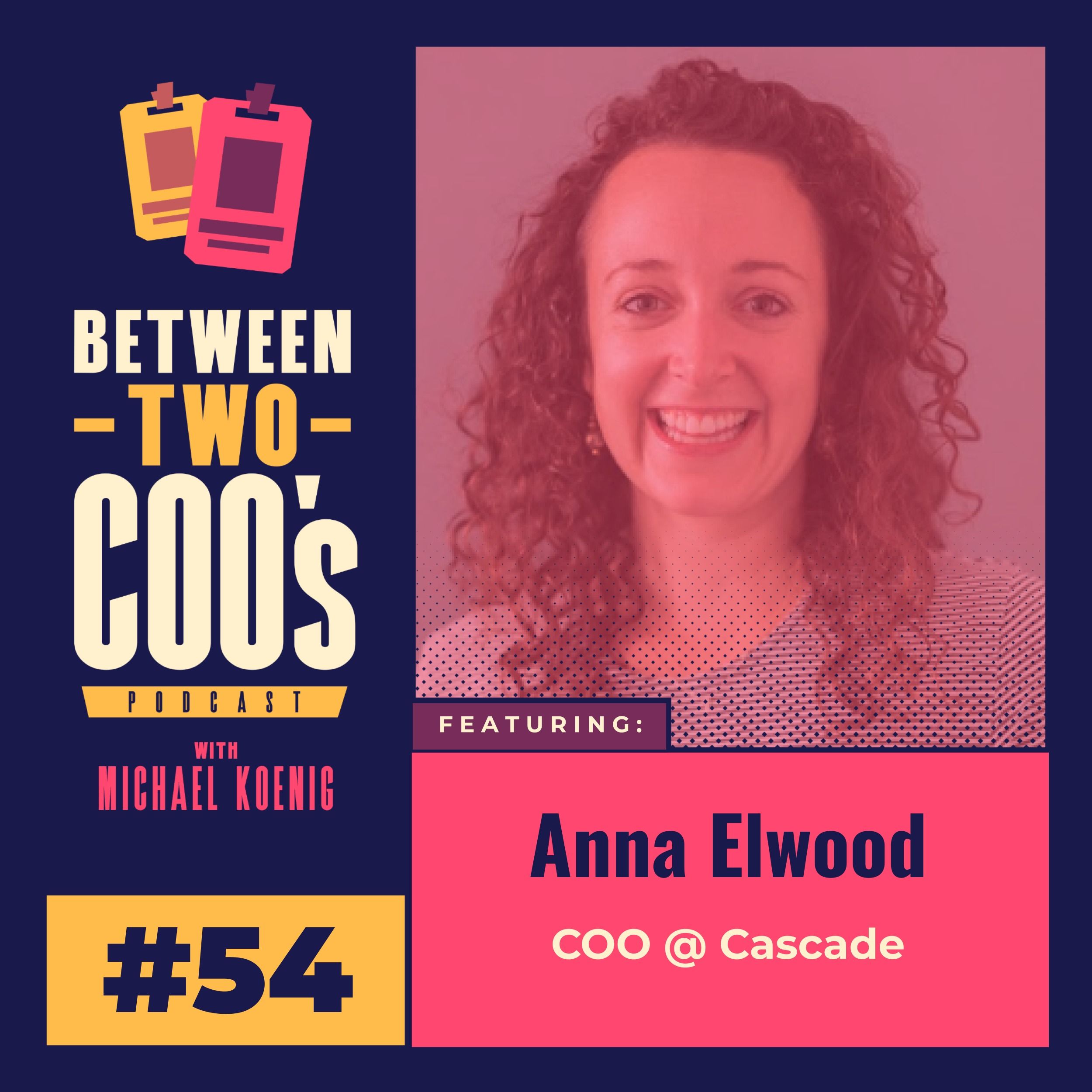
Anna Elwood, Cascade COO on Turning Chaos Into Clarity
Watch on YouTube
From Zocdoc to Cascade, COO Anna Elwood breaks down the systems, rhythms, and AI tools that turn chaos into execution.
In this episode of Between Two COO's, Michael sits down with Anna Elwood, COO of Cascade, the strategy-execution platform helping companies turn plans into results.
Anna shares how she evolved from Broadway actor to operator, scaling companies like Zocdoc, Knotel, and Teachable before joining Cascade to build the muscle of strategy execution.
She explains how to create an “operating rhythm” that keeps teams aligned across time zones, the tension between governance and red tape, and how Cascade helps leaders link vision to measurable execution.
The conversation dives deep into AI’s role in operations, the future of hybrid work, and what it takes to move from chaos to clarity in a global startup.
Anna’s storytelling — especially her account of leading through Superstorm Sandy — highlights what real-time operational leadership looks like when everything goes sideways.
Timestamps
Topics Covered
- Sponsor read and Superstorm Sandy cold open (0:00)
- Introducing Anna Elwood, COO of Cascade (2:00)
- From Broadway acting to Zocdoc operations (5:00)
- First focus at Cascade, fixing retention (10:00)
- Working rhythms and the move to hybrid (11:00)
- Meeting cadences, KPIs, and accountability (13:00)
- Governance, red tape, and Cascade's platform (15:00)
- Five pillars of strategic maturity (17:00)
- Turning strategy into measurable execution (19:00)
- Diagnosing strategy versus execution problems (22:00)
- AI inside Cascade and daily operations (25:00)
- OKRs, frameworks, and platform flexibility (28:00)
- Who owns strategy in an organization (34:00)
- Superstorm Sandy and rebuilding headquarters overnight (37:00)
Mentioned in This Episode
- Anna Elwood on LinkedIn
- Cascade: Anna's company, a strategy led performance platform
- Zocdoc: Where Anna spent nearly a decade in operations
- Knotel: Workspace company where Anna ran operations across continents
- Asana: Michael's example of platform flexibility creating complexity
Listen & Subscribe
Apple Podcasts · Spotify · YouTube · Amazon Music · RSS
About Between Two COO's
Hosted by Michael Koenig · betweentwocoos.com · b2coos.com
For more on OKRs and operational excellence, visit Helm.
Full Transcript
Show full transcript (auto-generated from audio)
Michael Koenig: Hey, it's Michael. If you've been on a Zoom with me lately, you'll notice that you have my full attention. It's because I'm not taking notes. Instead, I rely on fellow and AI meeting assistant to take notes for me, along with tracking action items and decisions, handling recordings, transcripts, and summaries, all in one secure platform. It's kind of like magic. Built with security and privacy at its core, fellow is the only AI meeting assistant that thousands of leaders and organizations trust to capture meeting notes and recordings while keeping your data safe. They're so confident that you'll love it. They're offering an insane deal to you all between two COOs listeners, 90 days of unlimited AI powered note taking and recording completely free. Visit fellow ai slash COO to sign up today and experience the AI meeting assistant trusted by leaders everywhere.
Anna Elwood: , back in 2012, I was at Zocdoc. Our offices are, we're in soho. . We had just opened an [00:01:00] office in Scottsdale. This is before, you could successfully work from home as a technology company. We had a hurricane in New York. Super Storm Sandy, and the power went out in, everywhere, like south, south of 36th Street, which is a huge portion , of Manhattan. I happened to be in Scottsdale, , and. I was fully functioning. , But the rest of the business was completely halted at one of the highest growth times of soc talk at that moment. Best laid plans. , , I think the job at that point was can we account for everyone? Is everyone safe?
Michael Koenig: Hello and welcome to Between two COOs. I'm your host Michael Koenig, and joining me today is Anna Ellwood, the Chief Operating Officer at Cascade, the strategy and execution platform used by thousands of teams to turn plans into results. Anna spent her career scaling high growth companies in building the operational muscle that [00:02:00] kept them running at speed like Zocdoc, which she helped grow into a unicorn and no tell where she managed operations across continents during a hypergrowth. Sprint now at Cascade, she's driving everything from hybrid work across New York and Sydney to tightening the feedback loop between product and customers to boosting adoption, retention, and performance. You get it. Anna's an operator who not only lives the chaos of growth, but knows how to bring order to it without killing momentum. You're gonna wanna take notes on this one. Anna, welcome. Thanks so much for being here.
Anna Elwood: Thank you. I thought you were gonna tell me that. I wanted to take notes on this, but I think you're telling the audience to take notes.
Michael Koenig: Yay. And that would've been weird, right? Anna, I want you to take notes on everything you say and I, and then we'll quiz you
Anna Elwood: do take a lot of notes. Um, so it wouldn't be out of the ordinary.
Michael Koenig: We're all starting to not take notes anymore in meetings because we've all got just [00:03:00] incredible voice assistants and, uh, that's a nod to my sponsor fellow who I, I absolutely love. Um, I didn't mean to do that, but
Anna Elwood: It's perfect.
Michael Koenig: up the door to to, to notes. Um, well, first off. And who are you and how'd you end up where you are?
Anna Elwood: Um, wow. What a big start. Um, with a big question. Um, and I think you captured, um, some of the pieces pretty accurately. Um, uh, I have been a generalist, um, and I've touched a lot of different parts of businesses across a lot of different industries. Uh, but maybe the more interesting stuff is that, uh, I'm a mother of an 11-year-old. Um, I'm an outdoor enthusiast. Um, live here in the northeast and, uh, love to hike the big mountains of the [00:04:00] northeast, which pale in comparison to other big mountains. But, you know, we take what we can get. Um, and I'm a wife and a daughter, and, um, uh, I'm generally someone that just like, wants to have fun and part of the fun that I get out of my life is really interesting challenges that stretch me. Um, uh, I find it very fulfilling to solve problems.
Michael Koenig: Now a generalist across various industries takes generalists to a whole different level, which I, I can relate to because I'm the same. I've at this point, filled every single role in a tech company across various sectors. How did you end up being one, A generalist, but also jumping from industry to industry, especially at a leadership level? Because so [00:05:00] often when we're hiring leaders, we want people who have been in that industry and done it before.
Anna Elwood: Yeah. Um, yeah, I don't know what that means then for the rest of my career. So now I'll just spend the rest of the time being afraid on this call. Michael. No, I'm teasing. Um, I, you know, I didn't, um, I think I'm a generalist. Um, uh, a little bit of like how I came into tech. I. Did not go to business school. I did not grow up like wanting to be in business or in technology or any of that stuff. Um, I actually went to school for the arts. I was an actor. I moved to New York with my equity card and um, uh, and I started pounding the pavement and auditioning and doing the thing that I thought I was gonna do for the rest of my life. Um, I think the thing that I've loved about the theater among many things was the diversity of, um, experiences, the different stories, the different people, [00:06:00] the different teams, um, and it requires a good amount of, um, developing relationships very quickly. Um, uh, learning new topics. Going deep, depending on top, uh, on like what the play is about on, um, uh, things specific to that, to that story. Um, and I, uh, soon realized that, um, I also am a type A and, uh, found it very unfulfilling to put my heart and soul into something and not have any control over the outcomes. Um, that's kind of the nature of auditioning day in and day out. And, uh, I happened to, uh, I worked a number of different jobs in New York and. Um, to pay the rent. I happened to be introduced to this very small company that had beta in the upper right hand corner of the website. And I was like, what does that mean? Um, that company was Zocdoc. I joined as an operations associate [00:07:00] and my job, there was everything, um, under the sun. Um, and, uh, it was. In healthcare, um, most of the people that I ended up working with and growing with at Zocdoc all either came from healthcare or were very committed to healthcare. You know, it's a very noble, um, uh, industry, at least certain parts of it that I'd like to think. Um, uh, and I. There's a intense desire to just make it better. And, uh, I've always been mission oriented and so it really, um, spoke to me. But when I left, you know, I, I didn't, my identity wasn't in healthcare. Um, at that point in time. You know, I had been there for close to 10 years. Um, I'd stayed so long because there were just so many different challenges to solve. And like I mentioned, that's the thing that really kind of motivates me. And, uh, those challenges aren't unique to any particular industry. Um, and I kind of followed the problems and, um, I think [00:08:00] that that probably has given me the ability to learn particular parts of a sector pretty quickly. Um. I think it probably keeps, um, me relatively nimble and flexible. I think when you join an early stage company, it's important to take your playbook, but you can't be married to that playbook. Um, and uh, and so I guess I'd like to think that I've been able to balance, um, you know, coming to things with fresh eyes, learning quickly, as well as kind of taking the universal, um, learnings and best practices, uh, and applying them to the roles that I've been in.
Michael Koenig: It is interesting because it's a balance about playbooks, especially across different industries. On the one hand, when you figure out good operations, you've figured out good operations, and they can largely be applied across very different industries. However, they're very different industries, so there's going to be that nuance and you can't take that playbook and then apply it broadly. How do you [00:09:00] balance taking the playbook with also. Being in the seat, uh, understanding the new vertical, the new industry, and then adapting that accordingly.
Anna Elwood: Had, I think there's a couple of things that, uh, allow the balance to exist. Um, uh, I think definitely pattern recognition is, is important, um, which takes a bit of observation for a period of time. At the same time, I think there are decisions, uh, you know, when you're applying certain parts of your playbook, there are decisions that you can reverse on pretty easily, uh, and then there are decisions you can't. And so making quick decisions on those things that are easily reversible is always kind of. Low risk.
Michael Koenig: Let's talk about Cascade. When you stepped into the COO seat there, what, what was the first sort of [00:10:00] change that you took on?
Anna Elwood: , that's a great question. There were, a lot of small things, so when I, joined, my biggest area of focus was on retention. , We had just, we had recently launched a new version of our product, and it took a little bit of time to get it, , to have feature parody with our old product. And, unfortunately there were some customers that were caught in the middle of that. And so we needed to really focus on, , the adoption challenges, , associated with that new product. , And so there are a bunch of like small changes associated with how we spent our time as a customer success team. Some, , parts of a, , my playbook that, , have been useful in the past. , But I think one of the things that we were really challenged with, um, and I would say, you know, within. Three to four months, we made a, a pretty drastic change on it. Um, was our, our [00:11:00] working rhythms and, uh, as an entire company and the fact that we were all remote, scattered across the globe, managing those time zones, being nimble and being able to make quick decisions. Felt impossible. It was just, uh, really, really challenging. And one of the things that I've learned in my career is that there, that every organization needs to have like a working rhythm. Um, uh, that's maybe part of what you might call culture. Um, uh, I kind of consider it to be part of a company's operating system that is the, uh, thing that you don't have to think about. It's just the way that we work, you know, because what we should be focusing on is driving customer value at all times, and, um, that, uh, was hard to do when we're distracted by all the other components of managing a global business as a [00:12:00] startup remotely. Um, and one of the major things that we made a change on, um, within a couple of months was the decision to invest in, in-person time and operate, uh, make a decision to begin operating as an a hybrid company. So I'm in our New York City office, which, um, we officially signed in October of last year. So within a year of my joining, um, it's empty today 'cause it's a Friday and most people are working from home. Usually it's kind about. You know, half a dozen to a dozen people here on a regular basis, and we've started to hire, um, from our New York office.
Michael Koenig: You were telling us about, uh, the working rhythm.
Anna Elwood: Yeah,
Michael Koenig: What does that actually mean to you? Like, can you go into a little bit greater detail, like what is the working rhythm?
Anna Elwood: sure. Um, I would break it down to, um, meeting cadences [00:13:00] where, uh, information is reviewed and decisions are made. Um, as well as information is communicated, um, I would, uh, break it down to communication, uh, practices as an organization where you talk about things. This is like, um, probably more related to the. The digital office, you know, slack versus email, slack practices. Um, and so for Cascade, one of, we didn't, when I joined, there was no like weekly leadership meeting. We weren't looking at business KPIs. Um, um, and uh, in many respects we weren't. The way that I would call it, like, uh, eating your own dog food, all of the things that we know are critical about strategic maturity. 'cause I think a lot of leadership changes in the [00:14:00] organization and moving quickly, we weren't abiding by them ourselves. Um, and so setting those, uh, practices that end up creating a bit of a governance model. Where, um, there's accountability, um, uh, that can be, uh, put based off of certain projects or initiatives or deliverables, uh, that are necessary. And if you don't have those meeting rhythms or that information's reviewed or you know, things are discussed, um. Uh, yeah, it's hard to, it's hard to keep people accountable. Um, so that's how I would probably describe some of those rhythms. Um.
Michael Koenig: Well it's interesting you talk about balancing governance, right? And this is something that has to get introduced as a company matures. You gotta be able to, one, hold people accountable, but also ensure that things aren't going off. The rails. With governance though, can also come. [00:15:00] You know, people say lots of red tape. How do you find that balance?
Anna Elwood: That's a great question. Um. I think, so we work with a lot of different organizations and, and maybe it'd just be helpful to introduce what Cascade, um, is again, um, for the sake of, of, of this part of the conversation. So, uh, we call ourselves a strategy led performance platform. Um, uh, it's a platform that allows an organization. To digitize, execute, and manage and consequently evolve their, uh, long term strategic plan. Um, now every organization has long term is, you know, unique to them. The smaller the organization, the younger the company, the, uh, shorter the, the time horizons we're talking about, you know, cascade as a post series a. We don't really have a very [00:16:00] concrete three to five year plan, but when you are a major auto manufacturer, uh, that is a very large brand, you absolutely, that's a public company. You absolutely have a three to five year plan that you also need to be held accountable to. Um, and, uh, and so I, I think it's a, for each organization, the governance model is, is, is different, uh, based off of the maturity and, and the size. Um, and. Um, I think there's a constant evaluation about, um, whether or not there is excessive process, excessive red tape. Um, I think it's hard for a large organization to be able to self-reflect and understand if things can go faster and if things are necessary. Um, but, uh, for much smaller organizations, I think that's like a, a probably a constant and ideally a [00:17:00] constant, uh, question. Um. When, when we talk about strategic maturity, when we reflect on our customers, we, we look at kind of five pillars. Um, speed is, is one of them. Um, this is, these are the pillars that we look to, to, um, kind of assess where a company is. Uh, it's kind of the pillars that we use to, uh, reflect and provide guidance to, to these, to these organizations. Uh, and so the SIFE pillars are visibility. You know, a, a strategically mature organization has high visibility across the organization. Alignment. Uh, this is I the idea that, um, uh, everyone's work is contributing, um, to the, uh, goals that the organization have set, has set out focus, that we're not distracted by the things that, um, uh, aren't as critical. Uh, that to, um, uh, the goals that we have in place, um, uh, accountability, um, which we, uh, talked about. And, uh, some of that happens through [00:18:00] that governance model, uh, but also speed. Um, and, uh, you know, if things are going slowly, um, if the, uh, objectives initiatives aren't being met, you know, I think that in the course of, um, you know, the. Governance model or in this particular instance, what we would recommend a constant kind of like strategic review. Um, I think those are critical decisions, discussions that an executive team needs to make, uh, have, and decisions that they need to make to ideally better calibrate, um, on what's really necessary, um, to achieve the goals and what's just getting in the way.
Michael Koenig: Hmm, very interesting and strategy led performance platform, which I, I love by the way. Um. There is a play between strategy and tactics. Strategy being the big overall picture, how [00:19:00] you're going to get to where you need to get to, and then the tactics are, you know, what actually you need to do to get there. How do you and cascade balance the two from setting strategy to. Being that strategy led performance platform, where does the performance part come in?
Anna Elwood: The performance part is the execution. And I think very frequently when organizations think about strategy, um, it's a vision and a plan that is set. And sometimes just sits on a shelf and is never referred to, um, until the board meeting or until the end of that, let's say fiscal year. And we kind of reflect. Uh, the performance happens in the ex execution. Um, and, you know, there are some critical elements, um, that make up, uh, an executable plan. You know, one of those being, having a broad objective, like what we want to achieve, and as you suggest [00:20:00] then the specific tactics we have to take to make that thing happen, or the key results if you're working in OKRs or, um, those things that you can measure. Um, KPIs, projects, actions. Um, and so our platform captures all of those things and every organization kind of has a unique way of how they organize their strategic plan. Um, uh, and we're flexible in whatever methodology and organizations using, but the idea is that, um, the C-Suite should have a tool that they use that is their strategic command center. Um, ideally the C-Suites, not firefighting, depends on the size of the organization. Uh, if they are, they still have a responsibility to be thinking for the future and thinking about the external factors. But that's C-Suite, which is kind of this, um, what I like to refer to this first team mentality. We manage [00:21:00] functions, you know, responsible for functions, but that first team is the peer group that is responsible for the ultimate success of the business. What do they look to to make sure that, um, we're achieving our overarching goals, um, not just whether or not we sold the widgets we need to sell this week. Not just whether or not we hit the gross margins for this particular month, but everything that we're set out to do. In the next three to five years are we set up to succeed and achieve those things. That's what Cascade is, and the idea is that strategy should be at the center of what the C-Suites focused on. Um, and that all the data around it, you know, the business KPIs, the business as usual. Um, should be able to integrate and be able to show them a, a full picture of, um, uh, of what's happening. Uh, and that's ideally the way that we marry the vision and the strategy to just making it happen in the execution.
Michael Koenig: Hmm. [00:22:00] Now we're talking about, there are two parts to this, right? The, the strategy, as you mentioned, is going to contribute to the success of the company and the execution is how you get there. What if it's the wrong strategy? What if, you know it's not an execution, but say, uh, we have to, I don't know, you need to raise your series B of funding and you lay out, here's how we're gonna do that. And say, your KPIs aren't quite hitting it. How do you then look at it and go, okay, is it a tactical problem, why we're not hitting our KPIs? Or was the strategy to actually hit those KPIs just completely wrong? Like, how do you evaluate that?
Anna Elwood: I mean I think it's the way that we evaluate almost any problem at first, it's data what's actually happening. Um, and I think a leadership team needs to first make sure that they're reserving the time to reflect on that data. [00:23:00] Uh, they also need to make sure that data, that data is there. Um, and um, and so when I refer to governance, um, and my, we refer to like operating rhythms, I think one of the key meetings that any leadership team needs to have be having is something that, again, we talk about eating around dog food that we have adopted in the last year and a half or so is, um, uh, meeting on a monthly basis. Meeting on a quarterly basis and reviewing the progress in, um, achieving the goals that we've set out that support the strategy. And as you suggest, there are things that aren't gonna work. Um, and there are, there are risks that are gonna be present. And because the team, um, in the company is actively working on specific objectives and initiatives and projects associated with that one, three, or five year plan, because they are, uh, making updates and [00:24:00] communicating, um, uh, creating visibility and accountability on, on progress. And because we're integrated in other parts of the business, we have, um, both quantitative. Um, uh, automatically tracked data as well as qualitative data from the team who's experiencing it firsthand. Um, you know, before the strength of ai, I think it's been a little bit harder to be able to synthesize all of that into one place, and that's where we spent a lot of our focus and embedding AI into our product so that we can pull out, um, those findings for that C-suite. So when they sit down, they're looking at the most critical pieces of information first. And they're having the discussions they need to have to be able to pivot or change or divest or invest.
Michael Koenig: Well, let's talk about AI because AI in operations is, uh, just very exciting. This is an operations podcast. Uh, cascade is [00:25:00] essentially an operating system company. How are you applying AI within Cascade?
Anna Elwood: Um, so the within Cascade is like within the platform and it's also, uh, within Cascade, um, how we operate as, as a business.
Michael Koenig: You know what? Either,
Anna Elwood: Um, I think they're perfect. They're beautifully intertwined because, um, we use our product, uh, to manage our business. Um, and so AI is a big part of, um, the synthesis of what's happening, uh, and is the thing that helps fuel the discussions that we have as a leadership team. Um, so AI for us, um, um, I, I think allows us just to better, um, analyze the data, um, and, and get to the findings faster. Um, the other part is like, you know, while we are a company of 60 people, I think, um, ai, because [00:26:00] we use it daily to help us with tasks as an organization, we have the power of probably a company that's twice as big as that. You know, when I, uh, we're still very much a startup and, you know, when I look at, um, certain parts of our, our functions, AI is doing, um, um, tasks that probably I'd have to hire someone to do. Um, and uh, I think it's really become embedded in, um, our, our daily lives just as we kind of manage the, the daily work. Um. Uh, those are the biggest areas at this point for us. Um, when we think about AI going forward, a lot of our energies, because Cascade is so much a part of our, uh, practices as a business, um, a lot of our energies are focused on, um, uh, coming from our product team, how to better leverage the technology to help, uh, uh, leaders, um, like us in our business just operate the business better.[00:27:00]
Michael Koenig: It sounds like the big unlock has been being able to do more with less operating as a a team, double your size. Um, what, what has been that big unlock for you? Is it just aside from the data synthesis?
Anna Elwood: I think it's the partnership of a chat GPT or a Gemini every single day next to me. Um, uh, and I, uh, know that. My team and, um, uh, parts of the rest of the company have, have the same experience. When you talk about operating with less, like again, like we're a small company, we don't have a lot, you know, I, I don't have infinite resources, um, to be able to leverage. Um, and I'm jumping from one thing to another every single day. Um, and the thing that jumps with me is ai.
Michael Koenig: Hmm. So cool. You mentioned, [00:28:00] um, OKRs. Certainly one of the more popular strategy frameworks. What are you seeing across Cascade and your customers, because you have such a, a wide diversity of them. , How many are you using? Okay. Like, is that the predominant one? What other types of frameworks are for operating systems? Are people using.
Anna Elwood: Mm-hmm. So there's, I think, OKRs, um. Uh, can be referred to in a couple of ways. Um, the first is the classic highly disciplined, um, OKR, um, vigilantes, where, you know, uh, it is a very specific practice and you don't diverge and you, you wanna do it exactly as defined. I think we see less of that. Um, but as there, because it became such a popular framework for such a long period of time, um, uh, it absolutely has, I think, and. There's a good reason for it. It makes a lot of sense. Objective with key results. It's essentially how I [00:29:00] refer to elements of, um, our, our strategy platform. Um, it's infiltrated into, um, uh, a lot of how people talk and what they use. Um, but what we have found is that many companies, if not all of them, um, have a bit of a unique model that they, that they utilize. Um. And, uh, and they want flexibility in, in how their strategy plan is represented. Uh, they might start with, uh, the KPI versus the objective and below that, you know, they might have objectives and sub objectives and key results and submeasures, um, um, they might start with pro. It's like, it's, it really varies with every, every organization. The way that we've developed our platform is to be able to meet them where they are. And, um, a big focus of ours has been to be able to have a flexible platform that allows us to capture the unique ways that every organization works.[00:30:00]
Michael Koenig: Now flexibility with a platform tends to create complexity. I know for instance, a Asana, you can use Asana a hundred ways, and none of them are. I mean, I, I, I use it, but I never feel like I'm using it to its fullest extent, whereas something that's much more deterministic, it's, it's very intentional. You're using the software, how the company, the developers envisioned, how do you balance the flexibility with that complexity?
Anna Elwood: Yeah, it's like the red tape question. I think it's a constant evaluation. Um, and I'll be honest, like I think our platform can do a lot and it probably does way more than a lot of people are actually leveraging. Um, I think that the way that we view our solution, um, is, uh. We are, um, [00:31:00] uh, um, really focused on developing the most powerful platform, uh, that delivers exceptional value. Um, but we also know because strategy execution, because, um, you know, this concept of strategy led performance is something that every organization and some of the biggest organizations you can imagine, struggle with. I'm always a little surprised. Um, um, at the maturity of some of these logos and, and brands that you and I know quite well, um, this isn't like a practice that many people learn in business school. They, you know, learn fp and a, you know, um, you know, sales processes. How you do sales is relatively, you know, similar for every organization. Um, but strategy led performance or strategy execution, um, uh, isn't as much of a practice across an organization. And so, uh, and there's behaviors [00:32:00] that need to come with it. We talked about governance, we talked about the criticality of reviewing and discussing, um, and, uh, because we're talking about behavior change. And potentially then cultural change. Uh, and we're talking about a platform, um, um, uh, uh, we believe very strongly that our solution is a combination of. The thing that you log into every day, as well as our team that can offer you the best practices, that can help you leverage, you know, the, um, uh, the, the full value of the platform, unique to your organization and the way that you work. Um, you have a pretty comprehensive, um, and relatively quick implementation process. You know, every customer as a customer success manager. We also will consult with you in depth and help you evolve your plan as necessary. Um. Uh, you know, we'll have to talk about like, how do we scale that over the long term? Um, um, but, uh, uh, but that's also I think to, to my earlier [00:33:00] point, uh, comparing this to the red tape question. Um, a strong product organization is constantly evaluating the usability and user-friendliness of the, of the platform. And, um, uh, and it's an evolution where, you know, we look to make things easier and faster over a period of time. And I would argue that every organization does the same thing.
Michael Koenig: Let's talk about the ownership of the strategy and the execution pieces I've seen in certain companies, an operations team will run it in other companies that I'm actually seeing quite. Regularly. Now I'm seeing HR teams being the owners of it, where these companies are kind of looking at, call it OKRs, whatever the, the operating thing is as really a performance measurement. What do you tend to see? How, like is, is the way that I've. Discuss, characterize this something that you're seeing and [00:34:00] has there been this shift that I'm perceiving, or is that just my own biases coming through?
Anna Elwood: Yeah, I think we see it in a lot of different places because I don't think people really understand where it lives and who owns it. Um, we believe that strategy is everyone's business. Um, it doesn't mean that, uh, um, everyone is the ultimate owner of it, obviously, but, um. But that it needs to be, you know, we talk about these five pillars visible, um, uh, and, and known and, um, how we focus and how we align needs to be centered around that. Um, I, we've worked with a lot of organizations. Um, uh, there's a difference between ownership and there's a difference between like who's actually involved in it on a very regular basis and making sure that there's, um. Um, uh, the right level of focus and commitment to it. Um, uh, the ownership in our experience when we look across all the [00:35:00] organizations that we've worked with, uh, is that it needs to be the C-suite and, um, it needs to be ideally the CEO, um, maybe the CFO. Absolutely we see chief strategy officers. Uh, however, I think one of the common pitfalls is a C-suite believing because we have a CSO, they own the strategy. Um, but strategy is the responsibility of the C-suite. They're not executing the, the plan. They're not, um, running the business necessarily. They're not, um, accountable, um, on a regular basis to particular KPIs. But what they ultimately are responsible for is the long-term success of that organization. Uh, and that's where strategy lives. Uh, so when we talk to our customers and when we coach them and give them guidance, I refer to this as maturity through modeling. When you're adopting, um, strategy led performance as a business, you know, you [00:36:00] don't first embed it over there in the HR team because no one's gonna focus on it. It's not gonna be nurtured, it's not gonna thrive. It first needs to start with the C-suite and once that happens at the top level, it can then cascade as a practice down the rest of the organization. Um, so that's what we found to be the best practice.
Michael Koenig: The best laid strategies, the unexpected happens. This goes to my last and favorite question. We've all had a moment in the seat where we see something just totally wild and we think to ourselves, wow. I, I never thought I'd see that. Do you have one you can share with us?
Anna Elwood: sure. There are a lot of them and I probably can't talk about many of them. Um, but I've, I've seen a lot of, a lot of surprising things. Um, um. I think the ones that leave the lasting impression [00:37:00] are those that absolutely are unpredicted, um, as well as those that immediately have an impact on the business, right? There's certain things like an acquisition, which probably is a bit of a slow burn of change. Um, and, um, the things related to that. Uh, I think the one that that comes to mind, you know, isn't the CEO abrupt changes? It's, it's not the pandemic in, in many respects. I think it's the thing that helped prepare me for the pandemic. Um, back in 2012, um, I was at Zocdoc. Our offices are, we're in soho. Um. We had just opened an office in Scottsdale. This is before, you know, you could successfully work from home as a technology company. I think at that time we were using a product called BlueJeans. There's no zoom at that time. And, and the last word I'd use to describe BlueJeans is nimble. [00:38:00] Um, uh, we all have to start somewhere. Um, and, uh, we had a hurricane in New York. Uh, super Storm Sandy, um, and the power went out in, uh, everywhere, like south, south of 36th Street, which is a huge portion of, of Manhattan. I happened to be in Scottsdale, um, and. I was fully functioning. Um, but the rest of the business was completely halted at one of the highest growth times of, of, of, of soc talk at that moment. Best laid plans. Um, and you know, I think the job at that point was one, like, can we account for everyone? Is everyone safe? Uh, and two, um, once we achieved one. How do we get back [00:39:00] to, uh, moving, uh, at the speed ideally that we were before? In a world where our office is inaccessible, our, um, um, servers, which were in Fi d this is before AWS our servers, you know, were in a building that was compromised. Um. And who knows if team members even like brought their computers home with them if they were able to work from home. Um, and so from Scottsdale, uh, which ended up being a little bit of our, uh, our command center, uh, during that time, um, uh, uh, we focused on. Uh, finding a hotel in Times Square, just north of 36th Street. Reserving pretty as quickly as we can, a conference room, uh, or a ballroom. Um, we probably were well over, you know, 200 people, 300 people at that time, um, communicating, getting the right speed of [00:40:00] internet, you know, with all the boosters that we needed. Um, and essentially creating in the course of, you know, 24 hours, a whole new headquarters. Um, at a Sheraton in, in Times Square. Um, the third piece of this after Superstorm Sandy was what is our business continuity plan, uh, when we encounter situations like this, um, and the various scenarios that that could happen, and how do we, um, create systems that allow us to kind of pull the trigger and execute this really quickly? Um, and so that was a, a big undertaking. After, uh, we kind of were able to re-access, uh, uh, the office. I think we were without power for like over a week or something like that. Um, it was, it's a wild time. Um, but again, I think a nice interesting training ground for the, the pandemic, which ended up [00:41:00] feeling in many respects, a lot easier to adjust to. Um, frankly, the technology is just way better now than it was, um, over 10 years ago.
Michael Koenig: Right. No need to, uh, go and reserve a. Sheraton Ballroom and unseat that wedding that was planned, which is very interesting. I'm trying to imagine you could have a very nice party celebrating wins at the Sheraton Ballroom.
Anna Elwood: That's true.
Michael Koenig: Yeah. Well that's, that's truly wild. Uh, that. So many of us remember that storm, and it was, it was absolutely nuts. Um, especially when you put it in, uh, a city like Manhattan
Anna Elwood: Mm-hmm.
Michael Koenig: of the commerce and all of the, the businesses that go on there. Having to essentially recreate a business in 24 hours is nuts. That's
Anna Elwood: I think, I think the other, uh, thing that, uh, is also, you know, critical to, um, remember here is, is a [00:42:00] product, um, uh, it's like an online booking platform for patients to find doctors, um, and, and book online. We also had. An obligation to our patients who had booked appointments for physicians. And the interesting thing is that. Uh, many instances the physicians will not proactively communicate to the patient that they are no longer accepting patients that particular day. And surprisingly, patients will go out under almost any circumstances to visit the doctor. Um, and so there's a layer below this around our business continuity plan that had to consider the customers and the people that we served, um, and how they are affected in extreme events. Um, um, hurricane Snowstorms, um, what have you. Um, so yeah, uh, it was a, it was a fun challenge to solve.
Michael Koenig: And the [00:43:00] lesson here, it's never too early to visit your your BCP, your business continuity plan because you never know. Natural disasters are completely, uh, out of our control. Well, Anna, thanks so much for joining me. Where can people go to keep up with you and Cascade?
Anna Elwood: Yeah, uh, check out Cascade at Cascade app. Um, and you can find me on LinkedIn. I think you can find me through. And Elwood. I also am on Instagram and I don't really use the. We, I think we call it X now. Um, um, but uh, but yeah, find me on LinkedIn.
Michael Koenig: Well, there you go, Anna. Thanks so much and thank you to you all for listening to Between Two COOs. I'm your host, Michael Koenig, and again, a very special thank you to Anna Elwood for joining us. Tune in to our next COO chat. I'm between two COOs, and be sure to subscribe on Apple Podcast, Spotify, or wherever you listen so you never miss an episode. And if you have a minute, [00:44:00] drop us a review. Thanks for listening. Until next time, so long.
More on AI in Operations
The COO's Execution Playbook
Frameworks, templates, and hard-won lessons from operators who've been in the chair. Every Tuesday.
No spam. Unsubscribe anytime.