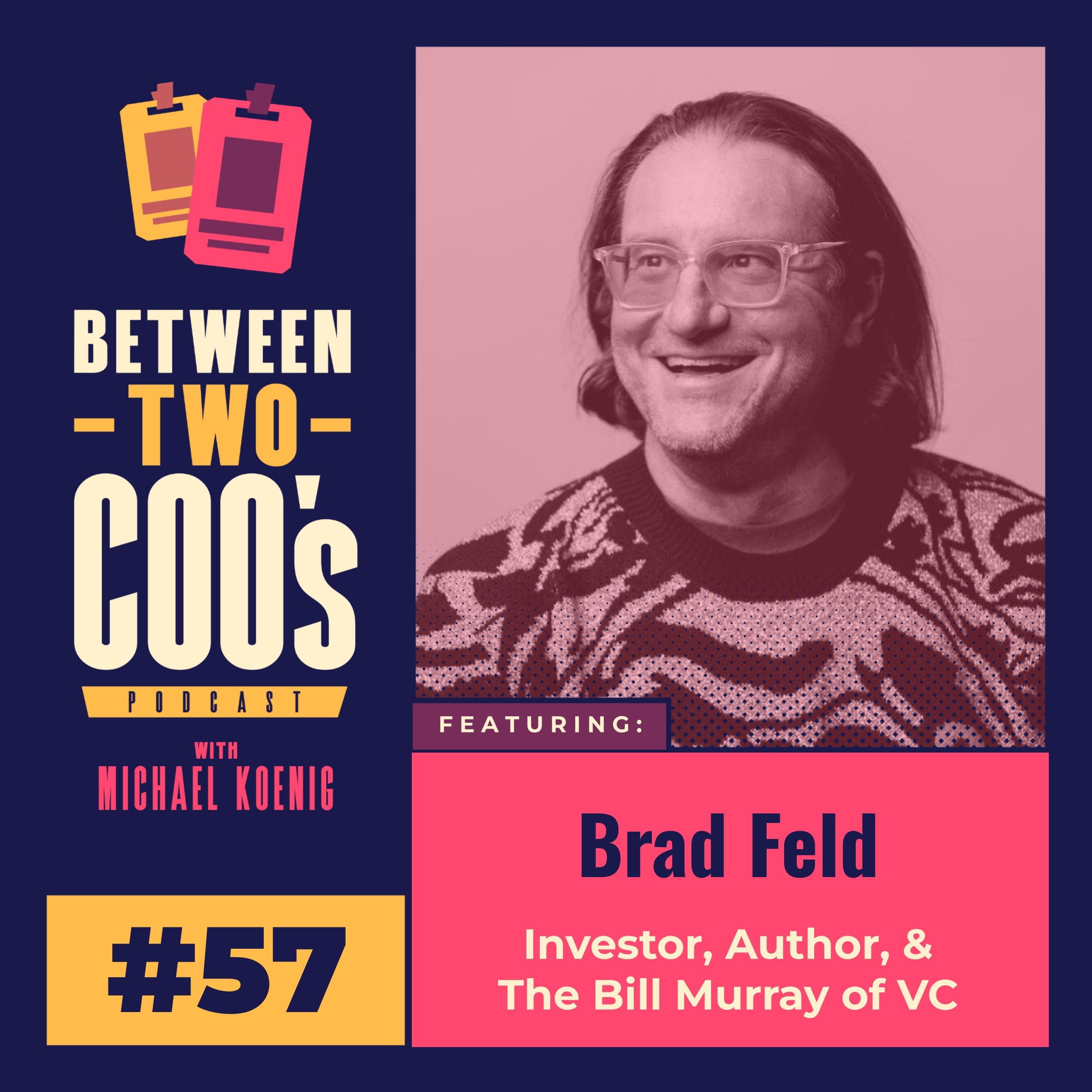
Brad Feld on Emotional Operating Systems and Giving First
Watch on YouTube
In this episode, Michael Koenig speaks with Brad Feld, partner and co-founder at Foundry, about Give First, his book on the philosophy that has shaped how he invests and lives. Brad explains why giving first is not altruism, how it differs from the transactional nature of pay it forward, and why positive sum, long term relationships elevate entire systems, using tennis and the Federer, Nadal, and Djokovic rivalry as his example.
Brad shares the mentorship method he learned in YEO forum groups, where Socratic questions and stories replace telling founders what they should do, recounts the FullContact board meeting where the CEO finally demanded the answer, and separates the jobs of mentor, coach, therapist, and advisor. He closes with the day Sphero's second floor collapsed during peak holiday sales and Len Fassler's 2001 advice: they can't kill you and they can't eat you.
Get Brad's new book, Give First.
Topics Covered
- Cold open and Brad Feld introduction (0:00)
- The Techstars t-shirt and Yoda story (2:42)
- Give First versus pay it forward (5:01)
- Positive sum relationships and the tennis example (7:35)
- Why Brad has written nine books (14:17)
- Writing as a search for meaning (19:43)
- Pattern recognition and mentorship done right (22:34)
- The FullContact board meeting story (30:01)
- Management power dynamics and self-defined goals (32:22)
- Building emotional intelligence as a leader (35:48)
- Mentor versus coach versus therapist versus advisor (39:21)
- Trust in mentor and coaching relationships (46:15)
- The Sphero building collapse story (47:32)
- Len Fassler's advice from the internet bubble collapse (53:08)
Mentioned in This Episode
- Brad Feld on LinkedIn
- Give First: Brad's new book on mentorship and giving
- Foundry: Venture firm where Brad is partner and co-founder
- Techstars: Accelerator Brad co-founded, origin of Give First
- Sphero: Portfolio company whose second floor collapsed mid holiday season
- FullContact: Company in Brad's board meeting story
- Feld Thoughts: Brad's blog post quoted in the cold open
- Entrepreneurs' Organization: YEO forum groups shaped Brad's mentorship approach
Listen & Subscribe
Apple Podcasts · Spotify · YouTube · Amazon Music · RSS
About Between Two COO's
Hosted by Michael Koenig · betweentwocoos.com · b2coos.com
For more on OKRs and operational excellence, visit Helm.
Full Transcript
Show full transcript (auto-generated from audio)
Brad Feld: Something new is Fucked Up in my World every day. If it hasn't shown up by about four o'clock in the afternoon, I'm sort of curious what it's gonna be.
Brad Feld: It's in the middle of the Christmas season, the company is Sphero, which sells a consumer product. It's a super hot holiday sales thing. I get a panicked call from Paul Berbarian, who's the CEO.
Brad Feld: He says, I think everybody's safe. But the second floor of our building just collapsed and, , we can't get into the building, , because the fire people are here and they won't let us go back into the building to get any of our stuff. What do I do?
Brad Feld: And I said, I don't have any idea what you do.
Michael Koenig: Hey, it's Michael. If you've been on a Zoom with me lately, you'll notice that you have my full attention. It's because I'm not taking notes. Instead, [00:01:00] I rely on fellow and AI meeting assistant to take notes for me, along with tracking action items and decisions, handling recordings, transcripts, and summaries, all in one secure platform.
Michael Koenig: It's kind of like magic built with security and privacy At its core, fellow is the only AI meeting assistant that thousands of leaders in organizations trust. To capture meeting notes and recordings while keeping your data safe. They're so confident that you'll love it. They're offering an insane deal to you all between two COO's listeners, 90 days of unlimited AI powered note taking and recording completely free.
Michael Koenig: Visit fellow AI slash COO to sign up today and experience the AI meeting assistant trusted by leaders everywhere.
Michael Koenig: Hello and welcome to between two COOs. I'm your host, Michael Koenig, and today's guest is Brad Feld, one of the most respected and enduring voices in venture capital.
Michael Koenig: Brad is a partner and co-founder at Foundry and has been investing in early stage startups for over 35 years. He co-founded Techstars, [00:02:00] helped shape the Boulder tech scene and runs Anchor Point, Foundation with his wife Amy Bachelor. He's backed some of the most iconic companies in tech, including Zynga, Fitbit, SendGrid, and MakerBot, and he's been writing candidly about entrepreneurship and mental health since 2004, long before vc Twitter was a thing. Brad's here today to talk about his latest book, give First. Uh. Philosophy in a practice that's really shaped not only how he invests, but how he lives. The book captures decades of lessons on mentorship trust in building communities that give more than they take. He's someone who thinks long term, speaks plainly, and doesn't shy away from the hard stuff, whether it's company building or personal growth.
Michael Koenig: Brad, great to have you here.
Brad Feld: Delighted to be, or Michael.
Michael Koenig: So our paths have overlapped in so many ways over the years, and I wanna kick things off by sharing the first time I actually met you in person.
Michael Koenig: I don't think you'll remember it, but I was working with John Fox and Isaac Kat on intense debate, which was one of those original [00:03:00] Techstars companies, uh, which we ended up selling automatic. You were an angel investor and we had just gotten our first batch of company T-shirts, which is like a major milestone for any broke startup, right? And I was in charge of our blog. So we came up with this idea to to hand out these shirts to folks around Boulder, snap a photo and post them. And when I did that, most people would just like throw the shirt over whatever they were wearing, but, and I remember this incredibly well. I walked into your office and I remember, um, this incredible like colorful painting of yoga Yoda on the wall, and I was like, totally mesmerized and then turned around and made eye contact and without a word, you just like ripped off your shirt, stood there, bare chested, and then like pulled a shirt on, and then you looked at me and you just went. In, in like a Yoda voice, like picture you take. And so I took this picture and I left thinking like that was one [00:04:00] of the weirdest but most delightful investor moments I've ever had. So,
Brad Feld: Well, there you go. Great. Great. First impression, right? Nothing like, uh,
Michael Koenig: Well, that's the thing, right? I feel like so many people have like these unexpected Brad Feld stories, and it struck me that you're kind of like the Bill
Michael Koenig: Murray of venture capital, where there's this like mythical and unpredictable quality about how you shape people's lives.
Brad Feld: I would totally take, by the way, I'm a huge Bill Murray fan, notwithstanding his, uh, uh, his challenges the last couple of years with whatever happened, uh, or didn't happen or everybody was confused about. Um, but I, I have loved Bill Murray since I was a kid. Like that. Humor is my humor. And the, the idea of this sort of elusive, mysterious just does his own thing, doesn't care about what anybody else thinks.
Brad Feld: Love it.
Michael Koenig: That
Brad Feld: Uh, so I'll take it. Thank you for, thank [00:05:00] you for the
Michael Koenig: Let's talk about, give first, first for listeners. What is give first? How is it different than those other things? Pay it forward and giving back.
Brad Feld: So give first is a philosophy. It's not a religion, it's not a set of rules. It's not a thing you have to do. It's a philosophy, just like a lot of other philosophies where. You can incorporate some of the ideas into how you are or not, depending on what you like from it. Uh, for me, what I have tried to do with this concept over time, and really the first time I put it in words was in the book Startup Communities in a little section called Give Before You Get, it's one paragraph in the book, and this is 2012.
Brad Feld: I was trying to. Make the point that as [00:06:00] founders in a startup community, if you want to get your startup community really moving, you have to be able to put energy into it, or you have to be willing to put energy into it without defining what you're gonna get back. And as part of that, I said very clearly, it's not altruism.
Brad Feld: You expect to get something back. You just don't know when from whom over what time period, and what form. so you get this sort of critical mass putting energy into a startup community, all of a sudden, amazing things start to happen. And it was from the experience that by 2012, I'd had in Boulder going back, you know, I moved to Boulder in 95, but I, I started thinking about this and, and acting around this, around 2006 when Techstars got started.
Brad Feld: You know, that was, that was the essence of, of the starting point. It. The interesting and important part of this as it evolved over time is they started to understand that it linked to three [00:07:00] ideas that pay it forward's. A good contrast to it. It's a cousin pay it forward's a good idea. It's powerful, but pay it forward is transactional.
Brad Feld: Someone once did something for me, therefore I need to pay it forward. It's obligatory. It's this sort of construct that, you know, you sort of carry with that emotional resonance versus a non-transactional dynamic. Pay, uh, give, give first is non-transactional. It's like you're just willing to put some energy into things.
Brad Feld: Um, it's not because somebody did something for you. It's not because you have an obligation to do it. It's not because you've defined what you're gonna get out. The, the second is this concept of of positive sum, which I've been talking about again since that startup communities book, in contrast to zero sum, zero sum being win-lose relationships, there's a winner and a loser.
Brad Feld: And [00:08:00] you know, of course there's many things in life that are transactional. Many things in business that are transactional and many things in both that are win-lose. But if you're engaging over time in a system of some sort, you can actually have positive summer relationships where both parties benefit from the interaction and the system as a whole gets better.
Brad Feld: And one of my favorite, I'm a huge tennis fan. I used to be a big tennis player, uh, as a kid. Uh, you know, one of my favorite non-business examples for people who challenged that idea of positive sum. And they say, well, you know, sports is zero sum, like there's a winner and a loser.
Michael Koenig: Yeah.
Brad Feld: My, my response is, think about tennis over the last 20 years with Nadal and Federer
Michael Koenig: Mm-hmm.
Brad Feld: and, and toss Djokovich in the mix too.
Brad Feld: Those three, like, yeah. Every time that any of them played, won one and one lost. That's how tennis match works. But the [00:09:00] relationship the three had was positive sum. And it elevated each of their games. They each got better through playing with each other and having that level of competition, but they so elevated the system they participated in, which was the sport of tennis.
Brad Feld: You know, 20 something years ago, the sport of tennis was popular, but it wasn't anywhere near as popular as it is today. Interestingly, if you. A, a tennis fan in history and you see, you know, Billie Jean King in the stands today. You know, she's just an amazing, amazing, uh, uh, leader and advocate for many things, including the sport.
Brad Feld: If you go back to her time, um, you know, women's tennis wasn't almost, I mean, it was a professional thing, but it was just so subordinate to men's tennis. And you think about women's tennis today, which in a lot of cases is even more exciting than men's tennis and same kind of thing, you have these amazing competitors [00:10:00] who lift each other up, who view it as a long-term system.
Brad Feld: So that notion of positive sum and then links to the last thing I was just describing, which is multi-term, right? You're not having a single turn experience, one tennis match, you're having a long interaction over a long period of time. So these three ideas are a key part of give first. And if you think about something like pay it forward, it's transactional, it's you're giving something to somebody else, you're not expecting that you're gonna get anything back.
Brad Feld: So it is this sort of one way thing. And ultimately it can be single turn. Think about the number of times where somebody justifies, well, I paid it forward by doing that one thing rather than actually like. Engaging for a long period of time. So I tried to position it as a different thing. Again, philosophy, it's not spend a hundred percent of your energy this way.
Brad Feld: It's not that you would never do transactional relationship, uh, transactional dynamics. It's not that you would ever have situations, you know, that were truly win-lose. [00:11:00] Um, but you try to sort of embrace this philosophy across a lot of the things that you're doing. And then in the book, of course, I intersect that with mentorship and the concept of mentorship.
Brad Feld: Uh, and so woven these two thoughts together in terms of how one can engage with others and engage with systems that they care about.
Michael Koenig: Well, let's talk about the transactional part that you just discussed. It, it's not altruism, right? Give first. You expect something in return at some point from someone who knows when, but it doesn't. That kind of blur the lines with the transactional aspect of the relationship. If you know it, some point, it's gonna come around in some form.
Brad Feld: Yeah, I think the, I, I, I don't think it does because you, you say in some form, in some consideration, but you also don't know who it's gonna come from. So the transactional relationship isn't between me and you when we're engaging in [00:12:00] some way in this construct. It's with whatever system exists around it, probably, you know, use this.
Brad Feld: Podcast even as an example. Like, you know, why am I doing this? I don't know. Um, you know, I, I know you for a long time. I like you. I just wrote a book. I'm happy to do podcasts. I've done a lot of podcasts. Why do I keep doing podcasts? I don't know. Um, you know, do I expect that I'm gonna get something out of it?
Brad Feld: Well, I'm not gonna get anything financial out of it. Maybe somebody will buy some books, but that's not even really a fin financial transaction in the context of, you know, the effort that goes into these things. Um, uh, but kind of my view is that getting, you know, getting this message out will have some impact somewhere in a good way that's worth it.
Brad Feld: Um, helping you with the thing you're doing, which is doing a podcast series and trying to help other people get their minds around different concepts is additive. So like I, again, it, is it blurry? Of course it's blurry because of philosophy. Philosophy should be a little [00:13:00] blurry, but I don't think it, I don't think it stomps on the, the, the non-transactional construct here, because you're essentially.
Brad Feld: I, I, I describe in the book, or the language I use for this as you, you're willing to, you know, engage in a system. You're willing to engage in a relationship without defining upfront what you're gonna get out of it. And so you really have to shift your mindset those situations. And look, I think everybody does engage in non-transactional relationships, even people who are extraordinarily transactional.
Brad Feld: However, if the amount of, uh, engagement that's transactional is 99.9%, I think you're missing, I think one, my view one is missing a lot of opportunities to have experiences that are unexpected, that are random, that go in different directions that end up [00:14:00] giving back to you in ways that you know, you didn't expect.
Michael Koenig: Hang on. First off, by the way, you, this, the listenership of between two COOs. It's it's rabbit. This is gonna skyrocket. Give first to New York Times. What? So
Brad Feld: That's awesome. Even if it, even if it does, even if it does, anybody who's written a book, uh, I, I should say a different way, anybody who's, uh, you know, an investor who's written a book, knows it's a non-economic relationship, you know? Yeah, sure. The, the, the reason, I mean, you know what, it's, it's kind of fun.
Brad Feld: Why, why do, at least for me, why, why have I written nine books? I haven't written nine books to. You know, make more money. Uh, I've written nine books because I had some ideas that I thought would be worth putting in form that was long form. Like, as somebody who has, you know, blogged for a long time and written a lot of stuff, it's, there's, it's a difference between [00:15:00] writing 140 character tweet, uh, which now I guess you can write longer, or a LinkedIn thing or a blog post.
Brad Feld: Now you're another level where you actually write like a short essay. Um, that's different than writing a edited article for somebody that edits something that actually, you know, fax checks what you do, like keep on going by the time you get to a book. Um, it's a lot of work to put the idea together in a way that you feel both is accessible.
Brad Feld: Maybe it's multiple things accessible, useful to other people, and in a comprehensible way. And, uh, that's something in terms of being someone who's always enjoyed writing, enjoyed trying to put the ideas together. The way I learn is by writing. And so, you know, I learn a lot. Just, you know, I, I hear, I listen [00:16:00] well, I get a lot of inputs, but really, until I write it down, I don't solidify the construct.
Brad Feld: In some ways, writing these books for me has been a very selfish act of trying to really work out on paper what my real thinking is or what my real thoughts are around a particular idea. That's what this book is when you finish the book and you know, there's this story behind every book. Uh, this book, I wrote a first draft, uh, uh, uh, three years ago.
Brad Feld: I got feedback from 20 or so people on the first draft, I had a lot of work to do to make it a good book. It's a process I go through. Um, but I, I didn't feel like putting the energy in. I, I wasn't feeling it, so I stuck it on the shelf for a while and I didn't know whether I'd ever finish it. I just, I, I just hadn't worked out the ideas very well.
Brad Feld: You know, I, I didn't feel good about like a bunch of the pieces. It didn't make [00:17:00] sense to me yet, and I just didn't have the energy for a variety of reasons to do it. Uh, when I took it off the shelf about a year ago and just reread it and thought to myself, you know, I reread it to think, is there something good here or not?
Brad Feld: You know, my reaction to rereading it is, there's some good shit here, but I got a lot of work to do and, and, you know, six months later I, I had worked out the ideas in a way that I felt were clear, compelling. I was proud of. But it also, again, for me, had resulted in me really understanding what was floating around in the ether in my brain and the conversations I was having, but that I hadn't really worked out.
Brad Feld: So that's, that's the goal. Um, uh, at least for me, I'm, people have different goals for different things, but that's, that's how I've approached each of these. And if you look at the different books I've written over time, right? And you go back in time and you look at startup communities, you look at venture deals.
Brad Feld: Right. Uh, you look at startup boards. I mean, these were a bunch of ideas, lots of stuff that I blogged about, [00:18:00] but I hadn't really put it together in a coherent, comprehensive narrative. Um, it was just a bunch of ideas, like, so much that as I think founders are encountering every day that range from very short things to essays, that it's like, geez, all this shit contradicts itself.
Brad Feld: Who is this person versus that person? And it's part of an idea, but it's not the whole idea, or in some cases, absolutely brilliant. You know, 200 2500 word essays that nail the whole topic, like, you know, the mark, the Mark Twain cliche. If I had time, I would've made it shorter. Um, uh, but, but that's, that's part of that, that's part of, I mean, you didn't ask the question, what's the motivation, but I think that's an important underlying thing.
Brad Feld: By the way, I think that's true for most people who are trying to create something, whatever that something is, whether it's, um, a piece of [00:19:00] art, a piece of software, a you know, product, a company, right? You're doing it if you're, if you're doing it just to make money. Uh, it's okay. Whatever. Uh, and that's fine.
Brad Feld: Not gonna judge it, but like, if it's gonna be harder, if the only reason you're doing it is to make money if you're doing it because it solves a problem you have, or, you know, I like to say you are put on planet Earth to work on this problem right now. Maybe not for the rest of your life, but right now, this is the problem.
Brad Feld: You were put on planet Earth to work on. Huh, that's so awesome to be able to live in that zone.
Michael Koenig: I was gonna ask, excuse me. There's this underlying narrative, uh, within the book that seems to coalesce around. Your efforts to find happiness and greater meaning in life and that this con, the philosophy rather of give first [00:20:00] has had a profound impact. Impact on that. And it sounds like, I was gonna ask, is that a fair characterization?
Michael Koenig: It, it kind of sounds like maybe that's there.
Brad Feld: Yeah, I think that's great. Uh, you know, and 40 podcasts or 50 podcasts later. I think that's the first time somebody said that. It's a nice job. Um, it, it, it lands well with me. I mean, you know, [00:20:20] Marker
Brad Feld: since the beginning of humans, I think humans have searched for meaning.
Michael Koenig: Hmm. Mm-hmm.
Brad Feld: And I think that for many people that's an essential part of the good and the bad aspects of their life, right.
Brad Feld: The challenging. Moments you're searching for, meaning the positive moments. You're searching for meaning and success. You look for meaning and failure. You look for like, it's, you know, whether you're religious or not religious, you search for meaning through the, you know, whatever the spiritual tradition you have is.
Brad Feld: So I, I like the concept that for me, you know, working through this book is some search for meaning. At this moment with the [00:21:00] reflection on 40 years of business, 40 years of technology, whether it's the first company I started, or all the investing I've done and then trying to find a through line that's consistent that I could, yeah, it's a phrase I, I would, that I could, I could sort of codify in my own philosophy, my own way of thinking about what.
Brad Feld: It gives me meaning,
Michael Koenig: Hmm.
Brad Feld: um, you know, in a, in an environment, again, over 40 years where I've had lots of successes and lots of failures, um, where I have consciously tried to approach it not as a, uh, you know, not in as a, as a aesthetic where, you know, I don't care about what anything else is or what anybody else thinks or whatever, but where I've.
Brad Feld: Try to model my behavior in a way that's internally consistent, even in the failure, even in the [00:22:00] disappointments, even in the broken relationships of which, you know, over 40 years. Of course, you're gonna have plenty of those. If somebody says, uh, yeah, I've been doing this for 40 years and everything I've done has been successful.
Brad Feld: Like, they're just full of shit.
Michael Koenig: Well, uh, let me
Brad Feld: so, so, so meaning, meaning is a good one. Meaning
Michael Koenig: Oh, okay. All right. Good. Uh, and, uh, well, I'm glad I, I said something different,
Brad Feld: Well, well, it was, I, I mean, again, I, I hadn't thought about it before, so thanks for putting me on that. I mean, maybe I had, but it hadn't come out like in that directive, a statement, so, well, well done.
Michael Koenig: Well, I, I wanna talk about, um, the experiences that you've had. One of the, as I was thinking a lot about mentorship and, um, the challenges, the rewards, the frustrations that I've had, both as a mentee and a mentor. Um, sometimes you just, you see someone. And it's so frustrating they're about to drive off a cliff, and you know, they [00:23:00] are, you've seen it before. Like, so much of what you do, uh, as an investor is all about, you know, pattern recognition. You try to guide them, they disregard, and then predictably they drive right off that cliff.
Michael Koenig: Like, how do you deal with that? Because it, for me, it's, you know, oh, well if you're not gonna listen, then you know, why are we doing this type of thing?
Brad Feld: The two parts to it, and I, I just, one caveat at the beginning, I, I personally dislike, I don't hate, but I dislike the word, the phrase pattern recognition. I think it's used as a, a cliche or a crib sheet or something like it's a abbreviation for a lot of people. Not everyone. There's lots of people who use it in a productive way, but for many people it's used as an abbreviation for not thinking hard about a problem.
Brad Feld: It's, it's this kind of like, oh, well I have great pattern recognition. So like, you know, I, I,
Michael Koenig: Yeah.
Brad Feld: you know, the worst [00:24:00] example of this, I have pattern recognition. I'm extrapolating from an example of. I had one experience and therefore everything else in the world works this way. I'm like, eh, you know, maybe that one experience was the canonical experience, but unlikely.
Michael Koenig: Canonical,
Brad Feld: I had a bunch of, right. I, I, I definitely had these, you, you nerd, nerd factor, right? Nerd alert. Um. You know, you, you have these situations, well, I've had all these experiences and here's the pattern matching from all these experiences, but they've had all these experiences in one domain, or, you know, with one set of people or in one geography, like, okay, uh, useful input, like the categorization of that's useful, but to then not have critical thinking around that as a result is, I think, uh, you know, I think, I think it's a weakness.
Brad Feld: I, I try not to, I personally try not to use that phrase to describe what I'm thinking about. Again, it's in the category of don't like versus hate. I [00:25:00] hate, for example, the phrase value added. I, I think that's a disgusting phrase. Um, uh, in, you know, in the, the, uh, the context of the specific where, okay, I see something.
Brad Feld: My view is the founder is about to drive off a cliff. I want to engage in a way with that founder to try to help them understand that I believe they might drive off a cliff 'cause I could be wrong.
Michael Koenig: Mm-hmm.
Brad Feld: And that I think they should think hard about what a cliff is, where it is, and what driving off it implies and, and could result in.
Michael Koenig: Hmm.
Brad Feld: Uh, it's a, it's a tactic that I think is effective mentorship. It's something I learned in my early twenties from my experience with Young Entrepreneurs organization and a thing called a forum group that's part of YEO and YPO, which [00:26:00] is uh, a confidential group of 10 people that meet once a month. Same group.
Brad Feld: You're all peers, and there's a process, and part of that process is, you know, somebody presents the issue that they're struggling with. Uh, and then, uh, you ask a bunch of questions. It's a very Socratic information gathering of the person. You don't ask questions of each other. You ask the questions of the person presenting the problem, and then, uh, at the end of the process, you give an example from your own experience that you think is relevant to the problem, not necessarily a solution to the problem, just relevant to the problem.
Brad Feld: It is extraordinarily powerful because it's not. At the other end of the spectrum would be, Hey, you're about to drive off the cliff. Let me tell you what to do so you don't drive off the cliff. You should do this. And the problem with that is that the [00:27:00] person saying all those things, number one, might be wrong about the cliff, might be wrong about the data and the inputs that the person's considering as they're figuring out what to do.
Brad Feld: Maybe the person wants to drive off the cliff 'cause they have a car that can fly and they haven't, you know, and you haven't had yet. It would be cool, but you haven't had that experience yet. Like, there's a whole bunch of different things in the mix that you, the person giving the feedback that presumably is the experienced person or the mentor doing instead.
Brad Feld: It's so much more powerful to say to the person. Let me tell you a story. Let me tell you about an experience I had. Lemme tell you about a couple of experiences I had. Lemme ask you a couple of questions to make sure I understand exactly the context of what's going on before I tell you a story, because the story I tell you might have nothing to do with the actual thing I'm observing.
Brad Feld: So, um, you know, I, I have found over a long period of time that most people that are founders, [00:28:00] uh, have a pretty allergic reaction. To someone saying you should, and when I say that, I think of like the, the Bernie Sanders finger wagging, you should, you should. And you know, my, my father saying to me, you know, pointing with his finger, you should, I'm like, no.
Brad Feld: Like, like I, I, you know, the, the, the, the sort of emotional reaction, a lot of people have the inner voice like, oh fuck you, I'm not gonna do that. The outer voice is obviously resistance or. Or, you know, defensiveness or a challenge, and it's like, no, I'm not telling you what you should or shouldn't do. You should figure that out for yourself.
Brad Feld: Right? And I, I'll use should in that context. Like, I have no idea what you should do. You figure it out, right? Here's, here's my experience for you to learn from. If you choose, and you're perfectly free to totally ignore me or decide I'm wrong or decide I don't [00:29:00] have a frame of reference. Because I'm often wrong, everyone is, I might not have the proper frame of reference because I don't have all the information you have.
Brad Feld: I might actually not really understand all the information that you have in a way. So all I can do as a mentor is give you more information to consider with context around that information. Try to elicit more information from you, so whatever context I give you can be even better.
Michael Koenig: And as I think about it, uh, if I look at the situations where I've been frustrated, the. Thing that I probably need to do a better job at is looking at it and saying, okay, did the stories that I shared with them actually were they effective? Did I, did I articulate them properly in a way that would help guide versus tell,
Michael Koenig: and maybe I need to improve.
Michael Koenig: Yeah.
Brad Feld: it's, it's, it's a good, it's a good thing to call out. There's a story in the book that you probably, since you read the book, remembers the Bart Lang story where, you know, I'm trying to do this in a board meeting, right? We're in a board meeting and you know, Bart, uh, who's the CEO of this company, full contact, it has a real problem that he's trying to figure out how to solve, and he presents it well to the board.
Brad Feld: Um, and, you know, it was a little back and forth and a couple questions asked, and eventually I, I tell a story to try to give an example of something similar in a different situation, what they did. And, you know, you're telling a story, it's just my stories are all too long. It's genetic. I got it from my dad, so everything's 20% too long and.
Brad Feld: Um, you know, I can kind of, you can, you know, I can read the room. Okay. Uh, even when I'm telling a story, I can kind of tell, uh, it's not really landing. Then another board member takes my example and goes in completely the wrong direction with my example. So my [00:31:00] example didn't map to whatever they, and you could see Bart getting more and more frustrated.
Brad Feld: And, you know, I ask, we ask a couple more questions and then I try again. I tell another story. Uh, and this time I think actually the thing I'm doing this time is better. It's been calibrated by everything. And, you know, now Bart's pacing back and forth in the front of the room, getting very frustrated, uh, and he finally turns to me and he says, Brad, I know you know what the answer is.
Brad Feld: Well, you just fucking tell me the answer. And, and I did. You know, and sometimes that's what it is. And, you know, I, I don't remember whether my answer was right or wrong, and I don't know whether we solved the problem or not. I can't remember. It's too long ago. You know, but it's not that that's the only way to do it.
Brad Feld: Sometimes you do, you should be directive. Sometimes the other person wants you to be directive. It's especially true if you think about it from a managerial perspective. A lot of times people want the boss, whoever the manager is to be directive and say, well, okay, here's the decision. We should do [00:32:00] this, this, this, and this.
Brad Feld: And so a lot of these constructs are not necessarily like how to be a better manager. It is much more around this notion of how to engage as a, as a mentor, as a board member, you know, as somebody who's not managing, who's not functionally responsible for executing and for the outcome of the thing.
Michael Koenig: The power dynamic that you're talking about. Can change the equation here. Even though, you know, good management, in my experience has always been guiding people to, you know, help them solve their problems versus solving it for them. But so often that can get lost outside of that mentor mentee relationship and more in terms of the boss employee dynamic.
Michael Koenig: I don't know if that rings true at all.
Brad Feld: It does, it does. I, I learned very early, you know, in my, my, my mid twenties, uh, I learned that if you are trying to get, you know, I was, I, I was running a company. [00:33:00] We were a software company. Um, you know, if, if you want somebody to be committed to the outcome, they have to define what that goal and desired outcome is.
Brad Feld: If you tell them what the goal and desired outcome is, they're not committed to it. And so the difference between someone, you know, saying to somebody, this must be done this way on this date with this stuff. Uh, versus having them say to me, uh, as, as their manager, here's what I'm gonna get done on this day with this stuff, it case B, where they're defining it.
Brad Feld: They're so much more committed to it, and the result is their work quality will be better, but they'll also work more and they'll work harder and they'll actually. Believe in the outcome versus the other, which is like, well the constraints that you know, Brad defined are totally ridiculous and I can't possibly [00:34:00] achieve this and so fuck it.
Brad Feld: I'll just do my best, but all whatever. Like, so like that dynamic plays across, I think all of everything, which is if you can engage with other people in a way where they are com, they are defining what they are going to be committed to. You don't have to accept, again, as a manager face value what that is.
Brad Feld: Um, you, you know, you challenge and you go back and forth, but it still has to be under their purview. What gets defined, and it's very interesting, if you look at contemporary software development versus software development from 30 years ago, 30 years ago, there was this thing called, uh, waterfall development where somebody wrote a specification and the specification could be hundreds of pages long.
Brad Feld: And it was written by somebody that was then tossed over to the engineers that said, get this done by Friday. And it was a very ineffective way to do software development versus Agile, which when Agile started to appear in the, you know, 2000, [00:35:00] I don't know, two, 2003, whenever it started to become really a thing.
Brad Feld: Um, maybe 2005 even. I don't know. Um, you know, that shifted the dynamic a lot. We're on a, on a, you know, very rapid cadence every two weeks or every month, whatever the, maybe every week. The team that was responsible for building things sat down and decided what they were gonna do and what the priorities are, and what they were gonna get done in this constraint timeframe.
Brad Feld: So the constraint became a timeframe, but the team decided what would fit in that timeframe versus it be dictated to them. I think that's generally applicable across, frankly, all management and all leadership.
Michael Koenig: It. It's, uh. It's such a fine, fine line to learn.
Michael Koenig: It's,
Brad Feld: It's hard.
Michael Koenig: very difficult and so much of it, I mean, you talk about EQ in your book and you definitely have to have eq, I think in order to be an [00:36:00] effective manager. An effective leader, perhaps an effective man mentor. You know, some of, some of the things though, like we teach, like in so many, uh. So many situations we teach tactics or how to handle a situation, how to navigate a challenge, but like the emotional intelligence aspect in developing that rarely gets that same attention. In fact, I, I only actually got to start developing it when I started working with an executive coach. My question here is just, you know. How should people be thinking about building their eq, and why don't we talk more openly about it in these contexts?
Brad Feld: Uh, maybe. Maybe a preamble to the answer is that there are multiple different ways to be successful and effective as a manager. Um, there are some people who think that the way to be effective is a very top down command and [00:37:00] control, uh, directive approach. And so, uh, and there are probably, I, I expect there are plenty of people in the world who.
Brad Feld: As, as people who, uh, work, uh, thrive on that approach or are attracted to that approach, like want that to be the environment. Um, so, you know, my preamble or my bias is I don't like that, right? Like, that doesn't work for me. Uh, it's never worked for me when I've found myself in those situations. And so from my frame of reference, while you can build very effective organizations with that approach for some period of time, it, it's not satisfying to me.
Brad Feld: And I think you can build very effective organizations a different way that result in people, uh, defining their success differently. Where the success might include a broader range [00:38:00] of characteristics in the outcome. I'll just say that generically, which is to, you know, to go back to this idea of philosophy, these are not rules.
Brad Feld: I don't have a, you know, the Brad Feld way of doing things is the right way, is not the, is not my goal. My goal is here's some ideas to think about it that are additive to, that I hope are additive to what you're doing and take and choose from what you wish. Um, you know, your comment about a coach I think is critically important.
Brad Feld: I, I think every leader should have a coach. Uh, every serious athlete that can afford a coach, has a coach, um, even, you know, aspiring athletes in different fields. Uh, often have a coach. When I'm serious about any of the running activities that I wanna do, when I go through a phase where I'm trying to train for.
Brad Feld: A marathon or, you know, some kind of longer adventure. Um, uh, I'll always add a coach back [00:39:00] into the system, uh, for me because it's very valuable to have somebody watching, observing who knows you, you know, who has their own experiences that can guide you towards being better and more effective at what you do now in, you know, in the world of.
Brad Feld: Uh, entrepreneurship. There's multiple categories of, uh, people who can help a founder or a leader or a manager with these, these different characteristics, right? One, of course, um, is a mentor and the dynamics of the mentor and how a mentor engages with you is different than how a coach engages with you.
Brad Feld: You don't pay a mentor. The mentor doesn't have an obligation to help you. Uh, you don't have a confidential, continual relationship with the mentor, although those are effective mentorship characteristics for it to be [00:40:00] confidential and for it to be continual. Um, uh, but coaches have that. In addition, you pay a coach, it's a transactional relationship.
Brad Feld: The coach views it as, I have a job to do this. It's not, in some ways different. From that perspective then, uh, a therapist, a psychiatrist, or a psychologist. But it's a different set of activities. It's a different frame of reference. It's a different skillset, frankly, that the coach needs to have. Some of it overlaps with what a therapist would have, but it's different.
Brad Feld: Um, and then, you know, you have another category of person in the mix, which is an advisor, which is somebody who's very experienced, presumably, that you're paying to help you with a very specific thing. And it really, if you look at this category of people that are helping, um, and you know, you're talking specifically about eq, um, you know, my own, my own experiences is that, uh, [00:41:00] as an individual leader, if you're hungry to improve on this dimension and be more effective at it, a coach is probably the most powerful tool.
Brad Feld: Or, you know, the second frankly, is probably a therapist. Because so much of what you're trying to do when you're exploring how to be more effective with what's categorized as EQ or emotional quotient, or you know, the soft stuff of management or whatever, you know, whatever people want to call it as step one is knowing yourself better, like understanding you.
Brad Feld: Because that's really it for me, you know? Uh, I like to say I, I believe everybody is the hero of their own story. You know, you, you, you're the hero of the Michael story. I'm the hero of the Brad story. Um, does anybody give a shit about the Brad story, the Michael [00:42:00] story, up to them, right? I, I give a, a shit about my own story.
Brad Feld: You give a shit about your own story. Well, how can you actually really know your story if you don't know yourself and understand yourself and understand what you're doing. That, how that is our successful things on the path of whatever your own hero journey is, or what's getting in your way. So many people wander through life never knowing those things because they didn't put the energy into understanding themselves.
Brad Feld: A coach can help with some of that,
Michael Koenig: Mm-hmm.
Brad Feld: um, but not, not the next level down and the next level down has a lot to do with, you know, things that are hard to talk about, things that are hard to confront, things that take a long time to understand or work through. And, you know, the way I describe therapy, it's going, you know, for me it was going to planet Brad, uh, for 50 minutes.
Brad Feld: Once a week. I pay this guy, he has to listen to [00:43:00] me. He has no choice. I can spend the whole 50 minutes saying whatever I want or saying nothing. And he has to sit there for the 50 minutes. And if he's any good, he will, you know, nudge and guide and occasionally challenge. Take me to a place. Help me get to a place, not take me.
Brad Feld: Help me get to a place that I can get deeper and deeper into some of these things to get some insights into what actually matters to me, what makes me tick, what's getting in my way, what really was hurtful or harmful to me in situations, and how I could look at them in a way that maybe wasn't hurtful and harmful back to the other person, and continued to be hurtful and harmful to me.
Brad Feld: Stuff like that. Coach has a harder time with that. Coach is more around the practical skills to develop, to be effective, along with the self-inquiry, understanding. What makes you tick an advisor. An advisor's job is just to do a thing. You say, Hey, help me with this thing. And a mentor is this [00:44:00] non-transactional.
Brad Feld: You can't say, Hey, mentor, help me with this. That that's not, you know, that's not really, I mean, you can, as an individual and a mentor might say, what? What do you need help with? That's actually a good invitation to say I'm really struggling with. However, again, most mentors are gonna have a different relationship with you than the clinical relationship or the professional coaching relationship.
Brad Feld: So just knowing what you're getting and frankly what you're ready for and what you want. And I'm sure there's people listening to this podcast and say, that's great. I don't want therapy. I don't want to go deep on myself. I don't want to know more about how I tick. I don't wanna figure those things out.
Brad Feld: That scares me. Or maybe it doesn't scare me. Maybe it's like, no, I gotta figure it out. I'm good. Hey, cool. No problem. I'm not saying that every human being should do that. I'm suggesting it as a way to think about how to be better and more effective at some of these things. Because they've been helpful to me, they've helped me be better and more effective, and therefore maybe they can help [00:45:00] others be more effective.
Michael Koenig: And if you're lucky enough to, to work with a really great therapist. Listening and thinking about how they got you someplace is fascinating. Like there's no one that asks better questions to guide you to a place than a really, really good therapist. And it's, it's kind of interesting 'cause I always have, I'm lucky enough to have found a really great therapist and afterwards I, I'll think about like, how the hell did we end up here, because that's not where I was when I first came into this session.
Michael Koenig: So
Michael Koenig: it's, it's pretty fascinating.
Brad Feld: I think some of it is, some of it's the skillset. I'll add one thing to it though. I think it's also, um, the context, right? You don't, you don't get there in one session or two sessions. Like I, I've had some, I won't, I won't say who, it's somebody once said to me, yeah, I had my, my one therapy session. And the therapist said, I didn't need therapy.
Brad Feld: Another person that I know went to therapy like three or four times and said, yeah, my therapist said I was good. It's just bullshit. [00:46:00] Like they teach you day one, a therapy is, uh, day one, a therapy school
Michael Koenig: Yeah.
Brad Feld: is not to say something like that. Um, you know,
Michael Koenig: the therapist didn't wanna treatment. They're like, my God, this asshole, there's no way I
Michael Koenig: can work. You're cured.
Brad Feld: could have been some of that. Right? Could have been like, I'm not, I'm not the right one for you. You need something different than me. So it's, so the context, because it's another thing that I just wanna, uh, uh, I wanna try to end on the power of these things is trust. The power of a mentor mentee relationship is trust.
Brad Feld: The magic trick in a mentor mentee relationship is that they become a peer relationship. You learn the mentee, the ment learns as much from the mentee. So you end up over time really learning from each other. In, in a, in a, in a coaching or therapy context, it's trust. You start to have this repeated experience where, where you as the person going to the therapist or [00:47:00] going to the coach starts to trust the other person and you, you let down some of whatever your natural shields are.
Brad Feld: Then you can get deeper into some of the issues because you yourself are able to get deeper into the issues versus the other person is just so amazing at guiding you and pulling you into them.
Michael Koenig: Well, I completely lost track of time and I think I'm losing you now. I didn't even get to ask my one in favor question,
Brad Feld: I'll give you, I'll give you extra five
Michael Koenig: Ah. Alright, well, uh, the question I always ask at the end is, we've all, and, and this is great for you because we, we've all had those moments in the seat where we see something totally crazy, or as you say, I've seen something that is going to fuck up my day to day. And you thought to yourself, I never thought I'd see that. Is there one that you can share That's just, it sticks out. That is, and so often these things are protected by confidentiality. Agree. That's
Brad Feld: Well, no, I have lots of, I, I, uh, you know, my, my, uh, it's a blog post that, that, uh, regularly gets sent back to me. Somebody runs into it and says, wow, this was so helpful to me today. And the title is Something new is Fucked Up in my World every day. And the key word is new. Right. And kind of my, my, uh, uh, quip now that I use is, if it hasn't shown up by about four o'clock in the afternoon, I'm sort of curious what it's gonna be.
Brad Feld: Uh, so it doesn't necessarily fuck up my day. It's just a thing that's totally new. Um, I'll tell a, I'll tell an old one that's a Boulder story that, that, uh, uh, people will know some of the, if you know Boulder, you know some of the people, but Will will understand how this was something I'd never seen before.
Brad Feld: Uh, it's in the middle of the Christmas season, so it must be like December 15th, right? The after Black Friday, but before [00:49:00] Christmas. The company is Sphero, which sells a consumer product. It's a super, a super hot, you know, holiday sales thing. Uh, I get a panicked call from Paul Berbarian who's the CEO. And Paul says, uh, in a very, again, panicked is only the word I can use for it.
Brad Feld: He says, uh, ev I think everybody's safe. Uh, but the second floor of our building just collapsed and, uh, we can't get into the building, uh, because the fire people are here and they won't let us go back into the building to get any of our stuff. In, you know, including, you know, a whole, you know, like what do I do?
Michael Koenig: Yeah.
Brad Feld: Uh. He, he and I said, I don't have any idea what you do, but you listen to the firemen, you know, like whatever they're telling you is what you gotta do. I'm like, just take a deep breath, make sure everybody's safe is step [00:50:00] one. I think everybody's safe. Well like count, count, you know, count noses, like just, okay, okay.
Brad Feld: Call me back, you know, after the firemen decide and then he calls me back, you know, 30 minutes later. Uh, I wasn't in Boulder so I couldn't like run over and check. He calls back, he's a little calmer now. He's like, okay, everybody's okay. Uh, you know, we got every, everybody's out of the building and, uh, the firemen have said the second floor did collapse.
Brad Feld: Nobody got hurt on the first floor 'cause there was nobody on the first floor 'cause it wasn't rented. Lucky. Uh, it's a beam, uh, structural beam in the building. And this is a, you know, a class, A building. Uh, a structural beam has broken
Michael Koenig: Hm.
Brad Feld: and they're not gonna let any of us back in because they're concerned about it.
Brad Feld: And, hey, that's a problem because, you know, I don't a hundred people in the building or something like that. It's like, you know, like this is pre, everything's in the cloud. You just go to your laptop at home and whatever you is got, you know, [00:51:00] some of the systems, da da da, da. You know, can you help? You know?
Brad Feld: Do you have any ideas? Um. Uh, and you know, I didn't, other than empathy, but it, you know, it's like, okay, I never thought of that one before. Right? Uh, nobody was gonna call me at two in the afternoon, in the middle of the big selling season and say, our building fell down. Um, but, you know, it's, it can be things like that.
Brad Feld: You know, it's, I have, I have hundreds of those kinds of stories and I think anybody that's been doing this for a long time where it's like, yeah, I didn't expect that.
Michael Koenig: I mean, there's some
Brad Feld: I mean, a recent one, a, a recent one I think for a lot of people was on, uh, uh, uh, whatever the day that, uh, I can't remember what it's called anymore, but that the, that, that, uh, Trump put up his big tariff numbers, um, uh, you know, and had this big press conference and everybody knew tariffs were coming.
Michael Koenig: Yeah.[00:52:00]
Brad Feld: Uh, everybody, I think everybody's kind of expected the China tariffs to be, you know, high.
Brad Feld: I don't think anybody expected some of the other ones on that list. Like, uh, Vietnam, what, you know, wha wha I've been moving all my manufacturing from China to Vietnam for the last, you know, year anticipating, or the last six months anticipating this happening and Vietnam's higher than China. What, like, what's up with that?
Brad Feld: Um, you know, so those moments where you're like. No. Okay, let's just go deal with this now.
Michael Koenig: And do you remember with the tariffs, didn't they place a tariff on an island solely inhabited by penguins?
Brad Feld: Yeah. Yeah. It was crazy shit. I mean, that, that, that was in the category of crazy shit. But, but you know, think about like each day, like today is, uh, what are we, Thursday? I mean, I haven't, I haven't encountered my thing yet today,
Michael Koenig: yeah.
Brad Feld: but there will be something.[00:53:00]
Michael Koenig: My litmus test is, well, did anyone die and did anyone go to jail? If neither of those things happen, this,
Brad Feld: You know, that's, that, that's good in that's good insight. You know, it's, uh, it's like the story in the book at the, that I opened the book with, maybe we'll end on this, but the book from, uh, the story from Len Fassler, um, where I'm having, you know, it's the, the collapse of the internet bubble. It, my world is miserable because not only am I co-chair of two public companies that are.
Brad Feld: In under great distress. Uh, I'm on a, a couple of other public company boards. Every one of the public companies is miserable. The two of the public companies that I'm co-chair of I was a co-founder of. So there's a lot of emotional stuff in that For me, I'm working as hard as I know how to work to try to like, make something sensible out of what's going on.
Brad Feld: And I'm on another 20 something boards of private companies because of all that, it's just insane. I look back on that period of time and they're like, I have [00:54:00] no idea what I was trying to prove to myself or to anybody else, or whatever. Like, it's just ridiculous. But in this moment, I'm at Len's House. He bought my first company.
Brad Feld: We're co-founders of this company and co-chair. He's 32 years older than me. I'm in my mid thirties and I'm just ejected. Like I, I've spent the night, we're about to go have another shitty day together, dealing with a whole bunch of crap. Trying to just like, you know, salvage something out of what is, is this complete collapse of the internet bubble.
Brad Feld: Uh, and he comes and he sees me sitting sort of dejected at the breakfast table in his kitchen. And he, he, he notices right away, he says, Brad, what's wrong? You okay? And I just, you know, I unload a little bit, uh, shitty that shitty, that blue. And he just puts his arms around. He gives me a big hug and he says, um, Brad.
Brad Feld: They can't kill you and they can't eat you. Suit up, let's go to work. And I [00:55:00] mean, that, that was in 2001. And I think about that any day that I wake up feeling, you know, oppressed by work or you know, whatever's going on, I'm like, can they kill me? I don't think so. Can they eat me? Nah. All right, we'll go deal with it.
Michael Koenig: I love it. Well, Brad, thanks so much. Appreciate you coming on
Brad Feld: My pleasure. I did not, I I did not change my shirt in front of you today. So that's a blessing.
Michael Koenig: sausage. Well, I didn't have a video camera. I, I just had still photo.
Brad Feld: you gave me something new to think about, which is, uh, I, I'm gonna go, I'm gonna go think a little bit more about, uh, the Bill Murray of Venture capital and see if that resonates with my. Uh, the person who I test all of my weird things with named Amy, who, uh, is very quick to tell me that is a dumb idea, Brad.
Brad Feld: Do not, do not say that ever publicly anywhere, especially on a podcast. Or she'll say,
Michael Koenig: that, then,
Michael Koenig: then [00:56:00]
Brad Feld: can leave it in.
Michael Koenig: forgiveness.
Brad Feld: yeah, it's been recorded. If she says, eh, you know, maybe that kind of could work.
Michael Koenig: Well, we, you know what? It's, uh, like I said to you in the pre-recording, Hey, if I say something stupid and you, you know, Hey Michael, don't say that. Or whatever.
Brad Feld: No, it's, it's, it's all, it's all been recorded now. And do you have it to do with, to do with it what you wish?
Michael Koenig: well, and make you look good. That's a, that's, that's what I wish. So everyone, um, go pick up
Brad Feld: Good luck. Good, good luck with, good luck with that.
Michael Koenig: Too self-deprecating. Uh, pick up a copy of Give First, uh, go to Amazon. Or maybe even better, just check out your local bookstore. Support the little guys. And, uh, there you have it. Thank you all for listening to Between Two COOs. I'm your host, Michael Koenig, and a very special thank you to Brad Feld for joining me.
Michael Koenig: Tune in next time for the next chat. It may be with another incredible author. You never know. It might be a COO, who knows? And if you have a minute. Leave a [00:57:00] review so other people can get great advice from phenomenal COOs or entrepreneurs like Brad. Thanks for listening,
Michael Koenig: and until next time, so long. [00:57:09] [00:57:15]
More on Fundraising
The COO's Execution Playbook
Frameworks, templates, and hard-won lessons from operators who've been in the chair. Every Tuesday.
No spam. Unsubscribe anytime.