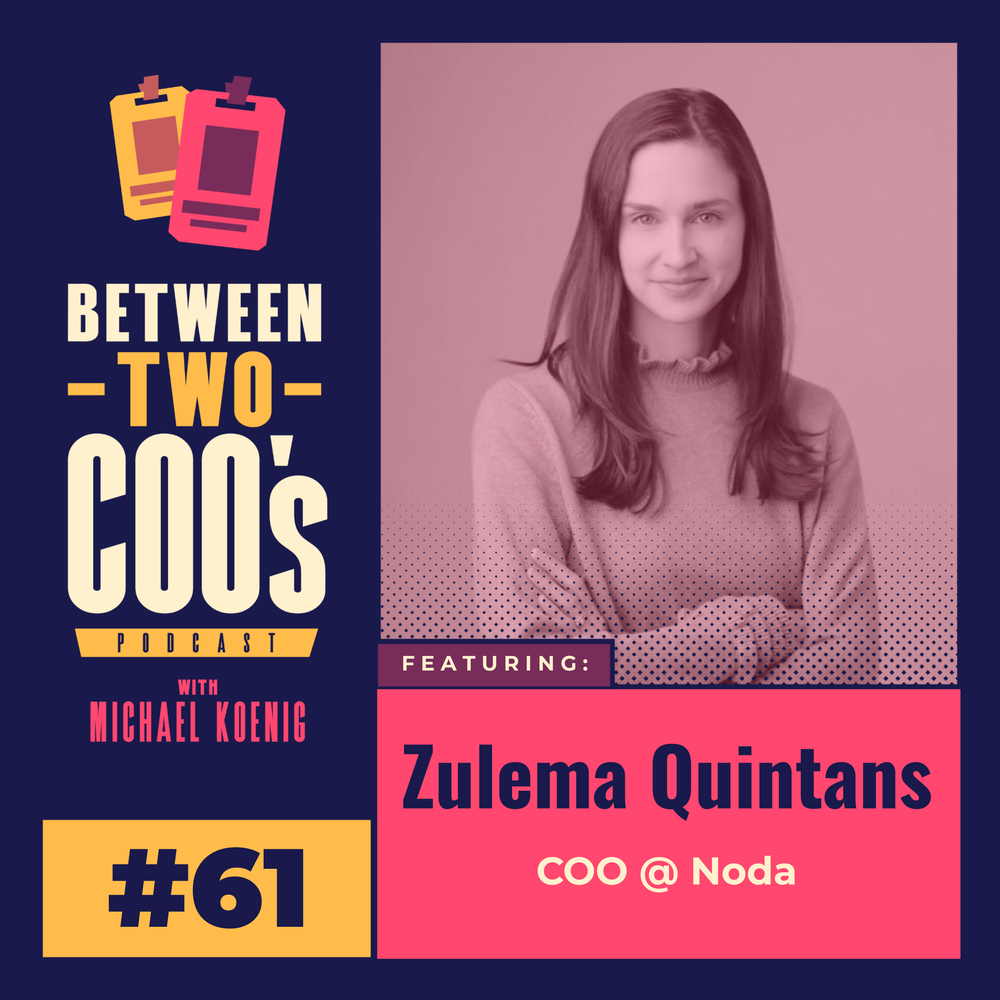
Zulema Quintans, COO of Noda, on Why Your OKRs Don't Get Done
Listen and subscribe: Apple Podcasts · Spotify · YouTube · Newsletter
Zulema Quintans is the COO of Noda, an energy management software company that helps commercial buildings stop wasting the 30 to 50 percent of energy they burn through today. In this conversation she and Michael dig into why most OKRs never actually get done, and the operating system she uses so hers do: every goal tied to an owner and a roadmap, published, reinforced, and wired into the performance management system. They also get into how Noda turns messy, legacy building data into something AI can use, and why she believes the winners in AI will be the companies that pair the technology with a strong service layer.
Chapters
- 00:00 Cold open, the energy waste problem
- 01:12 Meet Zulema and Noda
- 01:56 From Juilliard ballet to COO
- 03:27 Holding focus and flexibility
- 06:01 Why OKRs fail, and the 70% rule
- 08:41 Top-down meets bottom-up OKRs
- 13:09 Making OKRs the operating system
- 15:55 Inside Noda, climate tech for buildings
- 19:19 Turning messy building data usable
- 20:39 The modular path to automation
- 22:50 AI cuts onboarding weeks to hours
- 24:50 The Buildings IoT acquisition
- 25:46 AI, the COO role, and judgment
- 32:21 The five-year view for buildings
- 34:52 A warehouse full of sensors
About Zulema Quintans
Zulema Quintans is the chief operating officer of Noda, an energy management software company for the commercial built environment. She leads product, operations, and customer functions as Noda helps building operators stop the 30 to 50 percent of energy that commercial buildings waste before it happens.
Her path to operations was not a straight line. She trained as a dancer at The Juilliard School and spent the first half of her career as a professional ballet dancer before moving into business. She went on to consulting at Bain and Company, seven years at American Express, and operating and strategy roles at the climate technology company Arcadia. She holds an MBA and a master in public policy from Harvard.
At Noda she runs OKRs as a working operating system rather than a quarterly ritual, tying every goal to a specific owner and roadmap and putting the OKRs directly into the performance management system. She is direct about where AI helps and where it does not. Her team uses AI to automate work that used to take engineers weeks, but her bet is that the winners in AI will be the companies that pair the technology with a strong service layer, not the ones chasing the model alone.
Frequently asked questions
Why don't OKRs get done?
Zulema says OKRs usually fail when the goals are not linked to a specific person's job and to a real project or roadmap. If a key result is not owned and not tied to work that is actually prioritized and happening, it slips. She also puts Noda's OKRs into the performance management system so there is a record people are reviewed against, which makes teams take them more seriously.
What is a good OKR completion rate?
She treats around 70 percent completion as success, not a shortfall. The goal is to set targets lofty and stretchy enough to push people just past their comfort zone. Hitting 100 percent would mean the goals were not ambitious enough in the first place.
How should you balance top-down and bottom-up OKRs?
Zulema designs OKRs as a combination of top-down direction, aligned with company strategy, and bottom-up input from the teams closest to the customer. Senior leadership suggests objectives, then teams work to identify the key results and own them. The overarching objectives are set on a six-month horizon and the key results are refreshed every quarter.
How do you keep OKRs front of mind through the quarter?
She systematizes them through collaboration, reinforcement, and visibility. OKRs get owners, get published, and get discussed in the monthly all-hands. She reinforces them across internal communications, celebrates wins tied to them, and connects them to performance conversations so the focus does not fade after the drafting stage.
What does Noda do?
Noda is an energy management software platform for the commercial built environment. In the US alone, commercial buildings spend about 200 billion dollars a year on energy, and somewhere between 30 and 50 percent of that is wasted. Noda helps commercial building operators stop that waste before it happens and reinvest it in the things that matter.
What is the difference between climate tech and clean tech?
In the episode, clean tech refers to the technologies that actually power buildings and society, while climate tech focuses on optimizing how those resources get used. Noda sits on the climate tech side, using software to make existing buildings run more efficiently rather than generating new power.
How does Noda connect to old buildings?
Noda uses an independent data layer and an ontology of building equipment to connect through several routes: the building management system, smart meters, and data sources like utility bills. It brings that messy data into one platform, then standardizes and cleans it so points across the building are described consistently. Zulema notes that clean, structured data is the foundation for any AI application, because AI is only as good as the data it is fed.
How does Noda use AI in operations?
One of Zulema's top priorities as COO is using AI to automate Noda's own operations, support, and deployment. Mapping the systems and points in a building used to take her engineers hundreds of hours. Noda now uses AI to read the names and descriptions and assign those points automatically, turning work that took weeks into hours.
What is automated demand management?
It is Noda's automated layer, which Zulema describes as a knob that quietly adjusts every thermostat in a building through the day. It cools parts of the building earlier when energy is cleaner and cheaper, then eases off later. The adjustments are small enough that tenants do not notice, but they add up to meaningful energy savings.
Why did Noda acquire Buildings IoT?
Buildings IoT brought a technology stack that gave Noda an independent data layer, project ontology, and automated controls, plus deep expertise with building management systems. It complemented Noda's operational savings and service strengths and let the company offer products at every stage of a customer's automation journey.
Will AI replace operations teams?
Zulema does not think so. Most of her team are engineers who have spent years understanding building equipment, and she says AI is not a replacement for that expertise. She argues the service layer around the customer becomes more important, not less, and predicts a market correction where the winners are the companies that get the technology right and pair it with a strong service value proposition.
What skills will future COOs need?
She expects operators to increasingly need people who understand AI tools and how to drive rapid adoption of them across the team. As tooling reaches an underserved operations function, the COO's job grows to include championing internal tools and building the team's fluency with them. She frames it as a growth mindset and a willingness to experiment.
How did Zulema Quintans go from ballet to COO?
Zulema trained as a dancer at The Juilliard School and expected a career in ballet before planning a second act in business. She says dance taught her to hold focus and flexibility at the same time: the discipline to drive structure and OKRs, and the adaptability to stay open to unexpected moments. That balance is how she thinks about the COO role.
Full Transcript
Show full transcript
Zulema Quintans: In the US alone, commercial buildings spend about 200 billion every year on energy, and somewhere between 30 and 50% of that is just wasted. Buildings are very complex ecosystems. They have aging equipment, messy data, and many hands that touch that data and that equipment over time. So inefficiencies are inevitable.
Michael Koenig: Hello, and welcome to Between Two COOs. I'm your host, Michael Koenig, and today I'm joined by Zulema Quintans, COO of Noda, a company that's pushing the frontier of how buildings operate by using AI to make them smarter, more efficient, and more sustainable. Zulema has a fascinating career arc. She started out as a Juilliard-trained professional dancer, went on to Bain and American Express, and now she's helping scale a climate tech company that's rethinking how we run the built environment. Zulema, thanks so much for coming on. You started your career as a Juilliard-trained professional dancer. It's obviously not the typical path. Walk me through this, and what lessons did you take from performance and choreography that have carried through to how you lead?
Zulema Quintans: Yeah, I'd say my path to Noda was both unexpected and very natural at the same time. Unexpected in the sense that I spent the first half of my life thinking I wanted to be a professional ballet dancer. I did not envision being the COO of a tech startup. But ballet is a short career, so I always knew I'd need to plan for a second career. I ended up in business, where I was always naturally drawn to strategy, and then later entrepreneurship, the parts of business that always felt the most creative to me. As a dancer, I really enjoyed working with new choreographers and helping bring new ideas to life, and strategy was always very much like that. And as a dancer, you're always being asked to learn new things and step into new roles. You really have to excel at learning and be adaptive, and being in a technology environment, you're constantly learning and having to adapt.
Michael Koenig: And it's also highly structured and predictable.
Zulema Quintans: Yes. So that's the other really interesting lesson that shapes how I think about leadership now. It's this very creative profession in one sense, but it also requires extreme focus and discipline. So it's about holding both focus and flexibility at the same time, and that's a balance I think a lot about as a COO. You're often cast as the focus person, the one driving OKRs, discipline, structure, repeatable operating processes. But just like in dance, where the moments of the greatest artistry come when you're least expecting it, when there's an element of improvisation, you wanna be flexible so that you're anticipating change and open to those moments of magic.
Michael Koenig: How do you balance that? I imagine you take a lot of comfort in planning and in having that predictability. How do you push yourself into the flexibility range, and how do you decide when you need to be flexible?
Zulema Quintans: I think it depends on the context you're in and what your objectives are for that particular quarter. I really like OKRs as a framework, both because they give clarity to the teams and visibility at the leadership level on whether we're going on or off track. They're also a good check and balance on whether we came up with the right goals, whether we're being ambitious enough. It depends ultimately on how much time you have. With the benefit of time, you can give teams more space to come to the conclusion on their own. Sometimes when you're moving fast, you have to be super directive and push people to get to that outcome. But when you have periods of exploration and a little bit of time, it's always good to give teams more space to come to those conclusions on their own, even if it takes an extra day or an extra week.
Michael Koenig: Well, let's talk about OKRs. Probably the most predominant strategic framework out there, at least within the tech sector. But so many times they fail and fall right on their face. How do you approach them that's working so well for you and your team at Noda?
Zulema Quintans: I think there's a lesson in failure. We're all learning from failure all the time. And with OKRs, you're not trying to get 100% accuracy. Success is getting to that 70% mark so that they're lofty and stretchy enough that they're pushing everybody just past that comfort zone. But there are lessons in the ones that don't work, and why they didn't work. Sometimes, if you have to change your product OKRs in the middle of the quarter, that tells you that you probably didn't have a firm enough understanding of your product roadmap going in, and that's something you can get better at. So there's always lessons in the failure, and they're a good way for leaders to get a quick pulse on the business, and they keep everybody engaged and feeling like they know what they're doing and how that contributes.
Michael Koenig: Now let's talk about the 70% completion rate, because a lot of the time folks are a little demoralized about it, where it's I'm setting these lofty ambitions knowing I'm only gonna get 70% of the way there. Do you ever find complacency or people being down about it?
Zulema Quintans: It's natural to not wanna shy away from things that aren't going well. There's this great video of Roger Federer, the Dartmouth address, where he talks about failure in tennis and how, even at the top of his game, he only wins just over 50% of the points, and so he's gotta get really good at putting those failures in the rear view mirror so he can focus on the next point. And I think that's a really good analogy for these examples as well.
Michael Koenig: Let's get back to the flexibility aspect. With OKRs, it's so rigorous and structured that during the quarter new things pop up. How have you figured out the balance of evaluating whether those new strategic aspects need to unseat something you've already planned and agreed to?
Zulema Quintans: I think the OKR framework is a prioritization tool for leadership. You can make those informed trade-off decisions of, hey, this new thing has come up at this level of urgency, okay, what's coming off the list? That's one. The other thing that's really important in OKR design is they have to be a combination of top-down, aligned with the strategy where you wanna place the emphasis, but also bottoms up. They often fail when you put out these goals but they're not actually linked to projects or initiatives that people are working on. So closing that feedback loop, and then increasingly integrating them into the performance management system. We actually just put our OKRs into the performance management system and people are paying a lot more attention to it.
Michael Koenig: You mentioned closing the loop between bottom-up and top-down, with top-down being where the strategy comes from. When you're saying bottom-up, is that you taking the feedback from the team of, here's what we're seeing? So it's really creating a connectivity where the team informs you of what they're seeing on the front lines, and you take that and form the overall strategy?
Zulema Quintans: It's definitely that. In fluid tech startup environments, you constantly toggle between the people closest to the customer and the ground and what you're seeing externally in the market and where you're trying to go 6, 12, 18 months from now. But more importantly to the delivery of an OKR in the quarter, that OKR has to be linked to somebody's job and to a specific product or roadmap or project. That work needs to be identified, prioritized within the teams, and it needs to be happening. That's often where I see things not getting done, because we said we wanted to do this thing, but we didn't actually know how to do it and we didn't make it someone's priority.
Michael Koenig: Let's talk about the market-driven aspect. There's a balance of making decisions influenced by what you're seeing in the market versus decisions based on your North Star as a company. How do you balance those inputs and signals from the market with your plans?
Zulema Quintans: It's a great question, and it's certainly evolving. You have your roadmap, you're constantly getting feedback from customers, and it's finding that balance, you can't just listen to the loudest voice in the room. You're getting feedback from all directions. There are internal stakeholders who want internal tools competing with customers who want new features, and then you add investors, so there's a lot of surround sound. The role of the COO and the strategic planning process is to bring all these things together thoughtfully so you can assess the trade-offs based on where you see the biggest opportunities.
Michael Koenig: When we first started talking about OKRs and flexibility, you mentioned that sometimes it's all about the time available. How do you walk that fine line between being directive and micromanagement?
Zulema Quintans: It comes down to the delivery. As a leader, you can pose questions to your team to solicit the answers. Those questions can be broad or narrow, but that technique puts the onus on the team to arrive at the answer. And so in those moments where you're really trying to get to a solution, having very tight questions can sometimes get you there faster.
Michael Koenig: Last question on OKRs. You all have really cracked the code, and I love learning how other companies do this. In terms of cadence and implementing OKRs as an actual operating system, how do you systematize OKRs throughout the quarter, past the drafting portion, so the focus is always on them?
Zulema Quintans: It's a collaborative process. We typically think about our objectives, the overarching objectives, on a six-month time horizon, so those are set twice a year. Then you develop your key results, the performance you're trying to drive, every quarter. That's a collaborative process with the team. Senior leadership suggests some, then we have them work with the teams to identify them. Every OKR gets an owner. Then we publish these. We talk about them in our monthly all-hands. I spend a lot of time thinking about how we reinforce them internally and embed them in all our communications. How do we celebrate wins and highlight projects contributing toward these results? And we put them in our performance management system, so there's a record of your goals. When you do your performance review, you can see the progress and your manager can see the progress, and in that context people take them more seriously. So collaboration, reinforcement, and visibility, and tying that into your performance conversations, are three ways you can really reinforce and get people to focus on them.
[Sponsor segment omitted.]
Michael Koenig: So let's talk about Noda. This is a climate tech company, and just for listeners to understand, there's a difference between climate tech and clean tech, clean tech being the things that actually power the buildings and society versus climate tech that's focused on optimizing those. How does Noda play into this? What do you guys do exactly?
Zulema Quintans: Noda is an energy management software platform for the commercial built environment. In the US alone, commercial buildings spend about 200 billion every year on energy, and somewhere between 30% and 50% of that is just wasted energy. This is where Noda comes in. Noda helps commercial building operators stop that waste before it happens and reinvest it back into the things that matter.
Michael Koenig: And how do you do that? Because now we're talking about physical infrastructure, buildings that are hundreds of years old in some cases, or built during a time when technology wasn't as efficient and certainly not connected in the way we think about with IoT. So how do you actually do that with this legacy infrastructure?
Zulema Quintans: It's a great question. Buildings are very complex ecosystems. They have aging equipment, messy data, and many hands that touch that data and equipment over time, so inefficiencies are inevitable. There's also this perfect storm building operators are facing right now. It's hard to avoid articles on rising electricity prices. In addition, you've got increased compliance burdens for reporting, as well as a labor shortage in this industry. One in three building engineers, the teams that take care of these buildings, are retiring, and those positions aren't being backfilled. So this is where technology can come in to help automate some of those workflows for building operators to help them meet their goals, both reducing costs and reducing energy use.
Michael Koenig: Yeah, and we have a significant lack of electrons in the US. The energy dependencies we have, plus the energy needs of all the data centers that power AI, are quite significant. So reducing the amount of electrons a building is wasting is highly significant. In terms of the software aspect, the actual connecting the building to the internet to get those signals, how does that work? Say I've got a building that's 50 years old with a really old boiler, and maybe the only signal I have about my electricity use is the meter or the bill. How does that work?
Zulema Quintans: Building data is very messy. We have something called an independent data layer and an ontology of equipment in the building, so we can connect into a building through a variety of ways. We can connect into the building management system. We can connect into smart meters. We can also collect data through things like utility bills. We bring it into our platform, we standardize, and we clean that data so you have consistent ways of describing points throughout the building. That's really the foundation for any of the AI applications you might wanna run. AI is only as good as the data you feed it. So having really clean, structured data is a really important foundation for everything we're trying to do.
Michael Koenig: So once the data is there, what do you do with it? Because that's always been a big problem with companies that say, oh, we're connecting this data, and we'll sell that data. But what do you actually do with it, and how does that translate to the physical changes that reduce the carbon footprint of these buildings?
Zulema Quintans: I'm glad you mentioned the carbon footprint, because globally, commercial buildings are responsible for 40% of global greenhouse gas emissions, a pretty staggering figure. So thinking about how we operate them is a meaningful way to reduce the impact on climate. We've taken a modular approach to product design, because we need to meet customers where they're at in their automation journey. We start with a reporting layer, which puts more of the onus on the operator to understand what's going on in their building, identify and take action. Then we move into a layer where our analytics and our service team comb through the data in the building and understand where they can drive projects to reduce costs and energy use. And thirdly, we have our automated layer, which is where the technology gets really cool. Imagine you had a knob on your desk that controlled all the thermostats in the building, making small adjustments throughout the day, reducing cooling parts of the building early in the day when there's more clean energy and it's cheaper, then easing off later. These adjustments are so small that the people in the building don't know they're happening, so there's no disruption to the tenant experience, but you're driving meaningful savings in energy usage for the building.
Michael Koenig: That's so interesting. You talked about going through the data layer. Certainly this is something AI can excel in. How are you all embracing that to bring it to market?
Zulema Quintans: This is one of the top priorities for me as COO, thinking about how we use AI to automate our own operations, support, and deployment. As I mentioned, data from a building is very messy, and typically engineers on my team would spend hundreds of hours mapping all the different systems and points in the building. We've started to automate that process. Now we can use AI to read the names and descriptions and help assign those points automatically. What used to take weeks can now be done in hours, and that dramatically reduces the engineering time and lift.
Michael Koenig: So if I'm a building operator, and just to pull back so listeners can understand the scale of Noda, some of your biggest clients are Marriott and Hilton. These are major real estate holdings and property owners, and they have huge carbon footprints. In terms of actually adopting this automation, what are some of the big challenges you're seeing with building operators trying to do this?
Zulema Quintans: Technology like this, and certainly that example I described, which is automated demand management, can't work in isolation, certainly not in the context of buildings that are so unique and complex and full of nuance. This is where having a really strong service bubble around the customer, with technical expertise to drive things like product adoption and integration, change management, and technical support, is increasingly important as we think about how the market is going to adopt and bring these tools into their buildings.
Michael Koenig: And you recently had a fairly sizable acquisition with Buildings IoT. Can you give us a quick rundown of Buildings IoT and what it brought to Noda, and then how that's helping you meet these challenges?
Zulema Quintans: Buildings IoT had this incredible technology stack. We were thinking about how we relaunch our energy products. They had this technology that gave us the independent data layer, this project ontology, and automated controls, as well as really deep expertise working with building management systems. That complemented the operational savings, ROI, and service components of our energy product very well. It helped us expand our product suite so we had offerings at every stage of a customer's automation journey.
Michael Koenig: Let's talk about AI in ops, which you started to talk about. We've gone through your operating system. How are you thinking about AI within your operations? What have you done so far, what do you see in the future, and where are the biggest impacts you can have?
Zulema Quintans: As a COO, we're often the ones championing internal tools, right? How do you use automation to drive more productivity? One thing I'm excited about that we're prototyping is an agent that can help identify some of these cost savings working with a smaller data set. This is letting us really speed up customer onboarding and cut time to value for the customer pretty dramatically. It's also letting us completely revisit the whole choreography of everything that happens post-sale for the customer. So broadly, any workflow that touches the customer is gonna go through an exciting period of transformation. In the past you had one of two options, doing something bespoke and expensive or one size fits most. What AI is gonna let us do is create a new middle segment where tooling can drive more customization and personalization in a more cost-effective way, bridging between those two extremes.
Michael Koenig: It's an interesting example, this AI agent. Is that something you're building, or something you bought? How are you approaching the actual adoption?
Zulema Quintans: We're an AI-focused company. We are definitely prototyping and experimenting with AI agents, both to solve our internal workflows and eventually in customer use cases. So these are all things we're developing in-house right now.
Michael Koenig: Let's talk about how AI is impacting your role specifically as COO. What's changed? How do you compare this to last year, let alone what's coming in a couple of months?
Zulema Quintans: It's an interesting question. What a year to be in operations, because AI is suddenly everywhere in the conversation. The first six months of this job versus the second six months are so fundamentally different. But it also feels like a golden age for operators, don't you think? Because now we suddenly have all these magic AI wands, and you can create a custom GPT to help with strategic planning. That's something we're doing. We talked about the agents, but there are so many applications for all these things that historically have been hard to build. So it's gonna free up so much time and brain capacity to solve problems we haven't even thought of. What do you think?
Michael Koenig: That's a great question. There's a lot that comes into giving power to people that haven't necessarily had the power to build and make their workflows more efficient. Most of the time operators tend to not be technical, so they're reliant on engineers and data scientists. We've seen this adoption. If we go back to 2010, when you get tools like Optimizely and Mixpanel, these are surfacing data and the ability to do AB tests, for instance, which you would have needed JavaScript and PHP to do. As these softwares mature, more capabilities get put into the hands of the operators, and if you can have more self-sufficiency, it's gonna open up the door for what you can do versus what you were doing that you no longer need to do. So it's really exciting in terms of advancing the capabilities of everyone in terms of self-sufficiency.
Zulema Quintans: It's certainly a lot easier. You can build these tools with fewer resources, and you can often do it yourself, so they're more accessible. So I fully agree.
Michael Koenig: There's a question, though, of how much do we trust the AI tools to do a good job that's accurate, reasonable, and not just making things up? It still very much requires a human in the loop versus handing off complete automation. How do you think about that quality control?
Zulema Quintans: 100%. Most of my team are engineers, really technical people that have spent years studying and understanding building equipment. I don't think AI is a replacement for that expertise, which is why that service layer around the customer is so important in terms of embedding them into their operational workflows and being able to service and support them. That becomes increasingly important in your product design, that expertise.
Michael Koenig: As you think about the future skills you need to develop, let's pull this back, what skills do you think future COOs are going to need to succeed in this AI-driven operational environment?
Zulema Quintans: It's interesting because I think we're all kind of learning at the same time. Some of these things are relatively recent, and that's been a great normalizing function. But if you see the future as being able to bring tooling to an underserved operations function, then increasingly you're gonna need people who understand what those tools are on the team and how to drive that rapid adoption. So that's an area of growth for the COO.
Michael Koenig: So it's almost a growth mindset. You have to have a willingness to go out and experiment, and manage your time well so you have the time to experiment. Let's look around the corner. You have a crystal ball, looking out five years, what excites you most about the future of AI and autonomous building operations? I ask because if I asked what you think AI's going to be like software-wise in five years, we'd say, I don't know what it's gonna be a week from now. But buildings and infrastructure change much more slowly. Where do you think we are in five years?
Zulema Quintans: Getting back to this point that buildings account for 40% of global greenhouse gas emissions, I think the next frontier for buildings are buildings that don't just look inward in terms of optimizing their own operations, but also outward, adjusting how they use their energy in sync with the grid so they can be not just part of the problem but part of the solution. And touching on where we're going with the future of AI and autonomous operation, everybody is understandably very focused on the technology parts, and you'll continue to see investment and excitement in that space, but I don't think the service side is going away, and I think it becomes only increasingly important. So there will be some correction at some point, and the companies that have gotten the tech part right, with a compelling service value proposition to support customers through that journey, are the ones that will emerge as winners.
Michael Koenig: The inward versus outward thinking is quite interesting. Even as you said that, I'm thinking, even if they're thinking outwardly, it probably isn't for the greater good of the planet. It's probably more like, let's optimize when we're turning lights on because the grid is going to be more favorable. It comes through the bank account and the wallet.
Zulema Quintans: Well, this is the beauty of it, and this is why, as an operator, this is such a fulfilling problem to work on, because it ticks all our boxes. It's efficiency, it's cost savings, it's repeatable, improving our processes. And it also is good for the planet.
Michael Koenig: I love tech that actually touches physical infrastructure, where it's not just ones and zeros, but ones and zeros affecting the actual world and how it's running. It's time for my favorite question. We've all had those moments where we've seen something totally off the wall while we're in the COO seat, and we think, wow, I never thought I'd see that. Do you have one you can share?
Zulema Quintans: When you start a new job, you make the rounds, you turn over every stone, you're getting up to speed. When I took this job, I was surprised to learn that we had a distribution warehouse for sensors in the UK. It always puzzled me how, as a SaaS company, why were we managing a logistics supply chain. It actually brought me back to my first day at Bain. As a brand-new consultant, you do this strategy workshop, and I went into that thinking there's gonna be complicated frameworks and graphs, and it starts with a whole discussion around this simple but powerful question around business definition, which is, what business are we in? And they explain how that's where companies make hundreds of millions of dollars of mistakes when they don't understand what business they're in. So it brought me back all the way to the beginning, because we're not a logistics company. We're a SaaS company.
Michael Koenig: So what's the story there? Why did you have a warehouse full of sensors?
Zulema Quintans: In the process of this job, we've really focused our product portfolio. We've talked a lot about energy and climate change. We had a much broader product portfolio as well of other IoT sensors and things in the European markets, which we've exited.
Michael Koenig: That's so interesting. So this is a vestige of a past business strategy. What'd you do with all the sensors? Did you close the warehouse? Do you still have the sensors? What do you do with all that, which I imagine cost millions of dollars?
Zulema Quintans: We're in the process of finding a new home for them, a happy home for them.
Michael Koenig: Got it. So if anyone has interesting ideas on how to use a warehouse full of sensors, what kind of sensors they are, well, that's a mystery, but Noda is certainly open to ideas. Listen, it's been so great, Zulema. Thanks for joining me. Where can people go to keep up with you and Noda?
Zulema Quintans: You can find me on LinkedIn.
Michael Koenig: Probably the best place. We'll drop a link there. Thank you to all of you for listening to Between Two COOs. I'm your host, Michael Koenig, and a very special thank you to Zulema Quintans for joining us. Tune in next time for our next COO chat, and be sure to subscribe on Apple Podcasts, Spotify, or wherever you listen so you never miss an episode. Just visit betweentwocoos.com. And if you get a minute, leave us a review so others can get great advice from phenomenal COOs. Thanks for listening.
More on AI
The COO's Execution Playbook
Frameworks, templates, and hard-won lessons from operators who've been in the chair. Every Tuesday.
No spam. Unsubscribe anytime.